
Asia/Singapore Monday, 6th April 2026
Page 390

The path to purchase is paved with good travel videos

0

VIDEOS are a growing catalyst for travel purchases with viewers looking to connect with creators and travel brands, said MyTravelResearch.com, who has released a guide on how to latch on to video as a vehicle for marketing.

According to Google statistics based on the US market and released in August, two out of three US consumers now watch online travel videos when considering taking a trip.

Other statistics related to travel videos have skyrocketed – views of travel-related content on YouTube are up 118 per cent year-on-year; and travel video watching has increased 97 per cent on smartphones and 205 per cent on tablets.

Meanwhile 88 per cent of YouTube travel searches focus on destinations, attractions, points of interest, and general travel ideas in that order.

Google also found that 67 per cent of travel-related views are for brand or professionally released videos, while 71 per cent of travel-related searches on YouTube are for destinations.

Furthermore, video-watching is not a one-off affair, and most want to stay in the loop by subscribing to YouTube channels.

Most popular travel videos are those featuring authentic, real-life stories, and almost 50 per cent of travel subscriptions are to video blogs that feature personal travel experiences.

Bronwyn White, co-founder of MyTravelResearch.com, commented: “If an image is worth a thousand words, a good video is worth tens of thousands of dollars…As video becomes a bigger part of the traveler’s path to purchase, the tourism industry needs to embrace video with a passion.”

Successful tourism entities are embracing video to tell stories. “Show your secrets. Make videos with professionals – or start off doing it yourself by making videos using images from your smartphone,” she urged.

White dispenses advice on how to improve your marketing through videos here.

Destinations that have started down this path include the Japan’s Discover the Spirit of Japan campaign launched in March 2013, and as highlighted by White in her presentation, a video by the Devonport City Council.
https://www.youtube.com/watch?v=2uHTBKnk9ic

Singaporean travellers take on South-east Asia

0

WHILE South-east Asia has, unsurprisingly, emerged as the most visited destination for Singaporeans, a study released today by MasterCard has shown how five demographics differ in their travel spending and behaviour.

Last December, MasterCard conducted online interviews with some 1,600 Singaporeans who travel at least twice annually, asking for their recent travel histories.

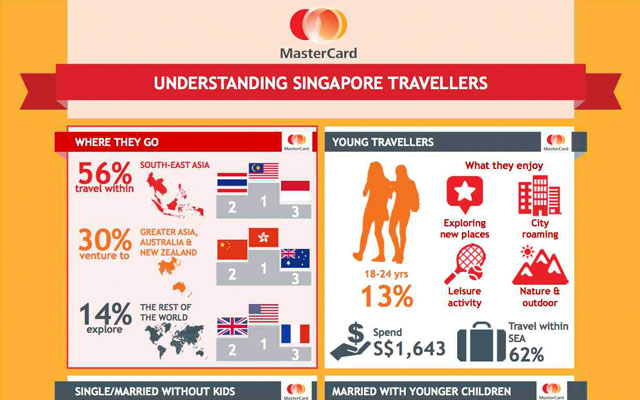
From the study, it concluded that more than half of Singaporean travellers (56 per cent) visited South-east Asia recently with Malaysia, Thailand and Indonesia being their top choices.

Another 30 per cent went to Greater Asia, Australia and New Zealand. Hong Kong, China, and Australia saw the highest number of Singaporean footfalls in that order. The remaining 14 per cent went to the rest of the world. The US was the most popular choice, followed by the UK and France.

Young travellers, or those aged 18 and 24, spent an average of S$1,643 (US$1,317) per person per trip. They enjoyed exploring new places, roaming the city, engaging in leisure activities, and getting in touch with Mother Nature through outdoor activities. This demographic accounts for 13 per cent of outbound Singaporean travellers.

Singaporeans without children in their late 20s and older said they travel for great shopping deals, cultural immersions, to get out of their routines and for celebrations. They spend about S$2,241 on each trip and make up the bulk of Singapore’s travelling population at 43 per cent.

Families made obvious concessions to their younger children by visiting theme parks and taking advantage of great shopping deals when on holiday, though they also took the chance to take a break and celebrate special occasions. They make up 26 per cent of travellers and spend S$3,160 per pax.

Married Singaporeans with older children contribute only 12 per cent of the travelling populace but spend the most, at S$4,266 each. They travel on guided tours or to visit someone, and enjoy leisure activities.

Senior travellers aged between 55 and 65 spend S$3,768 on average. When on vacation, they enjoy pampering themselves, indulging in fine dining, exploring new places and usually travel on guided tours.

Separately, Hotels.com’s latest Hotel Price Index found that Singaporeans’ top 10 destinations for 1H2014 were: Hong Kong, Bangkok, Taipei, Seoul, Kuala Lumpur, Tokyo, Bali, London, Penang and Osaka. While Thailand has traditionally been the hottest outbound destination among Singapore travellers, it has been eclipsed this year.

Tokyo experienced the biggest fall, taking a three-step tumble from third position to sixth. Taking its place was Taipei and Seoul, which rose one and two spots respectively to inch their way into the top five. Penang experienced the greatest jump, leaping four spots.

The results were based on bookings made on Hotels.com site.

mastercardinfographic_understandingsingaporetravellersaug2014

APAC hotel investments hit five-year high in 2013

0

HOSPITALITY investments rose to a five-year record high in 2013 for the Asia-Pacific region, according to global real estate consultancy Cushman & Wakefield. While China, Singapore and Japan led the charge, emerging markets will have a bigger role to play in the near future.

Cushman & Wakefield reported that hotel investments grew 30 per cent from 2012 for a total of US$12.8 billion.

China accounted for the largest share of total investment volume at 20.5 per cent or US$2.636 billion. Singapore took second place at US$2.63 billion, followed by Japan with US$2.61 billion, and Australia with US$2.27 billion.

Investment last year was spread over a wider range of countries including emerging and non-core markets such as Cambodia, Macau and the Maldives.

Akshay Kulkarni, regional director, hospitality services for South Asia and South-east Asia, Cushman & Wakefield, said: “Hospitality investment volume in 2013 more than doubled since 2008 and can be attributed to the excess liquidity, the low borrowing costs, and the region’s favourable tourism growth and outlook.”

Investment volumes for 1H2014 totalled US$5.2 billion, a 9.5 per cent year-on-year increase, though full-year figures are expected to come in at US$9-10.5 billion.

Asia-Pacific’s strongest hotel markets Japan, China, Singapore and Australia are still the most traded and make up 68.8 per cent of investment volume, but emerging markets like the Philippines, Malaysia, Sri Lanka, and Indonesia have seen more action as compared to the same period last year.

China has seen investments of more than US$1.5 billion in 1H2014, but the Cushman & Wakefield report expects this to taper in the second half of the year.

On the other hand, India, Thailand, Indonesia, the Philippines and Sri Lanka stand to gain with major transactions to be closed. Myanmar and Cambodia have witnessed renewed interest in their hotel markets and “could become viable investment destinations”, said Kulkarni.

Kulkarni explained: “We expect the balance of 2014 to equal or come close last year’s level in terms of transactional activity. Japan has already seen significant investment volume and will undoubtedly improve further and lead the pack, due to strong corporate demand and greater investor optimism arising from (Japanese prime minister Shinzo) Abe’s economic reforms. Lower hotel transaction volume is expected for Singapore this year compared to last year, at least in the organised institutional side. However with the change in norms on the shophouses, those that have approved hotel licences will see high guest demand.”

Longhaul market interest still growing for Thailand

0

SEVERAL longhaul markets have displayed more interest in visiting the Land of Smiles over the last one year despite the country’s political challenges, according to TripAdvisor.

In a study of site data for the period between June 30, 2013 and June 30, 2014,  TripAdvisor found that Brazil has shown the most interest in booking accommodation with Thai properties, growing 22 per cent year-on-year.

In second place comes the US with a strong showing of 17 per cent, followed by Egypt with 10 per cent, Ukraine and Canada with seven per cent, Russia with six per cent, Germany and Denmark with three per cent, and the Netherlands with two per cent.

This is despite the military coup and martial law established in Thailand in May (TTG Asia e-Daily, May 23, 2014) that shook tourism arrivals for the country, especially the MICE sector (TTG Asia e-Daily, June 9, 2014).

Grant Colquhoun, senior director of account management, APAC, TripAdvisor, said: “It’s encouraging to see a significant increase in traveller interest from longhaul, emerging markets like Brazil, alongside more established markets in North America, confirming Thailand’s appeal as a much-loved and desired destination for international travellers.”

Within Thailand, Phuket was the most searched destination. Bangkok came in second, Surat Thani third, Krabi fourth and Chonburi fifth. According to the same TripAdvisor study, the list is rounded up by Chiang Mai, Phang Nga, Prachuap Khiri Khan, Trat and Satun.

Room for economy, midscale brands in Cambodia hotel market: JLL

0

THE limited representation of international hotel brands in Phnom Penh and Siem Reap provides a significant opportunity for hotel operators looking to expand in South-east Asia, according to JLL’s Cambodia Hotel Market Update for July 2014.

The hotel supply pipeline for Cambodia includes four hotels with 1,705 rooms to come online by end-2015. Most properties to debut in future are located within the upscale and luxury segments, leaving ample room in the branded economy to midscale segment.

Cambodian capital Phnom Penh is witnessing strong year-on-year growth in terms of arrivals, boasting 16.7 per cent growth in 2013 or 0.8 million visitors. Year-to-date statistics for April 2014 have shown a 10.9 per cent increase over the same period in 2013.

However, the city only has three international brands delivering 745 rooms, while the midscale/economy segment is populated by unbranded boutique and independent hotels that offer between 20 and 40 rooms on average.

Growth in ADR for the luxury segment slowed by four per cent to US$138 in 2013 due to political tensions, as did hotel occupancies that tumbled 35 per cent last year. Similarly, RevPAR fell 15 per cent in 2013.

However, JLL anticipates that occupancy will bounce back in 2014 as demand for accommodation grows with a modest increase in ADR soon because of a strong supply pipeline.

More visitors from China, planned infrastructure improvement initiatives and promotion of the Phnom Penh-Siem Reap circuit will also boost demand for hotels in Phnom Penh in future.

Meanwhile, Siem Reap is the country’s top international tourist destination. It welcomed 1.2 million visitors in 2014, a 17.5 per cent increase over 2012 while year-to-date figures for April 2014 have posted growth of 15.4 per cent over the same period in 2013.

The city has 188 hotels, 205 guesthouses and 19 resorts but only a handful of international brands, namely Sofitel, Le Méridien, Raffles, Anantara, La Residence (Orient Express), Park Hyatt, Amansara and Best Western.

Occupancies have hovered around 60 per cent from 2011 to 2014, while the luxury segment has seen a seven per cent increase to US$150 in ADR during the same period. JLL predicts growth in overall hotel performance due to the increase in the number of tourist arrivals outpacing additions to hotel inventory.

Cambodia’s top three source markets last year were Vietnam, China and South Korea.

Australia, Hawaii, New Zealand ‘most attractive’ to Asians this year

0

ASIAN travellers are finding Australia and farther destinations of Hawaii and New Zealand most enticing this year, according to the Asian Outbound Traveller Survey 2013 conducted by online survey company AIP.

Respondents from 11 out of the 12 Asian countries surveyed chose Australia as one of the most attractive, followed by Hawaii (nine) and New Zealand (six).

Interestingly, although Singapore topped as the most visited destination among Asian outbound travellers in 2013, followed closely by Australia and Hong Kong, respondents indicated the Lion City as the least attractive this year.

Other findings include:

• Average nights of stay, with India recording the highest at 9.7 and Japan, the lowest at 4.8

• Type of recent trip, with India, China, Vietnam, Taiwan, Thailand, Indonesia and South Korea indicating full packages

• Hotel category of recent trip, with more Singapore, Taiwan and Hong Kong respondents indicating stays at four- and five-star accommodation, while those from Japan, Malaysia, Indonesia and the Philippines preferred three-star and budget categories

The survey was conducted in January with 12,000 participants, involving 1,000 from each of the 12 Asian territories in the study – Singapore, Malaysia, Indonesia, China, Vietnam, the Philippines, Taiwan, Thailand, India, Japan, South Korea and Hong Kong. Results were analysed by WisdomAsia.

India dominates TripAdvisor’s list of top Asian landmarks

0

INDIA made a strong showing in the second Travellers’ Choice Attractions Awards ranking of the best Asian landmarks, taking up four of the top 10 positions.

The Taj Mahal in Agra came in first to prove that love conquers all, with the Golden Temple – Harmandir Sahib in Amritsar taking sixth place, followed by Meherangarh Fort in Jodhpur and the Amber Fort and Palace in Jaipur at seventh and ninth places respectively.

Siem Reap, Cambodia put up the strongest fight with a second and third placing for the iconic Angkor Wat and Bayon Temple respectively.

Myanmar came in fourth for Yangon’s Shwedagon Pagoda. Fifth was Beijing’s Great Wall at Mutianyu, Bangkok’s Temple of the Recling Buddha weighed in at eighth, and Taktsang Monastery or Tiger’s Nest in Paro, Bhutan rounded up the top 10.

Peru’s Machu Picchu took the title for top world landmark, followed by Sheikh Zayed Grand Mosque in Abu Dhabi and then the Taj Mahal. Spain’s Great Cathedral and Mosque was fourth, St Peter’s Basilica in the Vatican took fifth, after which came Angkor Wat and Bayon Temple.

St Petersburg’s Church of Our Savior on Spilled Blood, Pennsylvania’s Gettysburg National Military Park and Croatia’s Ancient City Walls complete the list.

In a separate category, Singapore Botanic Gardens was named the top park in Asia. The Gardens, which has submitted an appeal for UNESCO World Heritage site status, beat other parks including Japan’s Hiroshima Peace Memorial Park, Beijing’s Beihai Park and Thailand’s Lumpini Park.

A total of 929 winners were identified in TripAdvisor’s second Travellers’ Choice Attractions Awards, based on the millions of reviews and opinions from TripAdvisor travellers and determined using an algorithm measuring reviews gathered over a 12-month period.

Decoding a coup

0
13-june-decoding-a-coupClearly, there’s a wide gap between how Thai sellers and buyers perceive a military intervention in Thailand. The former sees it as a measure towards certainty. For the latter it has uncertainty written all over it.


When the Thai army invoked martial law on May 20, followed by a military coup two days later,  many Thai hoteliers, DMCs and PCOs described the move as being “actually good” in as far as its intention to restore peace and order in the country, which has been embroiled in a political stand-off for seven months, goes.

They were at pains to explain there is nothing sinister about a coup in Thailand, that its people are going about working, dining, shopping as normally as ever. Thai sellers interviewed at IMEX in Frankfurt the day martial law was imposed – the same day the show opened – said they were not surprised at all, although they thought it might be imposed a bit later.

Buyers, on the other hand, were shocked.

Clearly, there’s a wide gap between how Thai sellers and buyers perceive a military intervention in Thailand. The former sees it as a measure towards certainty, and something that is so normal in Thailand – after all it’s the 19th coup. For the latter, a coup has the word uncertainty written all over it and is anything but normal.

Fact is, words like ‘coup d’etat’, ‘martial law’, ‘curfew’, ‘banned’, ‘black-out’ are all negative, despite their impositions in Thailand bringing some positive effects for the industry (for example, at writing time, the protests had stopped). Can we blame any tourist for hesitating to visit when he sees that there’s a curfew from midnight to 04.00, that he can’t gather with a group of five friends as there’s a ban on that, that it is strongly recommended he allocates at least three hours of travel time to the airport and stay updated with traffic news to avoid missing his flights, that International SOS has advised to defer non-essential travel to Bangkok, that several countries have also issued travel advisories for Thailand, including Malaysia, India, Singapore and Ireland? Too hard.

In today’s world of travel being a click and low-cost air seat away, recovery is irrelevant. As Bill Barnett, managing director of C9 Hotelworks, said: “Cycles are gone, and there is now only action and reaction.”

The military intervention will hurt leisure and MICE arrivals further in the next few months. What the Thai industry needs to do is swallow this bitter pill and focus its energies on positive actions that will enable it to compete effectively in the long term.

Use the time, for example, to rally the government to ease visa restrictions on markets such as China – look at how destinations such as Japan and the US are reaping rewards of easing entry requirements. Invest on training and raising the professionalism and morale of service staff. Clean up and beautify Bangkok. Review Thailand’s brand image to see if it speaks to a wider audience, not just tourists but investors. Be creative with marketing – how about an attractive rate for airline staff, hoteliers, travel agencies and other industry members in ASEAN to holiday in Thailand?

Oh yes, make people laugh too, to defuse the tension. I simply love Swissôtel Le Concorde Bangkok’s Curfew Rate which came out the day after the coup.

Planned Asian travel expenditure on the upswing

0

ASIAN travellers are committing greater amounts of money to travel in the coming year with plans to increase expenditure by seven per cent from US$4,331 last year to US$4,633 this year.

Meanwhile, average travel spend for Asians has been measured at US$4,300 for 2013.

Globally, average planned expenditure remains higher than Asia at US$6,136 for this year, up from US$5,955 in 2013, but the percentage growth in planned expenditure stands only at three per cent.

This is according to TripAdvisor’s third instalment of its biannual TripBarometer study, surveying the travel habits and choices of more than 61,000 travellers and hoteliers internationally. Some 5,657 consumer and 1,142 business respondents from Asia are represented.

The survey was conducted by research firm Ipsos.

Other notable findings include that Asian travellers currently intend to make more domestic than international trips, with 93 per cent of respondents saying they would travel locally this year against the 74 per cent who want to go overseas.

When travelling, some 94 per cent of Asian travellers continue to use their smartphones. Reflecting this, Asian hoteliers (82 per cent) are ahead in offering mobile services to travellers compared to their global counterparts (76 per cent).

The US is the top dream destination for Asians who want to travel overseas followed by Italy and Australia. However, currency fluctuations have a bigger influence on Asian travellers (51 per cent) than international travellers (44 per cent).

Visitor flows for Asia will grow 15 per cent yearly within next decade: Amadeus

0

THE Asian Century is well underway with a decade of sustained growth lying ahead for Asia’s travel industry, according to a new major industry study by Oxford Economics and commissioned by Amadeus.

Macro trends driving industry growth over the next decade predicts that international travel will rise by at least 5.4 per cent annually for the next 10 years, outstripping global GDP growth.

Asia-Pacific travel will skyrocket within the next decade, with visitor flows for Asia reaching an average annual growth rate of 15.1 per cent. This is close to double the figures for the period 2002 to 2012.

Asian travel expenditure will also leave top spender Europe in the dust by 2023. Growing at 18 per cent per year, Asian outbound travel spend will reach US$752.8 billion to make up 40 per cent of global spend.

Meanwhile, Asia will drive 55 per cent of global business travel growth in the next 10 years. North-east Asia alone will contribute 42 per cent of this, while South-east Asia makes up the remaining 13 per cent.

Emerging economies are also set to spearhead air travel growth, said the study. Countries such as India, Indonesia and Russia will overtake the OECD bloc as the biggest sources of global air traffic.

China’s prominence cannot be ignored either, with the country to drive as much as 20 per cent of global outbound travel and already touted to overtake the US as the world’s largest travel market by end 2014.

The pool of potential outbound travellers will more than double by 2013 and China is on track to become the world’s largest domestic travel market by 2017 as its GDP, employment level and consumer spending shoots up.

Still, other emerging markets like Russia, Brazil, India, Indonesia and Turkey will also register more than five per cent annual travel growth in the next 10 years.

“The findings underscore what most of us already intuitively know – that we have now truly arrived in the Asian Century. No matter where we look, Asian travellers have and will continue to change the landscape of travel, and businesses must adapt to them or risk falling behind,” said Angel Gallego, president, Amadeus Asia Pacific.