
Asia/Singapore Thursday, 9th April 2026
Page 347

APAC sees highest travel intent in February 2021: Sojern

0

Sojern has launched a new interactive dashboard providing real-time Covid-19 travel insights that will empower travel marketers to forecast travel demand and make informed decisions about market recovery.

The dashboard, updated daily at 10.30 (UTC), will provide market-level details on future searching and booking trends indexed to pre-Covid levels to provide visibility into timing for a recovery in specific destinations.

Sojern rolls out interactive dashboard providing real-time data on travel demand

Sojern collects and analyses travel intent data from thousands of airline and hotel partners from around the world to use as the foundation of its travel insights. This data provides an unparalleled view of travel demand by looking at online travellers’ path to purchase.

Travel providers can use these insights to help determine when to reopen or when to accelerate marketing to power recovery. Dashboard users will also be able to compare different regions to see when travel is likely to recover in each market.

Sojern director of travel insights Amber Kuo said: “Normally, weekly or even monthly data updates about how consumers are travelling would be acceptable to inform marketing campaigns. However, in Covid times, travel marketers are feeling stressed and uncertain about the future. Providing daily updates gives marketers more control because they can see how the situation is evolving, and when is the right time to act.”

This week’s insights on Covid-19’s travel impact in Asia-Pacific, which are based on data collected on May 4, 2020, showed signs of positive momentum in domestic travel, and revealed that destination markets can expect an uptick in travel in February 2021.

Following the WHO declaring that Covid-19 was officially a pandemic, from March 12 onwards, Asia-Pacific was seen to have a 40 per cent decrease in search volume. Following which, the individual countries within the region saw a further decrease in search intent as stricter travel restrictions came into play.

All Regions Year-To-Date Index in Searches
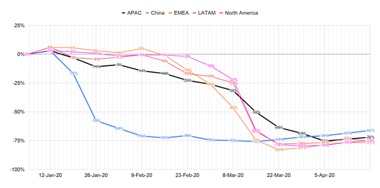
While Mainland China outbound travel started declining in December, it has since reached a plateau. Trends show that domestic travel took a sharp drop in mid-January when China imposed a lockdown, but continues to improve since mid-February, showing positive upticks.

This trend comes amid China’s prominence in the news, where a lengthy rebuttal of allegations was submitted over its handling of the Covid-19 outbreak, as well as the reopening of Shanghai Disneyland on May 11 to a reduced number of visitors, ending a three-month closure.

Source Market: China – Domestic Travel
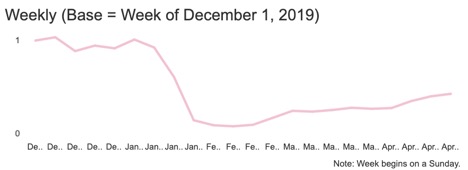
Hong Kong domestic travel was on a decline, but is showing clear signs of recovery since mid-February. Hong Kong outbound travel declined until the end of January, but has started to show signs of recovery at the end of April. Sojern noted that this uptick is coming from Hong Kong to China specifically. While Hong Kong has been celebrating progress of the containment of the virus, it remains to be seem if flash mobs that broke out over the Mother’s Day weekend will dent demand.

Source Market: Hong Kong – Domestic Travel
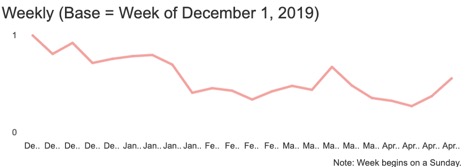
South Korean domestic and outbound travel has seen a general decline since mid-December, but Sojern’s data showed a slight improvement in April. Following positive news of containment of the virus, over the weekend, South Korea warned of a second wave of cases as a new cluster formed around a number of nightclubs. Since then, the capital Seoul has shut down all nightclubs, bars, and discos.

Source Market: South Korea – Domestic Travel
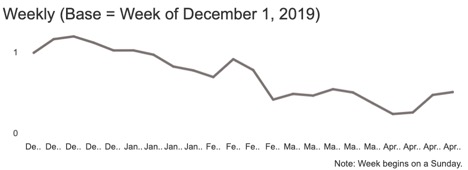
Taiwan domestic travel has a slower decline than average and showed signs of recovery in the second week of April. Additionally, Taiwan outbound has been on a decline since mid-January, but has reached a plateau. Taiwan reported over the weekend that they had no new cases of Covid-19, meaning the country has gone 28 days without reporting a single local transmission. This could reflect positively on travel trends in the near future, said Sojern.

Source Market: Taiwan – Domestic Travel
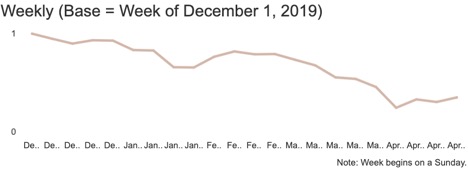
Looking at its flight data and the flight searches conducted across Asia in the last 28 days, Sojern noted that travellers are searching for potential destinations to visit during some specific months ahead. February 2021 has the highest search volume intent, presumably due to the Chinese Lunar New Year holidays. Additionally, Sojern also saw a high search volume for September and November this year, which could be due to the Mid-Autumn Festival in China.

Future Flight Departure Date Searches from East Asia, Oceania and South-east Asia
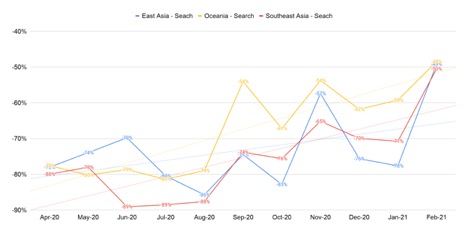
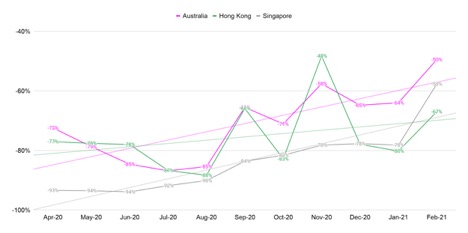
Hong Kong seems to have the highest search volume in November and this could be due to two anticipated events happening – The Airline Economic Growth and Fintech Conference. As for Singapore and Australia, February 2021 is the highest search month.

Even though the numbers are still lower than last year’s volume, it is a positive sign that travellers are “dreaming” of and planning their next trip, said Sojern.

Australia and New Zealand largely avoided high casualty cases by introducing strict nationwide stay-at-home orders and border closures, including travelling between states.

Positive signs coming out of Australia indicate that students of New South Wales and Queensland began returning to school this week on a limited basis, as the country’s rate of new infections continue to slow.

Future Flight Departure Date Searches to Australia, Hong Kong and Singapore
Covid-19 a catalyst for Vox innovations

0

Rome-headquartered tour content specialist Vox Group has sped up its innovation during the ongoing travel and tourism hibernation, and is ready to launch two new self-guiding products in mid-2020 that will answer to new travel considerations post-Covid-19.

Speaking to TTG Asia in an exclusive interview, John Boulding, CMO of Vox Group, revealed that Vox Connect and Vox City Walks, ready for release in June and July respectively, will allow travellers to maintain safe distancing while taking in enriched tour content as well as put critical market data into the hands of tourism industry players.

Boulding: Self-guiding technology is perfect for travellers wanting safe distancing as travel rebounds

The Vox Connect app sits on the traveller’s phone and the tour guide’s phone, allowing a connection via Wi-Fi and Internet that facilitates the streaming of video and audio.

Explaining how Vox Connect can enrich a traditional guiding experience, Boulding said: “A tour guide can point out a building that was featured in a James Bond movie, for instance, and play a James Bond soundtrack while explaining the (architecture).”

Vox City Walks, which will debut this July – or August at the latest – in Rome, Milan, Venice and Florence, is a flexible walking tour that provides a vast variety of city sights with pre-recorded audio introduction in multiple languages, plus the option of interaction with real-live guides covering the circuits featured in the programme.

“Our Rome circuit, for example, will have eight guides who can be tracked by GPS. The app user will be able to locate the guides and hop on that circuit at any joining point on the route. They can hop off any time they want to do their own things,” he explained.

A timetable will be provided for every joining point on the route map, allowing users to know when the guide will arrive next. A navigation feature helps the user to find his way to a selected joining point where he will meet a guide dressed in Vox uniform.

Travellers can join Vox tour guides on the circuit at any time they like

Vox City Walks is ready for replication through suitable business partners elsewhere in the world.

Describing the pandemic as “a game-changer” for the travel and tourism industry, Boulding said weakened businesses are now forced to change the way they operate in this new environment.

He recalled a resistance among industry peers whenever he spoke of Vox digital touring products in the past 30 months that he has been with the company.

“They’d say to me that their customers are older and do not use technology. I wasn’t sure if that was true then, but it certainly isn’t now. The city lockdowns have sped up technology adoption. Even the older people are now using their smartphones for information, entertainment and communication,” he said, adding that the industry is now more receptive of touring technology.

Boulding, who expects travel to change as a result of the pandemic, with one of the causes being legislation that prohibits “crazy, crushing crowds at popular attractions” and another being people’s desire for safe distancing, believes that travellers in the future will welcome self-guiding options.

“Many people departing their home as individuals, especially during the early days of travel recovery, are not going to want to be in a group. Self-guiding tech is perfect for them. You have your own smartphone and earphones – not a shared device that has been in someone else’s hands and ears – and you can distance yourself from other explorers while taking in the sights,” he said.

He added that self-guiding technology could also allow airlines, hotels, car rental companies to up-sell a standalone commodity.

“The market is going to be hyper-competitive once travel returns. If a hotel is not full, it will be obliged to sell every single bed off to anybody. It will be a commodity game where the lowest price wins. But if the hotel were to enhance its product with a self-touring option, which is very inexpensive because it is digital, it can sell to the customer a stay that comes with unlimited sight-seeing and audio guiding in their own language,” he opined.

Another critical advantage of Vox digital products is the data they generate, such as in-app usage that tells of where people went, what they saw, what time they got there and how long they stayed; and app store data, such as which countries the app was downloaded from.

“Every company needs new data and such intelligence will help businesses plan for recovery,” he said.

IHG signs Crowne Plaza hotel in India

0

InterContinental Hotels Group (IHG) has inked a deal to bring the Crowne Plaza brand to the northern Indian city of Lucknow, underscoring confidence in the industry despite challenging times.

Slated to open in late 2024, the 110-key Crowne Plaza Lucknow Sultanpur Road will feature a gym, an outdoor pool, an all-day dining restaurant, a bar, a club lounge, as well as 1,765m2 of meeting and banquet space.

IHG plants Crowne Plaza flag in India with new Lucknow signing

Sudeep Jain, managing director, South West Asia, IHG, said: “Lucknow is emerging as a key destination for both corporate and leisure travellers with its excellent transport connections and an expanding business and tourism landscape.”

He added that the signing “is a really encouraging sign of confidence in IHG and our brands in India, where we remain committed to growing our footprint, with a particular focus on primary and secondary markets”.

Currently, IHG has 36 hotels in India, and 42 in the pipeline.

Heritage Cruises to sail the coast of Vietnam

0

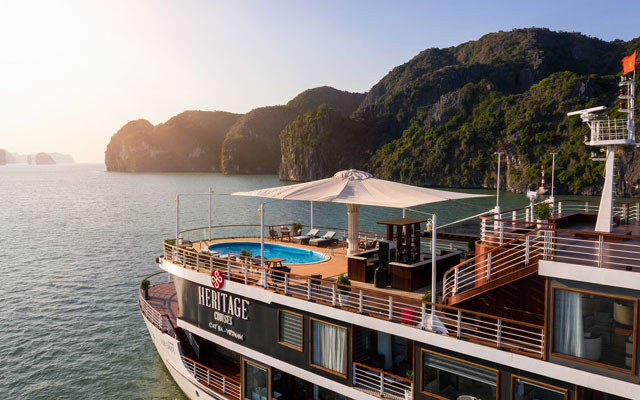
Heritage Cruises will launch its maiden voyage following the coastline of Vietnam in September 2020, on board four-deck, 20-cabin boutique ship Binh Chuan.

The first 10-day/9-night Heritage Binh Chuan Expeditions will depart from Halong Bay on September 7, 2020, and arrive at Nha Rong Saigon Seaport on September 17, with stopovers in Danang and Nha Trang. The return voyage will take place from September 20-29.

Heritage Binh Chuan will ply the coast of Vietnam come this September

The Heritage Binh Chuan Expeditions offers cruise holidays to more than four destinations in Vietnam and UNESCO heritage sites, such as Halong Bay, Hue, Hoi An, and Saigon. An array of onboard activities and shore excursions are also available.

After these maiden expeditions in September 2020, Heritage Binh Chuan will embark on two expeditions per month from September 2022, said a spokesman.

The maiden voyage from Haiphong to Saigon is a charter booked by an Italian group but the return trip from Saigon to Haiphong, also calling at Nha Trang and Chan May (Hue) seaports on the way back, are still available on a first come, first served basis, with prices start from US$5,200++ per person for the 10-day/9-night expedition.

Abu Dhabi rolls out e-learning platform for travel trade

0

The Department of Culture and Tourism – Abu Dhabi (DCT Abu Dhabi) has launched the Abu Dhabi Specialist Programme, an e-learning platform which will educate travel trade industry professionals with all destination-related information about the emirate through a series of online courses.

The programme will be rolled out in three phases in several languages across 17 markets, including the UK, the US, Canada, India, Australia, New Zealand, China, South Korea, Germany, France, Italy, Ireland and Russia, as well as GCC countries.

Abu Dhabi rolls out online courses for travel trade to learn more about the emirate; Sheikh Zayed Grand Mosque in Abu-Dhabi, UAE pictured

The first phase was launched on May 4, in the US, the UK, Canada, Australia, New Zealand and India.

Designed specifically for industry partners such as tour operators, travel agents and wholesalers, the Abu Dhabi Specialist Programme will equip travel trade professionals with up-to-date information about the UAE capital, so that they will be able to better promote the destination.

The e-initiative, which is part of DCT Abu Dhabi’s response to the Covid-19 crisis, aims to reach a larger number of travel trade agents worldwide, including previously untapped markets like Canada and New Zealand, according to Saood Al Hosani, acting undersecretary at DCT Abu Dhabi.

The courses encompassed in the programme cover information related to key attractions in Abu Dhabi, local events, accommodation options, and much more. Additionally, it includes a rewards section featuring incentive programmes, exclusively available for Abu Dhabi Specialists – travel trade agents who graduate from the main programme.

The Abu Dhabi Specialist Programme is now available for travel trade professionals on abudhabispecialist.com.

For the Indian travel industry, upon successful completion of two modules, agents can win an Amazon gift voucher worth Rs 10,000 (US$132). As well, upon successful completion of the Specialist Programme, agents stand to win the latest smartphones and a trip to Abu Dhabi.

Singapore births framework for tourism recovery, development

0

To help tourism businesses tide through the downtime amidst the Covid-19 pandemic, the Singapore Tourism Board (STB) has developed a new framework featuring new platforms for easier digitisation and potentially faster recovery.

Under the three-step framework coined Learn Test Build, companies can learn to identify gaps and opportunities in their business models through the STB Tech College, as well as a new self-diagnostic tool, the Tourism Transformation Index (TXI).

Quek: Singapore’s tourism businesses need data, insights and an ability to test and scale new products fast

TXI provides a holistic gauge of a company’s current state of digital transformation across six areas: leadership and organisation, process and operations, customer, innovation, technology, and data. Businesses can then identify the next steps that they should take to advance their state of transformation. TXI is being launched this quarter.

“TXI is like a company’s annual health check-up in this age of disruption. On STB’s end, this is an important first step that will allow us to identify areas of intervention for our stakeholders,” explained Quek Choon Yang, chief technology officer, STB.

Under the “Test” stage, STB will launch ThreeHouse, a new physical space at its headquarters where companies can collaborate, workshop and prototype new ideas and solutions. If successful, these ideas will be picked by STB to be scaled to a bigger platform. ThreeHouse will be launched in 4Q2020, and co-located with the Singapore Tourism Accelerator, another programme under the “Test” section of the framework.

Finally, the “Build” stage encourages businesses to formulate viable and lasting solutions. Besides information provided on open-sharing platform, the Tourism Information and Services Hub, STB has also opened its tourism data pool, the Singapore Tourism Analytics Network (STAN), to the tourism industry.

Businesses can now access 10 years’ worth of Singapore’s visitor arrival data broken down by market, region, visitor profile and mode of arrival. They will be able to gain consumer insights, create visualisations, analyse datasets and collaborate with other players on data analytics projects.

This platform is essential for businesses to “identify where the pockets of opportunities are once the tourism industry shows signs of recovery”, said Quek, elaborating that “certain sectors and certain source markets will recover quicker than others”.

He continued: “Post-Covid, we expect consumer behaviour and the norms for travel to change for good. Consumers are likely to come out of the pandemic with a heightened sense of hygiene, both personal and environmental.

“Hence, it is important for tourism businesses to build trust with consumers, provide safety for visitors and be able to influence consumer choices. To survive and even thrive in this new normal, businesses need to be armed with the right data, insights and ability to test and scale new products fast.”

STB will soon conduct an industry-wide capability upskilling programme and engage stakeholders, including hotels, attractions, business event companies and travel agencies, on how to adopt STAN and data analytics in their businesses.

Future updates for STAN include enhanced capabilities such as advanced data visualisation and analytics, as well as sandboxes for users to collaborate and co-create data models.

Airbnb trims workforce by 25%, refocuses business on home sharing

0

Airbnb is the latest travel and tourism casualty in the Covid-19-led business crisis, with 1,900 staff out of a global total of 7,500 being laid off.

The decision was revealed on May 5 in an open letter by co-founder and CEO Brian Chesky, published on the Airbnb Newsroom website.

Airbnb will refocus its business on home sharing

In the letter, Chesky acknowledged that decisions on layoffs were never “off the table” and the redundancy measure had to be taken as “Airbnb’s business has been hit hard, with revenue this year forecasted to be less than half of what we earned in 2019”.

He wrote: “We are collectively living through the most harrowing crisis of our lifetime, and as it began to unfold, global travel came to a standstill.”

Despite raising US$2 billion in capital and dramatically cutting costs across the company, Chesky said two “hard truths” – uncertainty around when travel will return and how travel will be when it does return – had made it necessary for the layoffs.

“While we know Airbnb’s business will fully recover, the changes it will undergo are not temporary or short-lived. Because of this, we need to make more fundamental changes to Airbnb by reducing the size of our workforce around a more focused business strategy,” he explained.

Along with the layoffs, Airbnb will reduce its investment in activities that do not directly support the core of its host community. As such, operations on Transportation and Airbnb Studios will be suspended while investments in Hotels and Lux will be scaled back.

The company has conducted “a comprehensive review of every team member and made decisions based on critical skills, and how well those skills matched our future business needs”.

“The result is that we will have to part with teammates that we love and value. We have great people leaving Airbnb, and other companies will be lucky to have them,” he wrote, adding that efforts were made to “take care of those that are leaving”.

Affected staff in the US will receive 14 weeks of base pay, plus one additional week for every year at Airbnb. Tenure will be rounded to the nearest year. Outside the US, afffected employees will receive at least 14 weeks of pay, plus tenure increases consistent with their country-specific practices.

Airbnb is also dropping the one-year cliff on equity for all staff hired in the past year so that everyone departing is a shareholder. Additionally, all departing staff is eligible for the May 25 vesting date.

The company will continue to cover affected staff’s health insurance – 12 months in the US and through the end of 2020 for staff elsewhere. Four months of mental health support through KonTerra will also be provided.

To help departing staff with new job opportunities, Airbnb will be launching a public-facing job website; creating an Alumni Placement Team with recruiters providing support to departing employees in job searches; providing four months of career services through RiseSmart, a company that specialises in career transition and job placement services; encouraging all remaining employees to opt-in to a programme to assist departing teammates find their next role; and allowing everyone leaving to keep their Apple laptops so that they can use it to find new work.

Chesky explained that with employees across 24 countries that have with their own laws and practices around employment, information around the layoff would not be immediately available.

However, he wrote that the final working day for departing employees based in the US and Canada would be May 11.

Herbert Laubichler-Pichler helms Alma Resort in Vietnam

0

Herbert Laubichler-Pichler has taken charge of the opening of the 196-pavilion and 384-suite resort in Vietnam’s Cam Ranh peninsula.

The hospitality veteran’s work in Vietnam spans almost 14 years and includes management of properties such as The Anam (also in Cam Ranh), Ho Chi Minh City’s Reverie Saigon, and Nam Hai in Danang.

The Austrian’s experience in Asia also includes overseeing the opening of Raffles Hainan in China; working for Shangri-La Hotels and Resorts in mainland China, Hong Kong, Singapore, Malaysia and the Philippines; and managing GHM (General Hotel Management) properties in Malaysia.

Born into a hotelier family, Laubichler-Pichler started out in the industry working at his parents’ guesthouse in Austria as a bellboy at 10 years of age during the summer season. He later studied hotel management and became a certified chef before rising through the ranks to become the general manager at properties in Austria, Germany and Cyprus.

Strong marketing, regional targets will lift Maldives post-pandemic

0

WIthout a domestic travel market to rely on for the post-pandemic tourism rebound, Maldives will need to sharpen its destination marketing efforts in accessible regional markets, opined industry leaders during a webinar organised by PATA and the Maldives Marketing & PR Corporation (MMPRC) on Monday.

Speakers at the COVID-19 Crisis and Maldives Tourism webinar were Thoyyib Mohamed, managing director, MMPRC; Mario Hardy, CEO, PATA; and Sarah Mathews, group head of destination marketing APAC, TripAdvisor.

The Maldives’ marketing content now conveys a ‘visit later’ message, and encourages people to see and dream about the destination

All speakers agreed that domestic travel would be the first to take off, with Hardy projecting the domestic market dominance will run for an extensive period before individual travel and eventually, mass market travel returns.

Damian Cook, CEO of E-Tourism Frontiers, expected the mass market to take a long time to recover due to health risks and higher travel costs driven up by stringent health checks, certification and longer turnarounds for aircraft needing disinfection.

On a positive note, Mathews said people would be eager to travel again after being cooped up indoors for so long.

“People are planning their next trip, doing research and seeking advice,” she shared, adding that travellers will book their next trip based on quality (value for money) and not cheap offers.

However, without “a domestic tourism product”, Cook said the Maldives would have to look at attracting travellers from the region and on short-haul flights.

Cook opined that destinations without a domestic market back-up would need a proper communication plan and show a lot of digital content to entice travellers to return.

MMPRC’s Mohamed revealed that while the destination’s Visit Maldives campaign was severely disrupted at the onset of the crisis, the team had chosen to “re-adopt and re-strategise our campaigns in our source markets”.

“We have shifted to digital and online campaigns, focusing on empathy. Our content is light-hearted and our ‘visit later’ message is for people to see and dream about the Maldives,” he explained.

Mohamed acknowledged that the Maldives would have to address public health in marketing, specifically the quality of the health measures and social distancing norms.

He emphasised that the Maldives’ one island, one resort concept has helped to contain the outbreak.

Maldives has 214 Covid-19 infections as of April 27 and no fatalities.

MGTO takes training online for Indian travel partners

0

The Macau Government Tourism Office (MGTO) India is taking the travel downtime to train Indian travel partners in Macau’s tourism products, using online platforms such as WhatsApp.

Destination videos, presentations, voice notes and brief text messages will be sent out on live online platforms as well as text and voice messaging platforms like WhatsApp to Indian travel agents.

MGTO’s online training programme is able to reach a wider base of agents across India

The content will include updated information on the city’s tourism offerings and points of appeal as an outbound destination.

Arzan Khambatta, head, MGTO India, said in a press statement that the country lockdown as a result of the pandemic has presented MGTO India a chance to “educate and connect with our travel trade partners virtually”, especially with travel agents it wasn’t able to reach out to earlier.

He said MGTO India is able to cater to a wider base of travel agents across India with this exercise.

Khambatta shared that he expects the travel industry to recover in a few months’ time.

“When the travel bands are lifted, we want to make sure agents are equipped with accurate information about Macau and can promote (the city) to discerning Indian travellers,” he said.

MGTO is also set to roll out a Macau Specialised Online Training Program for travel trade partners in India, complete with accreditation. Through completing and passing the modules in the specialist programme, agents in India can be certified as Macau Specialised Agents.