
Asia/Singapore Thursday, 9th April 2026
Page 345

Ready for a reset

0

Indonesia tourism stakeholders are taking steps to resume business in the new normal, as president Joko Widodo shared a welcome decision to gradually allow businesses to reopen and for his people to learn to live with Covid-19.

Without a vaccine, Cleanliness, Health and Safety (CHS) will become an important focus for travellers when considering a trip, opined Wishnutama Kusubandio, Indonesia minister of tourism and creative economy.

“We are working hard to formulate a protocol to speed up the recovery of tourism in the country,” he added.

Bali will pilot the new CHS protocol before it is rolled out across Indonesia, according to the minister.

Nia Niscaya, deputy of marketing with the Tourism and Creative Economy Board, projected that attraction capacity would be impacted by social distancing concerns and requirements.

“(One of the) new challenges for tourist destinations is therefore to rearrange the flow and determine the capacity allowed for attractions and supporting facilities,” she said.

At press time, the Ministry of Tourism and Creative Economy (MOTCE) is working with the Ministry of Health and related agencies to finalise new standard operating procedures (SOP) and certification for the industry.

The new SOP is part of the tourism authority’s three-phase recovery plan.

The emergency response phase will last until June 2020, and thereafter the recovery phase will take over from July to December. The normalising phase is expected to set in by January 2021.

“The communications strategy that we have been using during the emergency response period focuses on education and campaigns related to Covid-19 through our social media platforms. In addition, we have been providing market updates for industry players in Indonesia and overseas through webinars,” shared Nia.

These updates, which contain information on destinations and products as well as CHS measures, are being communicated through Visit Indonesia Tourism Officers (VITOs) in places such as France, Germany and China.

Content is tailored to specific markets, pointed out Nia.

Citing an example, she said that while Bali is a major destination for the Australian market, buyers that have requested for more updates on lesser known areas such as West and North Bali and even Banyuwangi, a destination in East Java which is gaining popularity among international travellers to Indonesia.

When asked to paint a picture of how tourism recovery would look for Indonsia, Nia said domestic travel would return before the regional and international markets.

Bali, Yogyakarta and Riau Islands would likely see the initial wave of returning tourists. As such, they will be promoted by the tourism authority in the first stage of recovery efforts.

Nia said: “Bali is obviously on top of travellers’ mind and will be the biggest contributor of arrivals to Indonesia. (Bali will also catch the first group of returning tourists because it) has managed to curb (the spread of Covid-19) cases earlier than the rest of the country.”

Besides Bali, Yogyakarta is a favourite among domestic travellers while Riau Islands is a hit with Singapore and Malaysian markets, explained Nia.

During the recovery phase, the MOTCE will run activities such as joint promotions with travel companies and airlines, and familiarisation trips highlighting the readiness of destinations in the new normal.

Destinations and tourist attractions are eager to respond to the government’s call for preparation.

Yanuar Bramuda, head of Banyuwangi Tourism and Culture Office, said in a webinar: “We have established the Nursing Tourism Programme, a collaboration between the Banyuwangi Regency government and the National Nurses Association in 2019, before this outbreak. The programme does not only take care of travellers who fall sick during their visit but also develop Banyuwangi as a healthy destination (defined as having a clean environment, hygienic facilities and healthy food products).”

The Recreational Park Management of Borobudur, Prambanan and Ratu Boko Temples (TWC) has started implementing health protocol since March, according to Hetty Herawati, its director of marketing.

The parks are currently closed but Hetty said the management has come up with SOPs that will kick in once the government lifts the compulsory closure.

The SOPs will include a cap on visitor numbers, temperature checks and provision of hand sanitisers around the temple complex.

“During the closure we have installed more signs in several languages to convey self-distancing reminders in restaurants and at sales counters,” Hetty added.

Jawa Timur Park Group, which manages several theme parks in Batu, East Java, has also used the downtime to develop new rides and adding areas for washing and hand sanitising.

Yokka Rismadora, Jawa Timur Park Group’s spokesperson, told TTG Asia that there was a silver lining in the quiet business period – Batu Secret Zoo, Eco Green Park and Predator Fun Park welcomed several new babies from rare animal species.

But before the park gates can reopen, Jawa Timur Park Group is bringing visions of its premises and animal residents to travellers though virtual tours on social media platforms.


JLL reshuffles APAC leadership

0

JLL’s Hotels and Hospitality Group has made several new appointments to its Asia-Pacific leadership team.

Mike Batchelor will take on the role of CEO, JLL Hotels and Hospitality Group, Asia-Pacific. He will divide his time between Asia and Australia, overseeing a team of 80 across seven countries and territories.

Mike Batchelor will take on the role of CEO, JLL Hotels and Hospitality Group, Asia-Pacific

In his new role, he will provide Asian clients with access to Australia, New Zealand and the Pacific Islands hospitality markets. Batchelor was previously CEO, JLL Hotels and Hospitality Group for the Asian region.

Meanwhile, Craig Collins will be stepping down from his role as CEO, Australasia. Peter Harper will assume the roles of managing director, head of investment sales, Australasia.

Nihat Ercan’s current role as head, investment sales, JLL Hotels and Hospitality Group, Asia, will be expanded to comprise Asia-Pacific. He will be working closely with the Australasia investment sales team to help Asian capital sources expand their investment portfolios worldwide.

Currently head, advisory and asset management, Asia, Xander Nijens’ role will expand to involve asset management across the Asia-Pacific region.

Indian hoteliers plan domestic revival as government eases lockdown

0

Hoteliers in India are looking to the local travel market for a business revival as the government lifts restrictions on hotel operations in safe zones from this week.

While some Indian states like Delhi have decided that hotels will remain shut, those that are moving ahead with business resumption are confident that local demand will ensure good occupancy rates.

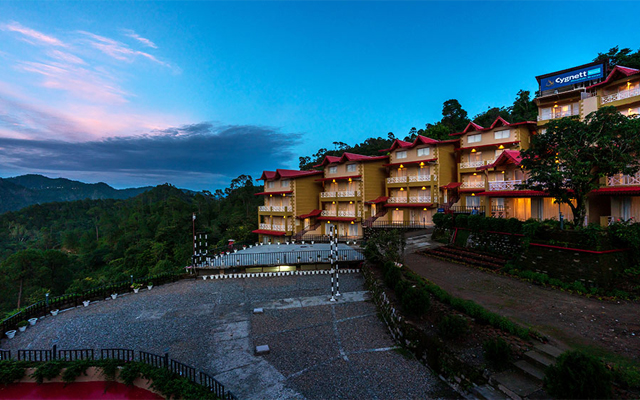
As India lifts lockdown restrictions, hotels like Cygnett Hotels & Resorts are looking to tap the domestic market in their initial recovery phase; Cygnett Resort Mountain Breeze Nainital pictured

Gaurav Taneja, corporate general manager, Amatra Hotels & Resorts, opined that local tourists who have not been able to travel overseas will turn to holidaying at home.

Sarbendra Sarkar, founder and managing director of Cygnett Hotels & Resorts, said: “To begin with, we will be targeting our existing guest database through e-marketing efforts. Our sales force will reestablish connections with domestic travel agents, and we are actively updating our travel agent network on the safety protocol put in place (at our hotels).”

Health and safety measures at hotels are of global concern now, as travellers return to activity in a world without a Covid-19 vaccine.

“The world around us has changed fundamentally and it has become imperative that we take even more stringent measures to ensure our guests and associates feel safe as we prepare to welcome them back again” remarked Anuraag Bhatnagar, chief operating officer of The Leela Palaces, Hotels and Resorts.

According to Indian credit rating agency, ICRA, hotels in the country have been operating at 10 to 15% per cent occupany and losses are mounting. It has predicted that the hotel industry recovery may only begin after three to four quarters and contingent on a vaccine, while the normal state of business may only be seen in two to three years’ time.

The changing face of Thai luxury travel

0

“The word luxury is out; we’ve reached the age where it’s very unfashionable to be pretentious.” These words, uttered by Leanne Reddie Hucker, director of sales & marketing, Rosewood Bangkok, at the Thailand Tourism Forum in Bangkok on January 20, days before Wuhan shut itself down in a bid to contain the coronavirus, have taken on new meaning in the pandemic’s wake as the crisis has upended the luxury travel industry, and spurred greater demand for more targeted and personalised services.

“There is no question we have entered a new era of defining the traveller. The one-size-fits-all approach is not going to work anymore,” Hucker added. “Memory creation, personalised experiences are in. The key to the heart of a new luxury consumer is personal relevance.”

Little did she know how much weight her words, spoken before a thousand hoteliers and travel industry professionals in a ballroom at the Intercontinental Bangkok, would carry in the following months, as no one could have predicted how the burgeoning Covid-19 crisis would instantly transform how the world defines luxury.

But the crisis offers hotels themselves a luxury – the luxury of time to rethink themselves and refine essences and brand messages, said Laurel Tuohy, deputy content director at Bangkok-based hospitality brand consultation agency QUO.

“Although it’s a scary and uncertain time, I think that, looked at with a certain optimism, high-end hotels and brands can use this down time well. It’s the perfect chance for brands to reassess who they are, how they’ve changed and what differentiates them from the rest,” she stated.

QUO is hosting a series of podcasts titled the Future of Travel, in which themes of simplicity, radical localism and less crowding have emerged, with the new luxury defined by authentic local experiences, integration of technology and wellbeing as core components of a hotel’s offer.

These are themes that many of Bangkok’s luxury hotels are focusing on as they prepare to relaunch. As part of its efforts in stepping up sanitation to tackle the new normal, Rosewood Bangkok’s Hucker said the hotel “will heighten existing health and safety techniques, policies, and procedures”.

Elsewhere, at the opulent 285-room Sindhorn Kempinski Hotel Bangkok, whose scheduled May opening has been pushed to 3Q2020, Aaishah Bohari, director of sales and marketing told TTG Asia: “The pandemic has changed the world’s views and expectations of travel which directly impacts the choices people will make when they can travel again.”

Speaking of the hotel’s 4,000m² of wellness facilities and carefully designed health-centric programmes, she added: “At our hotel, well-being is at the heart of every guest experience. Sindhorn Kempinski Hotel Bangkok is designed in every sense with comfort and well-being in mind. Health or wellness has taken centre stage and this allows us to enter an already crowded market with a point of differentiation that is relevant and important – more so now – to discerning travellers.”

“We are now planning a series of campaigns leading to our opening later this year, from beautiful performances specific to various service touchpoints that are unique to the Kempinski DNA to inclusive dining experiences where every culinary ethos is embraced.”

Localisation is a strong theme at another long-awaited luxury opening: Capella Bangkok, situated in cultural hotspot Charoenkrung overlooking the Chao Phraya river. It is now slated for an end-of-year opening due to the coronavirus crisis. “By promising ‘Crafted Moments, Steeped in Tradition’, our new-age urban resort maintains a great connection with the local community,” said John Blanco, its general manager, of the hotel’s plans to draw luxury travellers.

“The hotel’s Capella Culturist team will assist to craft original and inspiring experiences around the neighbourhood’s highlights for food, wellness and culture, allowing guests to discover their inner selves with energising alfresco activities during their stay.”

Other luxury properties are making use of the downtime to upskill their staff. At the Hotel Villa De Pranakorn – Sam Yod district’s first five-star boutique hotel which opened in February – for instance, kitchen staff have been undergoing cooking courses, while accountants are brushing up their computer software skills.

“As we are a new hotel, this break gives us time for staff training and making sure we have more knowledge and experience, so we will be ready when we are back in business,” shared Erik Lannge, general manager of the luxury heritage hotel.

At the Grand Hyatt Erawan Bangkok, one of the city’s most established luxury fortresses, a special taskforce has been set up to reimagine the new normal after Covid-19, and adapt its services and products to meet evolving guest needs.

“This (crisis) is going to require us to rethink and redesign the way we operate and accelerate the green and sustainable transformations initiated in the past,” said its general manager Edouard Demptos.

“Additional precautionary measures such as social distancing capacity in event venues and restaurants are being developed so that guests are assured that it’s safe to meet and stay at Grand Hyatt Erawan Bangkok. To communicate all our efforts, we are preparing a holistic marketing communications plan that is digitally-driven and customer-centric.”

A finer way to fly

0

Air New Zealand
Air New Zealand (Air NZ) is working on making lie-flat beds in economy class a reality, in what would be an industry-first move to shake up the base offering of rival airlines. A launch isn’t confirmed but Air NZ appears to be in the final stages of developing the Economy Skynest after three years of research and testing at their Hangar 22 innovation centre in Auckland.

The Skynest accommodates six full-length bookable sleeping pods, each equipped with a full-sized pillow, sheets and blanket, ear plugs, privacy curtains and lighting designed for sleep. Other features are also being explored, including a separate reading light, a USB outlet for personal devices, and an improved ventilation outlet.

“The scale of the challenge in developing the Economy Skynest and working through its certification with the necessary regulators is immense, but we believe it is a prize worth chasing and one that we think has the potential to
be a game changer for the industry,” said a spokesperson
at Air NZ.

“If successful, we expect other airlines to explore licensing the Economy Skynest from us just as they have with the Economy Skycouch,” he continued, referring to another innovation introduced in 2010 that effectively combined three economy seats and turning them into a couch.

Air NZ also prides itself in providing gate-to-gate inflight entertainment, the ability to order food and drinks from passenger touchscreens, and its own AI chatbot Oscar which can answer commonly asked questions about flight, baggage, lounge and Airpoints.

But would the Skynest cannibalise Air NZ’s business class offering? The airline doesn’t think so. “The Economy Skynest is tailored for economy travellers and clearly differentiated from our business class offerings,” said the spokesperson.

“It is envisaged to be an added option for economy passengers where they will be able to book a session in the pod and still have their seats for the remaining portions of the flight. A clear pain point for economy travellers on longhaul flights is the inability to stretch out, and the development of the Economy Skynest is a direct response to that feedback,” he concluded. – Adelaine Ng

ANA
Japan’s largest airline is boosting efficiency, comfort and barrier-free facilities on the ground. ANA rolled out the range of new offerings in March to improve passenger experience.

For international departures at Haneda Airport Terminal 2, self-service baggage drops with capability in seven languages have been installed. Smart lanes that allow four customers to use baggage screening lanes simultaneously are in place to reduce security waiting times.

There is also wheelchair-accessible counter and streamlined check-in for passengers who need special assistance.

Four new lounges have been opened, three at Haneda and one at Narita International Airport.

At Haneda, the 360-pax ANA Suite Lounge focuses on privacy and relaxation as well as made-to-order F&B. Its reception area features a Japanese garden and bamboo forest, designed to promote a calming atmosphere. The Napping Area features six beds and five reclining chairs as well as a private area with booths fitted with televisions.

In the Live Kitchen, chefs serve omelets in the morning and nigiri sushi in the evening, while the Bar prepares coffee by day and more than 20 kinds of cocktails at night.

The 900-pax ANA Lounge also has a Live Kitchen and Bar as well as 24 booths offering semi-seclusion and a kids’ room.

Open from 04.30 to 12.30, the ANA Arrival Lounge has a footbath with an ocean view and 18 shower rooms, two of which are barrier-free. It also serves light meals and beverages.

At Narita, the ANA Lounge is located in Satellite 2, catering to passengers departing from farther gates or taking a bus to their aircraft.

“Ensuring that passengers can easily access one of ANA’s lounges no matter where they are located in the airport exemplifies ANA’s commitment to Japanese hospitality and passenger convenience,” commented Hideki Kunugi, executive vice president of ANA, on the lounge’s location. – Kathryn Wortley

Emirates
One of Emirates’ most recent innovations is its biometric path at Terminal 3 of the Dubai International Airport.

Utilising the latest biometric technology, comprising a mix of facial and iris recognition, Emirates passengers will be able to check in for their flight, complete immigration formalities, enter the Emirates Lounge, and board their flights. Notably, this is a world-first for passport control, where passengers are “cleared” by immigration authorities without human intervention or the need for a physical passport stamp.
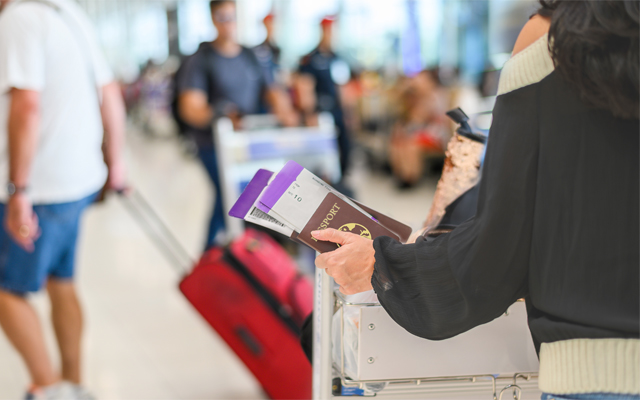

This technology can be found at select check-in counters, at the Emirates Lounge in Concourse B for premium passengers, and at select boarding gates. For instance, customers flying from Dubai to any of its 12 destinations in the US can benefit from this service, reducing the time taken for identity checks.

The Dubai-headquartered airline also adopts a customer-centric, technology-enabled approach to enhance a passenger’s travel experience through big data, predictive analytics, artificial intelligence, crowd sourcing and collaboration.

In 2018, Emirates introduced 3D seat models on emirates.com, becoming the first airline to introduce web virtual reality (VR) technology on its digital platform. In 2019, Emirates introduced a new function on its app to allow customers to create bespoke playlists ahead of their flight and sync it to their seats once on board.

Big data is also used to better understand an individual passenger’s needs and predict what they would want for a personalised flight experience. For example, flight attendants have access to tablets onboard filled with data gleaned from its website and the 25 million members of the frequent flyer programme, Emirates Skywards.

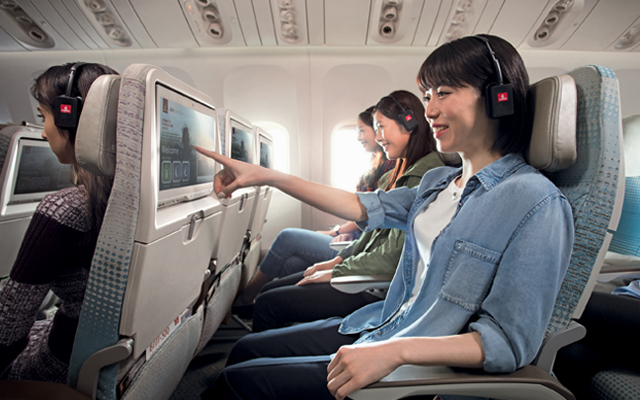
Regardless of cabin class, all customers can look forward to savouring regionally-inspired and diet-specific meals, to enjoying over 4,500 channels of on-demand audio and visual entertainment in multiple languages on its inflight entertainment system, ice.

On the ground, Emirates’ airport lounges are an integral part of the airline’s service and product offering for its premium and loyal customers.

The Emirates First and Business Class lounge at Changi Airport, for example, was designed with a focus on comfort and quality, offering facilities such as LED TVs, showers, a business centre as well as a dedicated dining area which features an extensive menu of complimentary hot and cold dishes.

First and Business Class passengers can enjoy complimentary chauffeur service the airline offers in over 75 cities worldwide, for a seamless journey from start to finish. Those travelling with young children meanwhile, will benefit from dedicated and faster check-ins, complimentary strollers, family baggage allowance and early bag drop-off when they travel via Dubai International Airport. – Rachel AJ Lee

APTCO eases air ticket changes for airlines

0

ATPCO has unveiled a new automated Emergency Flexibility tool that will be adopted by the airline industry from this week to enable them to automatically update flight changes and refunds for issued tickets.

Created within the framework of IATA and A4A supply chain resolutions, and in collaboration with airlines, GDSs and channels, the automated solution enables airlines to process the mounting travel changes stemming from the Covid-19 travel restrictions.

ATPCO rolls out new tool to allow automated flight changes and refunds for previously-issued tickets

The tool will help airline companies by automatically applying new changes and refunds in previously-issued tickets to reflect new policies such as longer validity periods and change fee waivers, providing passengers with greater flexibility for future travel.

In addition to supporting the needs of airlines, GDSs, and agencies, Emergency Flexibility also ensures that travellers can better understand new policies that have been put in place and the associated benefits.

“In these exceptional circumstances, there has been an increasing need for a consistent approach to ticketing changes for all players and across different channels,” said Hervé Prezet, vice president of Industry & Expertise at Amadeus.

“The solution that ATPCO has been able to create in a matter of weeks, and that Amadeus is enabling, will provide consistency in automated servicing for travel agents and airlines which will benefit the entire ecosystem.”

To date, over 60 airlines, including Air France-KLM, American Airlines, British Airways, Delta Air Lines, and Singapore Airlines, have been involved with the Emergency Flexibility solution. Additionally, all major GDSs, including Amadeus, Sabre, Travelport, and Travelsky have planned to go live with it.

New GM and DOSM for Six Senses Con Dao

0

Six Senses Hotels & Resorts has appointed Eric Hallin as general manager and Hannah Loughlin as director of sales and marketing of Six Senses Con Dao.

With more than 40 years of international hospitality experience, Hallin’s management expertise spans an impressive list of countries, including France, Greece, Maldives, Spain and Thailand.

From left: Eric Hallin; and Hannah Loughlin

Aside from contributing to the success of properties such Six Senses Samui in Thailand, Hallin has also held leading positions in PATA, chambers of commerce and Skål.

On the other hand, Loughlin began her sales and marketing career in 2002 at London’s Grosvenor House before moving on to join Design Hotels, and spearheading the field team of prestigious hotels including Sofitel London St James, InterContinental, and Anantara Angkor Resort & Spa.

The British national was most recently leading the sales, operations and finance team in Cambodia as general manager for Trails of Indochina, a luxury inbound agency across Indochina.

Evolving to meet APAC travellers’ changing needs

0

Before unforeseen circumstances altered life as we knew it, travel in Asia-Pacific was booming. Valued at US$446 billion in 2019, Asia-Pacific’s travel market led North America and Europe and was projected to grow further in 2020. But the coronavirus pandemic changed all that – halting non-essential travel around the world.

This grinding halt touched every element of the market. In the airline industry alone, the fall in passenger numbers has resulted in global revenue loss in excess of US$63 billion. However, with travel restarting in regions like China, consumer confidence isbeginning to grow.

Covid-19 has changed the way people in Asia-Pacific travel, with a greater focus on safety and cleanliness, and demand for more booking flexibility

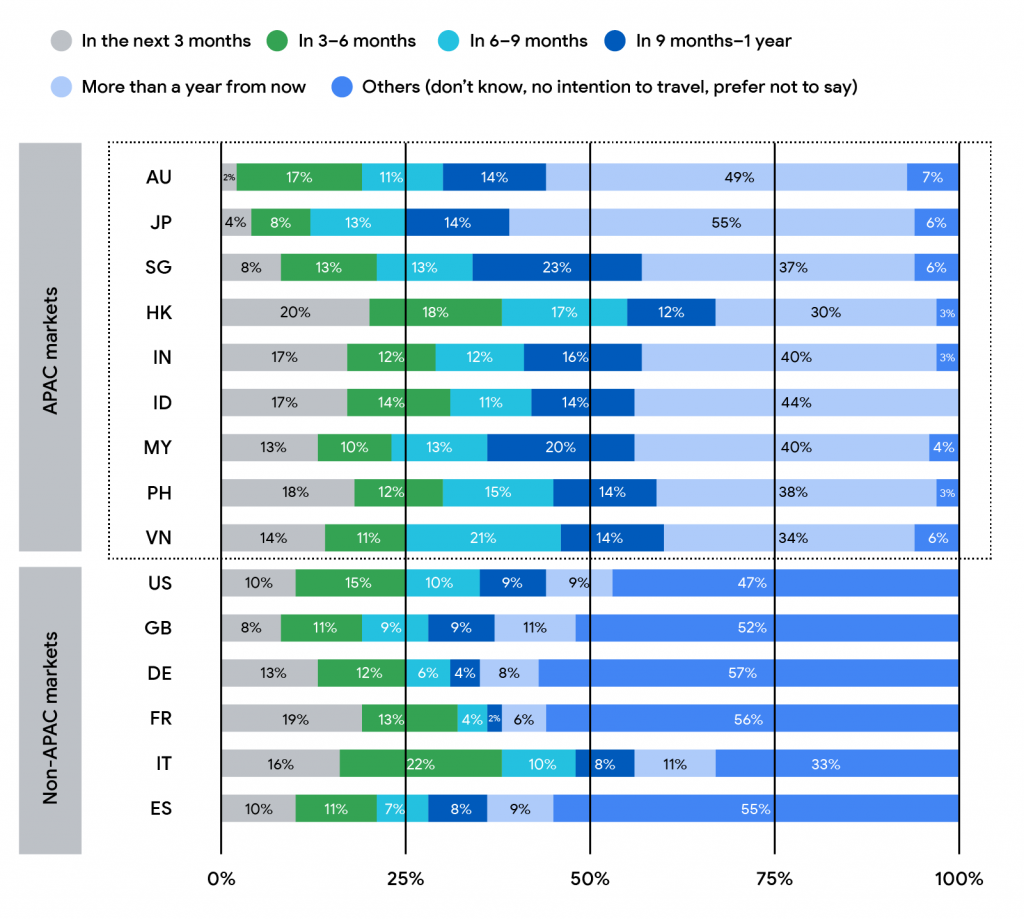
To better understand consumer sentiment around travel during the Covid-19 crisis, we’ve been conducting travel intent surveys across the world. While the majority of Asia-Pacific respondents said they don’t expect to travel in the next nine months, we identified pockets of shifting sentiment where respondents showed a higher willingness to travel sooner.

Paired with insightful data from a recent Global Web Index (GWI) study, our findings highlight emerging trends that travel companies should consider as we all navigate the road ahead.

Consumer sentiment around travel is shifting
According to our research, some markets in Asia-Pacific are expressing interest in future domestic travel. In Indonesia, India, the Philippines, and Vietnam, more than 25 per cent of respondents expressed plans to travel domestically in the next three months, compared with countries like Australia and Japan, where less than 14 per cent of them plan to do so.

Survey question: When are you next planning to travel domestically for a holiday?

This differing sentiment is also reflected in future international travel plans: Respondents in Indonesia, India, the Philippines, and Vietnam have indicated they are 1.5 times more likely than those in Australia, Singapore, and Japan to travel internationally in the next six months.

Travel is a priority for most consumers post-lockdown
According to the GWI study, booking a vacation is the top priority for nearly all surveyed markets with the exception of India, where buying consumer goods such as clothes and personal electronics has greater appeal. This sentiment is reflected around the world, with 45 per cent of people who delayed a vacation due to Covid-19 planning to prioritise booking a vacation or trip after the pandemic ends.

Search data indicates some early signs of recovery as well. In some Asia-Pacific markets, we’ve seen a gradual rise in searches around holiday planning. In Taiwan, searches for “hotels” are gaining momentum, while searches for “resorts” or “all-inclusive travel deals” are starting to pick up in Vietnam and the Philippines.

Consumer research has also highlighted some interesting age patterns: The older the consumer, the more likely they are to prioritise booking a vacation. While 29 per cent of baby boomers prioritise booking a vacation, Gen Zers are more inclined to focus on clothing (25 per cent) and smartphones (20 per cent).

People in Asia-Pacific expect to change the way they travel
The coronavirus pandemic has impacted the way people will approach travel-related decision-making: a whopping 87 per cent of Asia-Pacific consumers expect to make changes to the way they travel, compared with 67 per cent and 70 per cent in North America and Europe, respectively.

With consumer behaviours and expectations changing rapidly, travel companies need to adjust their strategies to meet consumers’ needs in meaningful ways. In addition to revealing how people currently feel about travelling, our research also uncovered three key ways for travel companies to approach their marketing efforts based on consumer insights.

1. Prioritise safety and cleanliness
Safety is top of mind for consumers around the world, especially as they get older: 65 per cent of baby boomers say a personal feeling of safety is by far the top confidence booster for resuming travel. But only 28 per cent of consumers say reopening borders will make them feel confident enough to travel again, so travel companies have to do more to make them feel safe.

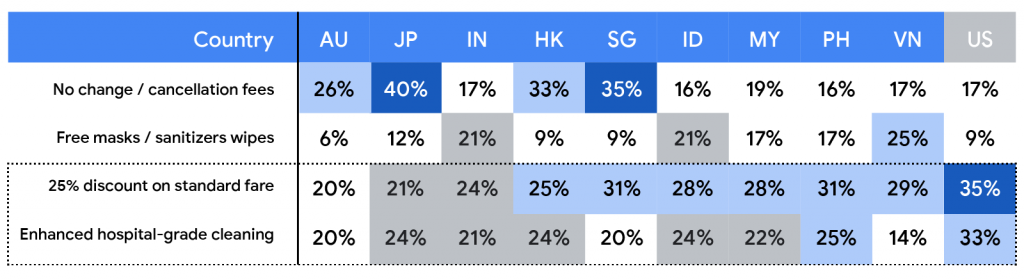
Survey question: Which of the following would make you most likely to book a hotel in the next three months?

One important contributor to this feeling of safety is assurance of higher cleaning standards. On average, 25 per cent of all people looking to travel in the next three months mentioned “hospital-grade cleaning” as a key driver for making a hotel booking.

2. Promote discounts and flexibility
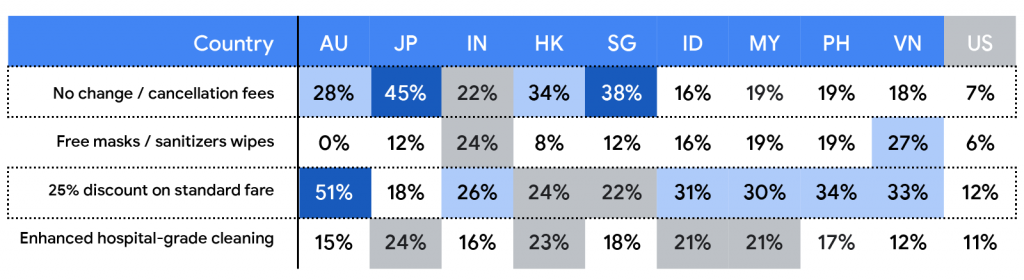
When Asia-Pacific consumers begin to consider travelling again, a key motivator for booking will be both the flexibility to make changes to bookings and the promotional discounts available to them. The chart below shows Asia-Pacific consumers listed discounted fares and waived cancellation fees as key factors for booking a flight within the next three months.

Survey question: Which of the following would make you most likely to book a flight in the next three months?

But just because Asia-Pacific consumers want discounts doesn’t necessarily mean they’re looking for cheap places to travel. While 25 per cent of respondents indicated plans to make more use of promotions, only 15 per cent claimed they were looking for cheaper vacations in the future. This indicates people are looking for more premium travel experiences that are still within their budgets.

3. Consider consumers’ short-term preferences
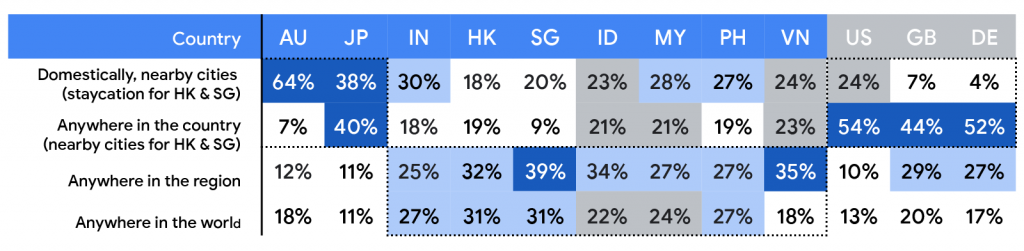
Both research studies indicate that 25–35 per cent of consumers’ first trips will be to nearby destinations such as staycations or places within driving distance. According to the GWI study, 42 per cent of Chinese consumers are planning to take more trips in their local area than they did before the coronavirus pandemic.

Survey question: If you were to travel in the next three months, where would you most likely travel to?

In addition to short-haul domestic travel, outdoor destinations are more appealing to people around the world: More than 50 per cent of all survey respondents said they would travel to a beach or other natural destinations if they were to book travel in the next three months.

Planning a path to recovery
As sentiment around travel begins to change, travel marketers need to stay agile to meet consumers’ needs in meaningful ways. By listening to people and reaching them with relevant information during this difficult time, travel companies can earn their trust and put themselves on the road to recovery. Below are three cost-neutral actions travel marketers can take to set themselves up for success in a post-Covid world:

1. Monitor trends
While complete global recovery is a long way off, travel “bubbles” offer a potential way forward in the meantime. Tools like Google Trends can help marketers navigate these bubbles and track consumer sentiment with real-time search data. For example, there has been a gradual rise of searches for “international flights to India” in Singapore. Marketers can also keep their fingers on the pulse of wider industry trends by attending virtual events like Google’s SME Leadership Academy travel webinars.

2. Rethink your messaging and targeting strategies
As seen in the data above, consumer behaviours and expectations can vary from market to market (and user to user). To succeed, marketers need to highlight what matters most to different people at each stage of recovery and adjust their messaging accordingly. With Director Mix, marketers can create customised videos at scale and swap out different elements to tailor content to specific audiences.

3. Improve your digital hygiene
Use this as an opportunity to restructure your marketing to be best in class. Clean your technical feeds and underlying account and campaign structures. Boost your coverage with auto-bidding and use tools to proactively communicate with travellers. To help our clients and users during the Covid-19 crisis, we are focusing on initiatives like updating ads to show when hotel rates are refundable and indicating whether hotels are temporarily closed on their Google My Business profiles.

Rohan Dhanuka, industry analytical head, travel and finance; and Christopher Siantar, analytical consultant, travel contributed to this piece.

Amadeus, Troovo unite to automate B2B travel payments

0

Amadeus has integrated Troovo’s advanced Robotic Process Automation (RPA) engine into its B2B Wallet, allowing its travel agent users to benefit from faster automated payments.

The introduction of RPA means key data relating to each payment and booking can be moved between the booking system and the airline passenger service system (PSS) or the hotel property management system (PMS) automatically by a software robot.

Travel agencies using Amadeus’ B2B Wallet for virtual payments now benefit from advanced process automation

Software robots are a light-weight tool that can quickly be configured to complete basic business processes, such as entering a 16-digit virtual card number, or travel booking details, from a travel agency system into an airline or hotel system to complete a payment.

This automation avoids error-prone human processes or traditional systems integration work, which can take longer. The data transferred includes virtual card information that is written back to the booking system as well as transaction data provided to the travel supplier and the card-issuing bank.

Combined with Amadeus’ B2B Wallet solution, it enables travel agencies to pay suppliers using the right virtual card for that specific booking scenario – be it pre-paid, credit or debit – in the most efficient way.

Troovo can be deployed easily within the travel provider’s payment processing workflow to provide a completely virtual solution for generating and processing payments.

Amadeus B2B Wallet customers can now enjoy the significant commercial, risk management and data visibility benefits of B2B Wallet, alongside the operational cost savings and simple integration capabilities of Troovo Payments.

Damian Alonso, head of payer services, payments, Amadeus, said: “Even though our industry is in challenging and uncertain times, payment innovation has remained resilient given the typically low implementation burden and incremental contribution towards both cost reduction and revenue collection. As we navigate the pandemic and begin to reimagine how travel agencies pay providers, it’s important we strive for the most automated and efficient approach possible.”

Troovo’s co-founder and CEO Kurt Knackstedt added that virtual payments “eliminate inefficiencies while providing a whole new level of security, data richness and ease of use, thanks to RPA”.

Swire Hotels makes trio of senior appointments

0

Swire Hotels has moved three members of its senior management team into new roles.

Brian Williams, Toby Smith, and Dean Winter have all worked with the company for over a decade, each contributing to the launch and growth of EAST Hotels and The House Collective brands.

From left: Toby Smith; Dean Winter

Toby Smith will replace Brian Williams as deputy chairman, while Dean Winter will take over from Smith as managing director. Following 14 years at Swire Hotels, Williams will take up the role of senior advisor to the brand on a part-time basis from his new base in the UK.

As deputy chairman, Smith will lead Swire Hotels’ growth strategy for both Swire Properties-owned developments and hotel management agreements with third-party owners.

Smith joined the Swire group as a management trainee in 1991, and has since held positions within the group’s shipping and aviation sectors, taking him to countries across the globe including Papua New Guinea, Vietnam, Australia, Turkey, Sri Lanka, France, Singapore and Hong Kong.

On the other hand, Winter has over 25 years of experience as a hotelier and restaurateur across London, Hong Kong and Singapore, and will oversee the day-to-day operations of the hotel and restaurant businesses.

Winter came onboard Swire Hotels in October 2006 to concurrently manage operations and pre-opening preparations for The Opposite House in Beijing, The Upper House and EAST in Hong Kong, before opening The Upper House as general manager in 2009.

Williams originally joined Swire Hotels as managing director before becoming deputy chairman, and will now relocate to the UK to take on his new role. He will continue to support the development plans of the group, as well as act as a brand ambassador to raise the profile of EAST and The House Collective globally.