
Asia/Singapore Friday, 10th April 2026
Page 329

Soft adventure tourism making waves in Asian markets

0

Industry experts predict Asia’s younger generation will lead the tourism recovery charge as they seek unique soft adventure experiences abroad.

At PATA’s hybrid Adventure Travel Conference and Mart, this was predicted across the outbound Chinese, Indian and Malaysian markets, where experts note the trend has been emerging in domestic travel during the pandemic.
More younger travellers in Asia engaging in soft adventure activities domestically; Suluban Beach in Bali pictured

Dan Sandoval, co-founder of Perspective China, said the huge growth in domestic tourism in the country caused by Covid-19 travel restrictions has triggered a swathe of new products. This includes an explosion of adventure activities that travellers aged 25 to 44 are particularly keen to explore.

He noted: “We’re seeing a huge demand for products that didn’t traditionally exist. China was more of a conservative travel market but we’re seeing this huge shift towards experiences. This says there will be a huge demand for these as an international experience.”

For example, the surf scene has exploded in Sanya; while in Yunnan, safari-style camps are emerging, and are proving popular with the country’s younger generations.

Said Sandoval: “We will see a huge surge in people looking for these niche products in unique locations, especially this age group. This is a wonderful playland for the adventure and experiential travel industry.”

In India, a similar shift in demand from the 25 to 44 demographic is being driven by the “bragging factor”.

Deeya Bajaj, director of operations and business development at Snow Leopard Adventures, said: “Indian youth are now more willing to spend on experiences. There’s the bragging factor that comes from being able to do something unique rather than buying a luxury item.”

Sandoval noted a similar movement in China, where investing in a unique adventure holiday or travel experience is the new designer item.

He said: “There used to be a time when you’d brag about having a Louis Vuitton bag but that time, for the most part, is gone. Now, we’re seeing experiences are what people want to brag about.”

Bajaj said younger generations in India are showing a desire to try soft-adventure holidays and excursions in undiscovered destinations – all new experiences for the market.

She added: “They don’t want long or hardcore adventures. They want to go to offbeat places, but be comfortable. They’re excited to try new things, but they’re not as self-sufficient as American or European adventure travellers. There will need to be some handholding involved as the average Indian adventurer is trying these activities for the first time.”

In Malaysia, Jessica Yew, co-founder and director of Sticky Rice Travel, noted the devastating financial impact brought on by continued lockdowns and other restrictions has left younger generations with less disposable income to spend on travel.

However, she said the pent-up demand can be seen in the domestic market, with more Malaysians aged 25 to 44 opting for soft adventures. She said glamping, slow travel, as well as environmentally-friendly and community-based travel programmes are on the rise.

Yew said: “Travel is a lifestyle for this segment; it’s not a luxury item. A lot of people with the disposable income to travel live in the city and it forms part of their work-life balance. People in this age group are now looking for authentic experiences and soft adventures.”

She added that it is imperative the industry remains active on social media to capture this tech-savvy segment.

This sentiment is strongly echoed by Sandoval. With the lack of exposure to the outside world due to cancelled trade shows, limited fam trips and tourism and destination marketing companies slashing promotion budgets, China’s young is turning to social media to source travel information.

He advised: “Getting on the social media train is so important right now. Keep social media accounts active, you have to stay in people’s minds. Wave that delicious smelling platter in front of their faces so that when the cafeteria opens, you get a surge of people coming. It will be this segment who lead the charge, and you need to be ready.”
International tourist arrivals down 83% in 1Q but confidence rising: UNWTO

0

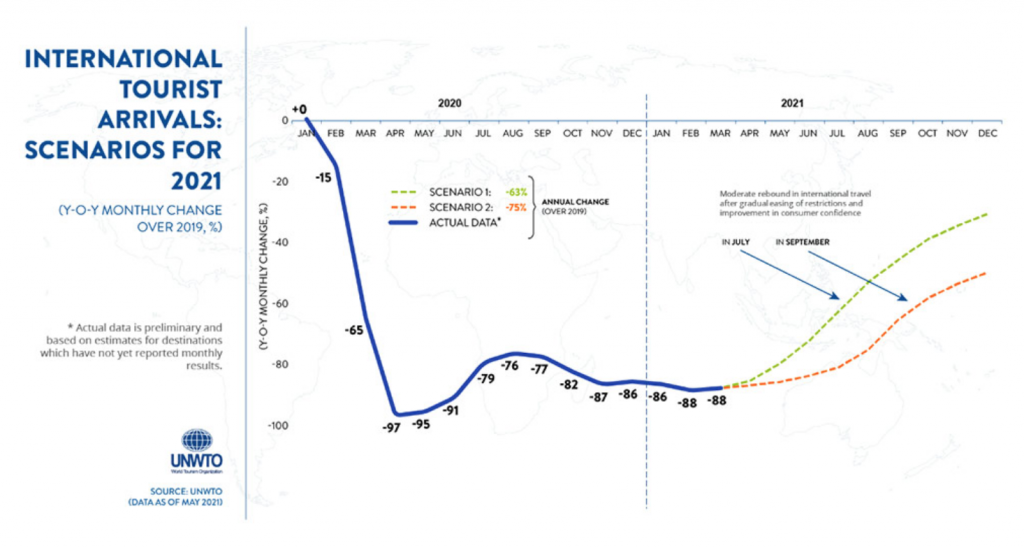
International tourist arrivals plunged by 83 per cent year-over-year in the first quarter of 2021 amid ongoing widespread travel restrictions, according to the latest data released by the UNWTO. However, the UNWTO Confidence Index shows signs of a slow uptick in confidence.

Between January and March 2021, destinations around the world welcomed 180 million fewer international arrivals compared to the first quarter of last year. Asia and the Pacific continued to suffer the lowest levels of activity with a 94 per cent drop in international arrivals over the three-month period. Europe recorded the second largest decline with -83 per cent, followed by Africa (-81 per cent), the Middle East (-78 per cent) and the Americas (-71 per cent).

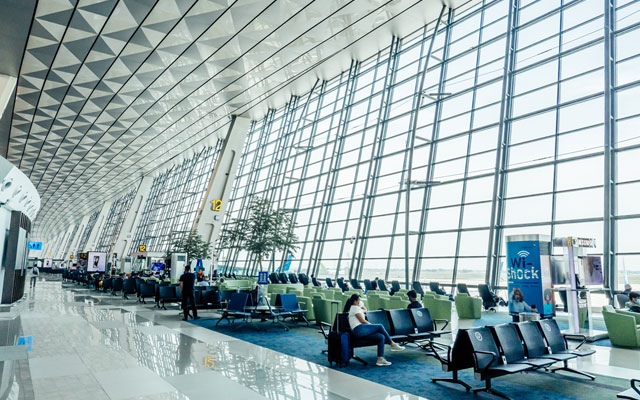
Asia-Pacific recorded a 94 per cent drop in international arrivals between January and March 2021; a largely empty Soekarno-Hatta International Airport in Jakarta, Indonesia during Covid-19 pictured

This all follows on from the 73 per cent fall in worldwide international tourist arrivals recorded in 2020, making it the worst year on record for the sector.

UNWTO secretary-general Zurab Pololikashvili commented: “There is significant pent-up demand and we see confidence slowly returning. Vaccinations will be key for recovery, but we must improve coordination and communication, while making testing easier and more affordable if we want to see a rebound for the summer season in the northern hemisphere.”

The latest survey of the UNWTO Panel of Tourism Experts shows prospects for the May-August period improving slightly. Alongside this, the pace of the vaccination rollout in some key source markets as well as policies to restart tourism safely, most notably, the EU Digital Green Certificate, have boosted hopes for a rebound in some of these markets.

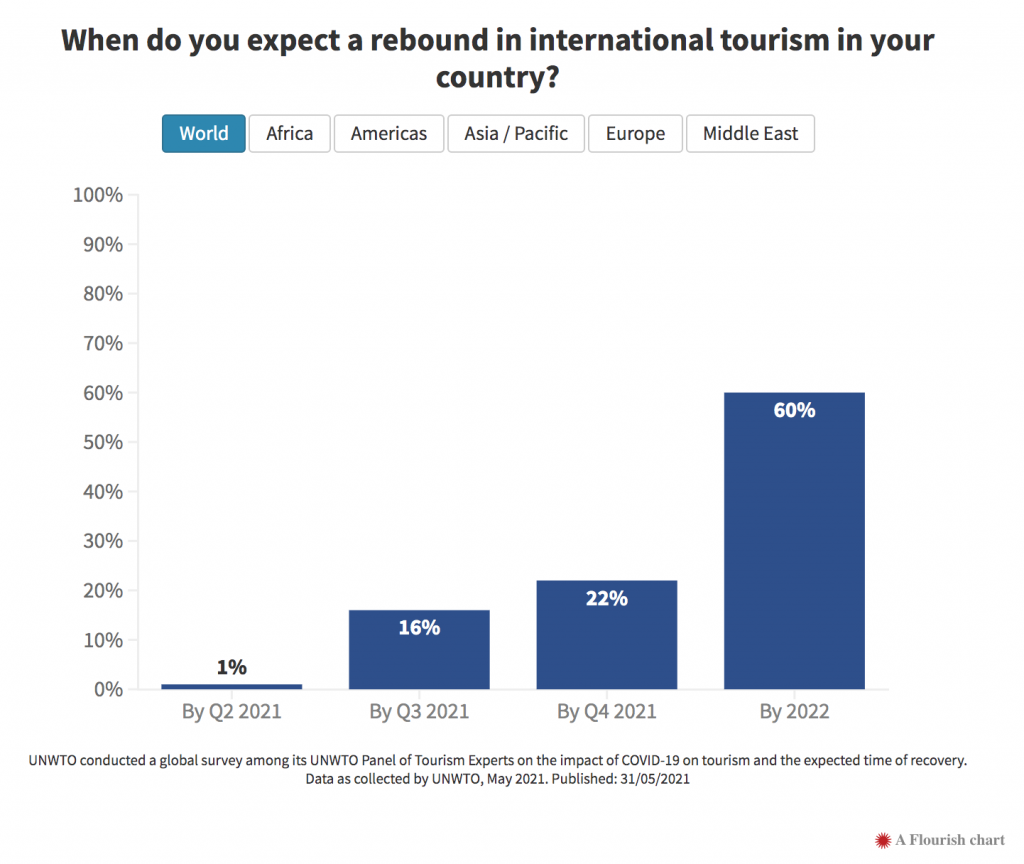
Overall, 60 per cent expect a rebound in international tourism only in 2022, up from 50 per cent in the January 2021 survey. The remaining 40 per cent see a potential rebound in 2021, though this is down slightly from the percentage in January.

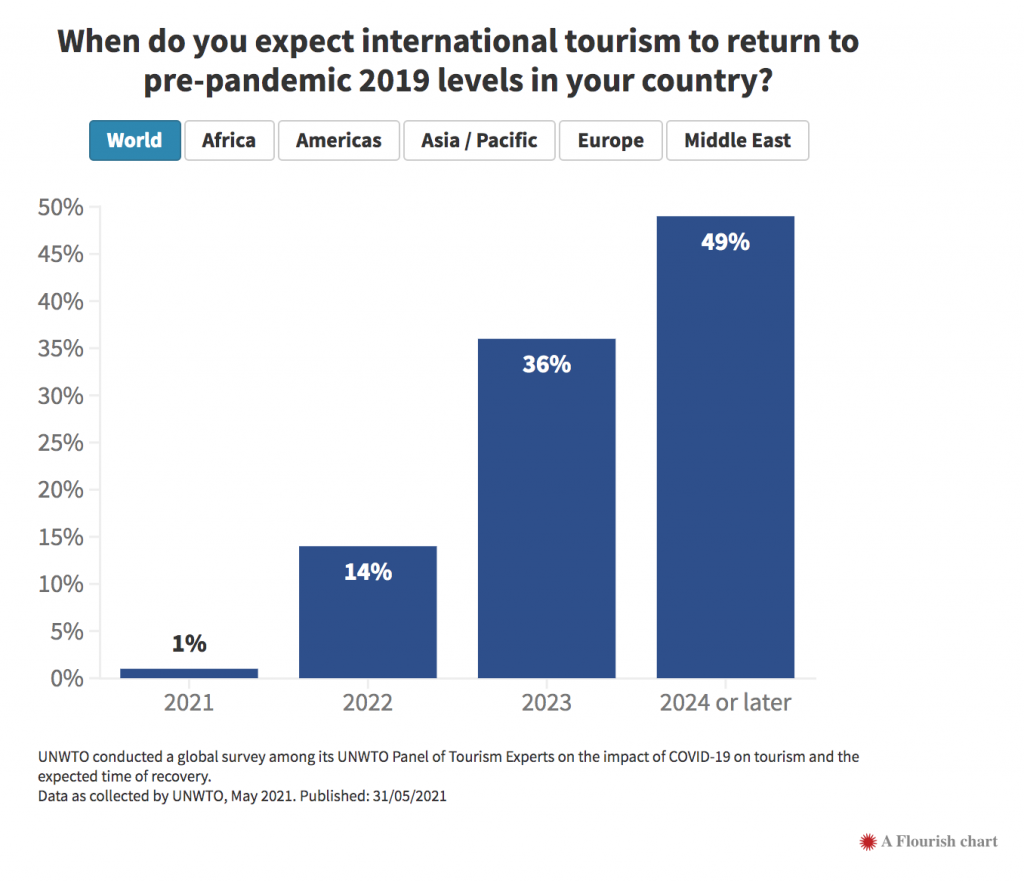
Nearly half of the experts do not see a return to 2019 international tourism levels before 2024 or later, while the percentage of respondents indicating a return to pre-pandemic levels in 2023 has somewhat decreased (37 per cent), when compared to the January survey.

Tourism experts point to the continued imposition of travel restrictions and the lack of coordination in travel and health protocols as the main obstacle to the sector’s rebound.

The UNWTO World Tourism Barometer also shows the economic toll of the pandemic. International tourism receipts in 2020 declined by 64 per cent in real terms (local currencies, constant prices), equivalent to a drop of over US$900 billion, cutting the overall worldwide exports value by over four per cent in 2020. The total loss in export revenues from international tourism (including passenger transport) amounts to nearly US$1.1 trillion. Asia and the Pacific (-70 per cent in real terms) and the Middle East (-69 per cent) saw the largest drops in receipts.

As room demand weakens, new hotel revenue sources awaken

0

For almost two decades since 2002, Singapore-based Global Hospitality Solutions (GHS) has established a profitable business in helping hotel partners be present in the entire customer journey in travel and tourism, from engaging travellers to driving purchase and eventually rewarding for loyalty.

But with a large part of their business being in room bookings, GHS found its existence challenged when the pandemic hit in early 2020.

Quek: Online retailing, including F&B delivery, plays a crucial role in supporting hotel businesses

“There was zero tourism. And so, our work suddenly became focused on helping our hotel partners survive – which in turn ensures our own survival,” recalled CEO Bernard Quek.

To develop different and more stable ways for hotels to get business amid recurring lockdowns and continued international travel restrictions, GHS adjusted its technology platforms to facilitate F&B orders and delivery, voucher sales and e-gifting services.

GHS’s transformation birthed Social Media Hospitality Salesbot, which enables hotel room bookings and voucher sales via Facebook and Messenger, online F&B ordering for takeaway or delivery, and restaurant reservations via a chatbot as well as WhyQueue Hotel e-Store, which powers a private e-store for both hotel companies and individual properties.

However, Quek discovered that the business pivot required more than just a technology change. By stepping into F&B purchase and delivery services, GHS now has to put on a new operational hat and play the role of a coordinator that connects customers with transport vendors and hotel partners.

He detailed: “When it comes to selling a room, the customer puts in arrival and departure dates, selects rooms, books, pays, and the transaction is complete. With online F&B purchases, the customer selects what he wants, and puts in his delivery address which must be linked to Google Map for us to instruct our delivery partners. This process can get complex beyond Singapore, such as in the Philippines where there are many regions and zones.

“We have to work with our transport partner – in Singapore, it is Lalamove – to ensure the hotel meal, chocolates or wines are delivered to the customer in good condition and in accordance to our hotel partners’ brand and service standards. And should there be delays, we must sort things out.”

GHS’s WhyQueue Hotel e-Store now supports various hotel companies and properties, such as Grand Hyatt Singapore, Grand Hyatt Jakarta in Indonesia and Wyndham Hotels and Resorts across Asia-Pacific. It recently won over Marco Polo Hotels and will be establishing an online store for the chain’s properties in Manila.

According to Quek, hotels have a lot to gain by moving into online retailing. Citing an example, he said a hotel client in Singapore generated seven-digit revenue “over the last couple of months” from just F&B delivery alone.

Online retailing can also cushion hotels from recurring lockdowns. When Singapore went into Phase 2 partial lockdown on May 16, which restricted staycation guest movement and prohibited dining in at eateries, Hyatt’s online orders grew 300 per cent in a day.

For now, Quek observed that major hotel companies and high-end properties were more open to the idea of shifting to online retailing and F&B delivery, compared to smaller, local properties. But even with a more open mind, it was not easy for these companies and hotels to move out of their traditional business in room sales.

“Most have never done F&B delivery as a key segment of their business, so we must guide them in every step of the way. Today, F&B is a very important part of hotel business. To do F&B business now requires hotels to relearn concepts. For example, hotels cannot sell a delivered meal at the same price as a dine-in meal because the customer is not paying for the hotel ambience and service,” said Quek.

He said Hyatt properties have done well in transitioning a part of their F&B business to takeaway and home delivery. They had the foresight to set a much lower, more practical price range for food orders. An Impossible Burger served at a Hyatt hotel restaurant would cost about S$30 (US$22.70) or S$40; the same meal for takeaway costs S$12.

F&B products sold by Hyatt properties are marketed at lower prices online

Quek opined that e-gifting is another valuable lifeline for hotels. The service allows corporate clients to purchase hotel vouchers for their staff and/or business partners, which can be used to redeem a specific product – such as a two-night stay in a deluxe room at a specific hotel – or a range of products, such as premium toiletries or gourmet treats.

“E-gifting supports the future of work. Many people are working from home, so bonding is gone and organisations are looking to make up for that loss of engagement through thoughtful gifts that their staff or business partners can enjoy at home, be it a nice meal or a bottle of wine,” said Quek.

Even when movement restrictions ease and post-pandemic travel resumes, Quek is confident that online retail will remain useful for hotels. “Consumers have formed a habit to send gifts of food, wine and other goodies to people they love and miss during the pandemic, and e-gifting will continue to have a place even as movement restrictions ease. There is still room for improvement in overseas e-gifting, and what we do can help to enable this service,” he said.

GHS is growing its Social Media Hospitality Salesbot and WhyQueue Hotel e-Store solutions most prominently in Singapore, Indonesia and the Philippines now, with plans to expand into Vietnam, Hong Kong and Taiwan soon.

Absolute Hotel Services targets senior market with new extended-stay brand

0

Remote working, greater sustainability focus to drive slow travel post-pandemic

0

SiteMinder launches new hotel distribution solution

0

APAC airline traffic remains dismal in April: AAPA

0

International passenger demand continued to linger at the significantly depressed volumes seen since April 2020, according to preliminary traffic figures released by the Association of Asia Pacific Airlines (AAPA).

The ongoing Covid-19 pandemic and surges in transmission across many Asian economies have resulted in renewed border control restrictions as well as domestic lockdowns, quelling hopes of any meaningful resumption in international travel markets.

Airlines continue to face headwinds as Covid resurgence casts a pall over recovery hopes

In total, Asia-Pacific airlines carried just 1.1 million international passengers in April. Although this was an improvement over the same period in 2020 when international passenger volumes plunged precipitously, it represented just 3.5 per cent of passenger volumes recorded in the same month of 2019.

Available seat capacity was only four per cent of levels registered in 2019, with the international passenger load factor averaging 26.4 per cent for the month.

Subhas Menon, AAPA director general, said: “The emergence of different variants with higher transmissibility rates has deterred Asian economies from reopening their borders, with extended quarantine requirements further suppressing international travel demand. Bilateral travel corridors offer hope for a recovery, yet remain susceptible to disruptions, as evidenced by the second postponement of the Singapore-Hong Kong travel bubble, reflecting the extremely challenging operating conditions faced by airlines.

“In Asia, the relatively slow pace of vaccinations continues to undermine the region’s economic recovery, in particular, the travel and tourism sectors which have been badly hit. Accelerating vaccination rollouts will be key to paving the way for the restart of the travel industry. However, governments are still facing numerous challenges, including supply constraints and logistical issues.

“Meanwhile, Asian airlines continue to play a pivotal role in supporting international efforts to save lives, through the delivery of much-needed medical supplies. However, the majority of the region’s carriers, with their international passenger business severely curtailed, continue to burn through cash every month. Some airlines are undergoing major restructuring, whilst others are raising further equity.

“As Covid-19 becomes endemic in society and borders progressively reopen, the collaboration of multiple stakeholders such as governments, airlines, airports and service providers, as well as the implementation of harmonised risk-based measures in accordance with ICAO and WHO guidelines, will be needed to restart international air travel in a smart, safe and sustainable way.”

Room for growth

0

When a nationwide lockdown in Malaysia left hotel rooms across the country sitting largely vacant, Hanley Chew saw a window of opportunity to help hoteliers put their distressed inventories to good use.

That led him to set up online hotel booking platform JustTonite in February, at a time when Malaysia was under its second movement control order and the hotel industry was suffering with occupancies less than 15 per cent, even in the nation’s capital, Kuala Lumpur.

JustTonite’s Chew plans to introduce the concept of selling distressed inventory to other travel-related sectors beyond hotels

“There were more than 50,000 unoccupied hotel rooms daily in the capital alone. Nationwide, the number was in excess of 100,000. I created JustTonite solely with the intention of assisting hotels to fill up their unoccupied inventories for the same night,” shared Chew, founder and CEO of JustTonite.

The platform offers same-day, room-only bookings with check-in from 18.00 onwards. “This unique model was very welcomed by the hotel industry as it focuses only on the segment of unoccupied rooms for the night that will (otherwise) not generate any revenue,” said Chew.

Chew, who has been in senior management in the hotel industry for the past 28 years, shared that it was initially a challenge to explain the concept of distressed inventories to hoteliers.

“Many thought JustTonite was another OTA coming into an already very crowded marketplace. Many a time, I got ‘lectured’ on rate parity and hotel positioning, a topic which I am way too familiar with,” he elaborated.

“The industry ethics on rate parity only applies when all parties are selling the same product. In the case of JustTonite, we are selling a different product which is of restricted use. We are only selling (hotels rooms based) on a time segment – (a concept) which no hotels nor OTAs are focusing on.”

The platform was launched with 30 hotels in Kuala Lumpur and Selangor. That number has since increased to more than 100 hotels nationwide, and Chew is optimistic that the platform will grow to 300 hotels by year-end.

Hoteliers are allowed to list their inventory free-of-charge on the platform. A transaction fee is charged only when a booking materialises, with payment made to hotels immediately through the payment gateway.

Chew now plans to expand the platform to Singapore as he sees similarity in booking preferences between Singaporeans and Malaysians in that they desire a user-friendly booking platform with fixed, consistent rates.

To that aim, JustTonite has appointed Infinity Hospitality Asia as its partner in Singapore, effective July 1. Chew shared: “Its role will be to introduce this new concept of marketing distressed inventories to the hotel community in Singapore, and to reach out to staycationers through various marketing initiatives.”

The ambitious Chew is also in discussions with an organisation based in Dubai to promote this innovative model to all seven GCC countries. If all goes according to plan, the roll-out will start in the UAE this September.

JustTonite’s success in Malaysia has given Chew a long-term vision of adding value to the entire travel ecosystem, based on the similar concept of creating an effective distribution channel for distressed inventory.

Chew explained: “Airlines, car rental companies, bus operators and theme parks have similar distress inventories during low or no demand periods. All these industries have enough data to know which periods have low demand, and will need platforms like JustTonite to assist them. Each industry, however, defines distressed inventories quite differently.

“We are currently engaging with the captains of these industries to first understand their definition of distressed inventory. Through some proprietary tools we developed in-house, we determine a matrix to price these inventories effectively.”

Chew added that this pandemic season is the “perfect time” to introduce the concept of distressed inventory management via JustTonite as “hotels and many travel-related industries are currently undergoing some stages of ‘reset’ for their businesses”.

Travel trade backs Malaysia’s full lockdown

0

Tourism and hospitality players have welcomed the move by the Malaysian authorities to impose a full nationwide lockdown for two weeks beginning tomorrow (June 1) in a bid to flatten the Covid-19 curve.

The announcement made on Friday night comes after a record surge of 8,290 new cases on that day. This record was broken the following day with 9,015 new cases.

Malaysia will enter a full nationwide lockdown for two weeks beginning June 1 amid record virus surges

This will mark the country’s second full nationwide lockdown, following the movement control order (MCO) initiated last year in March for almost two months to stamp out Covid-19.

During this fresh lockdown from June 1 to 14, only essential and service sectors will be allowed to operate. This includes health services, the food and beverage industry, as well as banks and transport services including ports and airports.

Hotels and accommodation are allowed to open, but only for the purposes of quarantine, and not tourism.

The government has also decided that 80 per cent of civil servants and 40 per cent of the private sector will work from home.

If the 14-day lockdown succeeds in reducing daily new infections, the government will move to a four-week Phase 2, where economic sectors may resume, provided there are no large gatherings involved and physical distancing is possible.

This will be followed by Phase 3, where economic sectors are allowed to operate, but social activities are not allowed. The decision to move from one phase to the next will be based on risk assessment.

The tourism and hospitality sectors are in agreement that a complete lockdown is much needed to break the current spread of Covid-19 infections in the community as well as to ensure the long-term survival of all businesses and industries.

Malaysian Inbound Tourism Association (MITA) president, Uzaidi Udanis, shared: “MCO 1.0 was a success, no one can deny it. It had helped to flatten the curve. We had been calling for a similar lockdown to MCO 1.0.”

He added that concurrently, Malaysia also needs to speed up the pace of its national vaccination programme as that seems to be the only way out of this pandemic.

“Our members are also willing to volunteer the use of all our assets including vans and tour buses to speed up the vaccination programme by providing free transport and manpower to bring people to the vaccination centres,” he said.

MITA’s voluntary service comes in the wake of several news reports that the take-up rate for vaccination is low. It has also been reported that more than 14,000 mostly senior citizens in Johor, 11,000 in Kedah and about 10,000 in Kedah, did not show up for their appointments, with common reasons being not having transport to get to the vaccination centres and not having someone to accompany them there.

On the new lockdown, Malaysian Association of Hotels (MAH) president, N Subramaniam, opined: “The government must ensure that implementation (of mobility restrictions) is executed at the highest level, and that there be no room for compromise when the country is facing such high daily numbers.”

Both MAH and the Malaysia Budget & Business Hotel Association (MyBHA) also called on the government to support businesses during this period.

Subramaniam added: “Enhancement to the wage subsidy programme is long overdue, and banks must play its part by giving automatic full moratorium at zero interest to assist the government in ensuring the survival of businesses. Banks had collectively declared billions of net profit for 2020 as well as the first quarter of 2021.”

MAH and myBHA also called on the national electricity provider, Tenaga Nasional Berhad, to extend support to businesses, with a minimum of 50 per cent discount on electricity charges.

“Businesses unable to cope with operating and payroll costs should be given leeway on statutory payments during the lockdown to protect jobs,” shared Subramaniam.

Requests made by MyBHA to the state and federal government include providing special exemption on tax assessment for 2020 and 2021 for all hotel premises as well as introducing special tax incentives from 2020 to 2022 for all registered and licensed hotel and tourism industry players, shared Sri Ganesh Michiel, national deputy president.

MyBHA had also requested for the establishment of a special division under the Ministry of Tourism, Arts and Culture or the Ministry of Finance to process all loan applications by hotel and tourism industry players, allowing them to bypass approval requirements by financial institutions.

Hey, who turned on the lights?: Defeating darkness with creativity

0

Singapore has just stepped back into partial lockdown this month due to new infection clusters and unlinked Covid-19 cases in the community. The current state also means yet another disruption to the highly-anticipated Singapore-Hong Kong Air Travel Bubble, which was supposed to materialise on May 26. At press time, both governments have agreed to revisit the arrangement on or before June 13, when Singapore’s Phase 2 Heightened Alert restrictions end.

In yet another blow for Singapore, who has taken pride in resuming many in-person business events safely since October 2020, the World Economic Forum decided on May 17 to cancel its special annual meeting in the city state. The high-profile meeting was scheduled for August this year, following postponements from mid-May to late-May and then to August because of pandemic uncertainties.

Disruptive as these developments may be to travel and tourism recovery, most of us know that such evolving conditions are something we have to take in our stride. We have a full year and more to observe how the virus impacts countries and communities, and we know that even the best in Covid-19 containment is not immune to sudden infection surges.

Maldives, the envy of many destination marketers for being able to safely resume international tourism in July 2020 when most international borders were still shut, has been dealing with a surge in cases since early May. Maldives has now withdrawn her welcome to travellers originating from high-risk countries and regions.

Taiwan, yet another success story in Covid-19 containment, is battling a growing number of local infections.

India, Malaysia and Thailand are still trying to quell troubling new waves.

Hopes of 2021 being better than 2020 are dashed! Or not. It depends on how we want to remember this crisis. This is either a time of darkness or a time of creative brilliance. I will gladly go with the latter. There are plenty of creative survival examples here in Asia.

We have seen hotels, resorts and serviced apartments do well with workation, staycation, long-stay and themed stay packages, some built for beloved pets and others for home owners waiting out home renovations. Some hotels have successfully turned to delivering gourmet delights to customers stuck at home, while others have become skilled destination story-tellers.

NTOs, tourist attractions and tour operators have devised out-of-the-box ideas to engage their customers and keep the travel dream alive, such as through virtual reality tours and online interactions with in-destination artisans, chefs, oenophiles, cave explorers, and many other subject matter experts that travellers would love to meet on their trips but might not always have the chance to do so.

Innovative partnerships with non-hospitality businesses have been forged to the benefit of travellers and guests.

We may be living in one of our darkest times in modern history, but these are also days of bright ideas that could forever change how we travel and appreciate destinations.