Asia/Singapore Saturday, 4th April 2026
Page 398

International tourism revenue shoots past US$1 trillion

0

LAST year, international tourism receipts exceeded US$1 trillion for the first time, reaching an estimated US$1.03 trillion, up from US$928 billion in 2010, according to the latest UNWTO World Tourism Barometer.

In real terms (adjusted for exchange rate fluctuations and inflation), international tourism receipts grew by 3.8 per cent, while international tourist arrivals increased by 4.6 per cent to 982 million.

By region, the Americas (+5.7 per cent) recorded the largest jump in receipts in 2011, followed by Europe (+5.2 per cent), Asia and the Pacific (+4.3 per cent) and Africa (+2.2 per cent). The Middle East was the only region posting negative growth (-14%).

Europe holds the largest share of international tourism receipts in absolute numbers (45 per cent share), reaching US$ 463 billion in 2011, followed by Asia and the Pacific (US$289 billion), and the Americas (US$199 billion). The Middle East earned US$ 6 billion and Africa, US$33 billion.

Among source markets generating strong demand in 2011, it was the BRIC countries that stood out. China’s expenditure on international tourism increased by US$18 billion to US$73 billion, the Russian Federation increased by US$6 billion to US$32 billion, Brazil by US$5 billion to US$21 billion and India by US$3 billion to US$14 billion. Of the advanced economy source markets, Germany, Australia, Norway, Belgium and Canada reported the biggest absolute growth.

Both advanced and emerging economy destinations benefited from the growth in arrivals and receipts last year. Destinations where international tourism receipts grew by US$5 billion or more in absolute terms include the US (increasing by US$13 bn to US$116 bn), Spain (by US$7 bn to US$60 bn), France (by US$7 bn to US$54 bn), Thailand (by US$6 bn to US$26 bn) and Hong Kong (by US$5 bn to US$27 bn).

Furthermore, significant increases on lower base value destinations were reported by Singapore, the Russian Federation, Sweden, India, South Korea and Turkey.

Qataris top Arab travel spending ladder

0

QATARIS are the highest overseas spenders among Arab travellers, according to a study on the outbound travel habits of Gulf Cooperation Council (GCC) nationals unveiled during Arabian Travel Market 2012.

The study, entitled ‘The Outbound GCC Travel Market – Unique Trends and Characteristics of GCC Nationals’, was based on interviews with 2,500 GCC nationals from Bahrain, Kuwait, Oman, Qatar, Saudi Arabia and the UAE.

Conducted over a one-year period from January to December 2011, the study revealed that Qataris spend the most on travel with an average expenditure of US$4,100 per day, followed by travellers from Saudi Arabia at US$3,360 and the UAE at US$3,280.

The breakdown of spend across all GCC nationalities includes 54 per cent allocated to airfares (across all classes of travel), 18 per cent on accommodation, nine per cent on dining, and five per cent on car rental. Compared to the rest of the world, GCC nationals spend 260 per cent more on airfare and 430 per cent more on accommodation, but 13 per cent less on car rental.

The class of travel is also important, with 40 per cent of Qataris interviewed opting for first class, and between 40 and 60 per cent of all GCC nationals booking business class.

Decision makers differ across the region, with the wife usually picking the destination in Bahrain, Kuwait and the UAE, and the male head of household having the final say in Oman, Qatar and Saudi Arabia.

According to the report, 53 per cent of survey respondents plan to embark on leisure trips to between two and five countries over the next 12 months, with Saudi nationals the most frequent travellers, followed by the UAE.

Cultural experiences and family focus are the two most important factors when planning travel, with 40 per cent of respondents looking at taking an extended three to four-week trip over the next 12 months.

Thailand profits from booming South Korean inbound

0

SOUTH Korean inbound arrivals to Thailand are expected to hit 1.22 million this year, representing a 20 per cent year-on-year increase, and contributing 40 billion baht (US$1.3 billion) to the Thai economy, according to the Kasikorn Research Centre in Bangkok.

Statistics from the centre also found that more than half of South Korean arrivals to Thailand are aged between 25 to 44. Most are first-time visitors who make their own travel arrangements based on information from online sources, rather than through travel consultants.

Major destinations include Phuket, Krabi and Samui, and to a lesser extent Bangkok, Pattaya, Rayong and Chiang Mai.

According to Thailand’s Ministry of Tourism and Sports, South Korean visitor numbers jumped 30 per cent between 2010 (805,445 arrivals) and 2011.

Last year, South Korea ranked as Thailand’s fifth largest source market after Malaysia (2.47 million), China (1.76 million), Japan (1.12 million) and Russia (1.01 million).

Reporting by Chami Jotisalikorn

Global hotel sales on the uptrend

0

GLOBAL hotel transaction volume, which plummeted to a ten-year low of US$10 billion in 2009, continued on the path to recovery last year, with US$31.2 billion worth of deals taking place, compared to US$26.8 billion the year before, according to research by Jones Lang LaSalle Hotels.

Speaking during the Investment Outlook panel discussion at the recent Hotel Investment Conference Asia Pacific (HICAP) UPDATE, Mike Batchelor, managing director, Investment Sales, Jones Lang LaSalle Hotels, revealed that investment activity spiked in Singapore last year, with 34.7 per cent of overall regional transactions taking place in the city-state.

Next on the list was China (22.9 per cent), followed by Japan (14.2 per cent), Hong Kong (10.2 per cent), Taiwan (7.7 per cent), Thailand (5.2 per cent), Vietnam (1.5 per cent), Indonesia (1.3 per cent), South Korea (0.8 per cent), India (0.7 per cent) and Malaysia (0.6 per cent).

Comparatively, Japan topped the regional transactions list in 2010 (20.2 per cent), followed by China (17.9 per cent), Hong Kong (16.0 per cent), India (14.4 per cent), Singapore (11.9 per cent), Thailand (6.6 per cent), Malaysia (5.6 per cent), Taiwan (5.1 per cent), the Maldives (1.6 per cent), the Philippines (0.6 per cent) and Vietnam (0.3 per cent).

Notable transactions for 2011 include the 254-key Laguna Beach Resort, Phuket in February; 469-key Sofitel Silom, Bangkok in March; 320-key Crowne Plaza Changi Airport, Singapore in April; 241-key ibis Novena, Singapore in June; and 112-key Phi Phi Village Beach Resort & Spa in November.

Properties up for sale this year include a five-star resort in the Maldives, one of Singapore’s best performing hotels, as well as a new-build hotel in Sukhumvit, Bangkok.

Singapore has Asia’s most expensive hotels

0

DESPITE a two per cent drop in average room rates, Singapore hotels are still the most expensive in Asia, according to the latest Hotel Price Index by Hotels.com.

Singapore was placed sixth on the index, among traditionally expensive destinations such as Switzerland, Italy, Denmark and France. A hotel room in Singapore cost an average of S$239 (US$189) in 2011, down from S$244 the year before.

This year’s index also ranked Singapore as the world’s second priciest (destination) for five-star accommodation, with room prices averaging S$494. In comparison, London’s five-star hotel rooms are the most expensive at S$537.

“The hotel industry in Singapore has developed tremendously in recent years. The hotel room inventory has really grown with numerous openings of prestigious hotels targeted at affluent business travellers,” said Johan Svanstrom, managing director, Asia Pacific for Hotels.com.

“On top of being a business hub and a stopover for longhaul travellers, the country has also invested in upscale attractions such as the integrated resorts that have proved to be a great hit with tourists – these make Singapore the perfect vacation option for luxury travel.”

Meanwhile, hotels in other Asian cities are becoming more affordable, according to the index.

Reduced demand and occupancy in Japan following the March 2011 earthquake saw room rates there dip by seven per cent, while Thailand room prices suffered a drop after the recent floods.

Chinese cities such as Shenzhen and Shanghai saw a decline in room rates due to oversupply from new hotel developments and currency fluctuations.

Meanwhile, Vietnam, Cambodia, Thailand, the Philippines, Malaysia and Taiwan recorded some of the cheapest rates in Asia last year.

Sentosa reports higher volume of international visitors

0

SINGAPORE’s Sentosa Island welcomed 19 million guests in 2011, a 7.3-per cent increase over the year before.

Outside of the Resorts World Sentosa (RWS) integrated resort, locals made up 50 per cent of arrivals to the island. Visitor numbers from the top three international source markets India, Malaysia and Australia jumped by 20 per cent, 28 per cent and 20 per cent, respectively.

Sentosa Leisure Group attributed the growth in arrivals to the opening of new and refurbished hotels and attractions, as well as strong attendance at various events throughout the year.

RWS opened two new luxury properties last month—the 172-key Equarius Hotel and 22 exclusive Beach Villas.

In the second half of the year, the Mövenpick Heritage Hotel Sentosa is scheduled to launch its refurbished heritage wing, while W Hotel at Sentosa Cove is expected to open, bringing the number of keys across the island to more than 3,100 by end-2012.

Earthquake takes a toll on Japan inbound

0

JAPAN registered a sharp decline in international arrivals in 2011, which can be attributed to the March 11 earthquake and tsunami, as well as the ensuing nuclear crisis.

According to the latest figures from Japan National Tourism Organisation, international arrivals fell from 8.6 million in 2010, to 6.2 million in 2011, a dip of 27.8 per cent.

Top ten source markets to Japan (2007-2011)top-ten-source-markets-to-japan-2007-2011
Source: JNTO Unit: 10,000

Singapore contributed 111,300 visitors to Japan in 2011, a 38.5-per cent drop from 2010’s 180,000. For the month of December, usually the peak period for the Singapore market, there was a 37.8 per cent decline, with 22,900 arrivals compared to 36,827 in 2010.

Prior to the natural disaster, Japan had experienced robust growth in Singapore arrivals, with an average increase of 20 per cent annually from 2006-2010, except in 2009 during the H1N1 influenza outbreak.

Meanwhile, Japan’s top North Asia market, South Korea, registered a 32-per cent drop in 2011 over the previous year, while strong recovery was evident in Hong Kong and China during fourth quarter 2011.

Trafalgar records twofold increase in forward bookings

0

TRAFALGAR, which specialises in European and North American guided vacations, has reported a twofold increase in 2012 forward bookings out of Asia and Singapore, as compared to the previous year.

The latest figures from the company reveal a demand hike for its top European destinations, including France, Greece, Italy, Spain and Switzerland, as a result of the weak European currency.

Nicholas Lim, regional director of Trafalgar Tours, said: “Key drivers for the increase in sales are the new product offerings, increased travel agent distribution network, and the weak US and Euro currencies.”

Meanwhile, Trafalgar’s CostSaver packages to Russia, as well as luxury First Class packages to South America are also proving a hit with Singaporeans. CostSaver packages target young professionals and tertiary students in their twenties, while First Class packages target the older, affluent segment.

“Singaporeans planning for 2012 vacations are snapping up tours to exotic destinations in Eastern Europe, Russia and South America,” said Lim.

“They are looking for new experiences and destinations as part of their holiday, and are turning to immersive experiences in evergreen destinations such as Europe and North America, and also less-trodden destinations such as Argentina, Brazil, Morocco and Russia.”

Lim added: “Giving rise to this trend is the increasing affluence of Singaporeans, who covet more distinctive experiences as part of their holiday.”

Endorsements, show presence key for incentive biz

0

WORD-of-mouth endorsements and participation in trade exhibitions are crucial to securing incentive business, according to the latest Incentive Travel Survey Report released by The Shanghai Municipal Tourism Administration (SMTA).

Based on feedback from 352 MICE-related companies in Asia-Pacific, 56.7 per cent of respondents rely on recommendations to get new customers, while 50 per cent leverage on networking at domestic and foreign incentive travel trade exhibitions to gain new clients.

The report also reveals that the majority of incentive travel lasts three to four days and is tied in with business activities, with 90 per cent of groups having fewer than 100 pax.  The average budget per person per day is US$300, while most clients prefer to book directly with hotels, showing that Internet and direct sales greatly influence the way accommodation is secured.

About 83 per cent of respondents expressed willingness to organise incentive travel in Shanghai in the near future, in light of the city’s cultural and shopping attractions, as well as its high level of security.

SMTA will be attending five overseas MICE exhibitions and conferences this year as part of its marketing strategy. These include AIME in Melbourne, IMEX in Frankfurt, AIBTM in Baltimore, ICCA in San Juan, Puerto Rico, and EIBTM in Barcelona.

It will also be hosting two post-conference fam tours in September during SITE China Conference and The National Association of Career Travel Agent Conference.

Reporting by Patricia Wee

Singapore sets another year of tourism records

0

SINGAPORE earned an estimated S$22.2 billion (US$17.8 billion) in tourism receipts for 2011, while 13.2 million overseas visitors were recorded for the year—both new records, according to the latest figures from the Singapore Tourism Board.

The figure for tourism receipts met the forecasted range of S$22-24 billion. All major components saw year-on-year growth, with Sightseeing & Entertainment recording the highest growth (+37 per cent).

tourism-receipts-by-major-components-january-december-2011
Source: STB

The 13.2 million International Visitor Arrivals (IVA) registered in 2011 exceeded the forecasted range of 12-13 million.

international-visitor-arrivals-january-december-2011
Source: STB

Indonesia (2,592,000), China (1,577,000), Malaysia (1,141,000), Australia (956,000) and India (869,000) were Singapore’s top five international visitor-generating markets.

Seventy-six per cent of total IVA came from Asia (including South-east Asia, North Asia, South Asia and West Asia, excluding Oceania). IVA from Europe saw a two per cent increase despite a four per cent drop in IVA from the UK.

international-visitor-arrivals-top-15-markets-january-december2011
Source: STB

Gazetted hotel room revenue for 2011 came in at an estimated S$2.6 billion, representing a 27.8 per cent year-on-year hike.

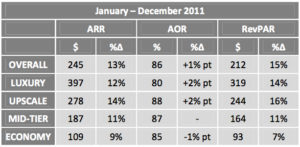
ARR was S$245 in 2011, a year-on-year increase of 13 per cent. Room rates for all hotel tiers increased, with the upscale tier posting the highest growth rate of 14 per cent.

AOR reached 86 per cent in 2011.

Robust performance in ARR and AOR resulted in a 15 per cent growth in RevPAR, which stood at S$212 in 2011. The upscale tier was the top performer in terms of RevPAR growth.

arr-aor-and-revpar-2011
Source: STB