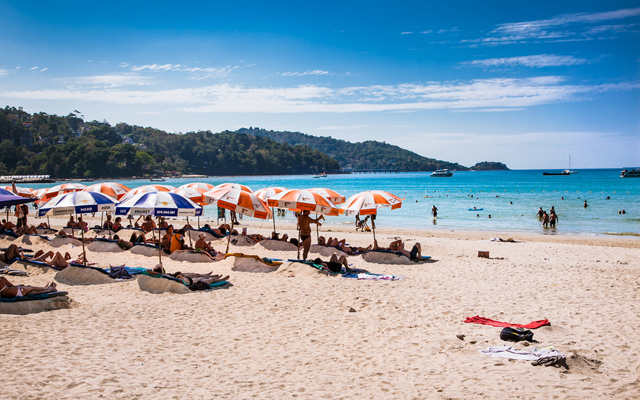
Bolstered by a strong low season and double-digit China growth, arrivals into Phuket hit a historic high of 8.4 million in 2017, growing 11.3 per cent over the previous year, according to C9 Hotelworks’ Phuket Hotel Market Update report.
Demonstrating the destination’s progress towards becoming a year-round destination, C9 revealed passenger arrivals averaged 641,863 per month during the low season last year compared to 759,703 in the high season, closing the gap between high and low seasons.
Phuket now sees more year-round demand
Another key trend is marketwide occupancy was pushed up as 54 per cent of Chinese and 55 per cent of Australians chose to visit Phuket during the May-October low and shoulder seasons.
C9 further shared STR data showing that hotel performance continued to see an uptick in occupancy at 77 per cent last year, although the volume metric pushed the median room rate slightly to 3,740 baht (US$116.20).
C9’s managing director Bill Barnett is quick to point out that island hoteliers need to be pragmatic about the shifting geographic segments. “Phuket International Airport is the de facto entry point for tourists to Khao Lak, which has nearly 9,000 hotel keys in its inventory. Lower-priced accommodation and a large selection of beachfront properties are benefiting from increasing Australian and Chinese numbers in July and August,” he said.
And while arrival growth prevails, the average length of stay is shrinking due to regional Asian market take-up. Moreover, exponential growth in shared economy offerings such as Airbnb are becoming mainstream competitors to hotels.
Barnett further cautioned: “While the recent upgrading of Phuket International Airport and new terminal has been a welcome change, the longterm reality is it’s just a band aid to a macro issue. As Khao Lak continues growing along with the beach areas north of Phuket, the need to diversify Phang Nga’s rising tourism market with its own airport is becoming more and more urgent by the day.”
A new IATA report has revealed adjusted forecasts for airline performance across different regions, such as in Europe, where airlines are benefiting from economic recovery among other factors.
Passenger markets in Asia-Pacific show mixed results, with key factors affecting profitability including continuing new entry in South-east Asia, which has kept profits in the sub-region low; strengthening domestic conditions in China, India and Japan; and a pause in the competitive pressures on longhaul connecting markets from the super-connectors.
IATA has adjusted forecasts for airline performance globally
Airlines in the region are forecast to see profits of US$8.3 billion this year, close to IATA’s June forecast, before growing to US$9 billion in 2018.
Meanwhile, challenges in the Middle East have seen IATA downgrading its 2017 forecast to net profits of US$300 million. IATA estimates the region’s airlines will see a moderate improvement to US$600 million in net profits next year.
Low oil revenues and regional conflict have damaged home markets in the past year or so, while travel restrictions by some governments and competition from new super-connectors restricted growth on international markets. As a result, airlines in the region have scaled back their pace of expansion and business model changes have led to substantial write-offs in the region.
On the contrary in Europe, airlines have benefited from strong economic recovery in home markets, a rebound from terrorism events the previous year, and some consolidation following the failure of some regional airlines. IATA forecasts for the year were upgraded to US$9.8 billion from the June forecast of US$8.6 billion. IATA forecasts further gains going into 2018 leading to net profits of US$11.5 billion and stronger operating margins.
As a result, passenger load factors at 84.3 per cent so far this year are the highest in the industry, which helps both reduce unit costs and support unit revenues. The recovery of the Russian economy in the East of the regions has also helped, while the important North Atlantic market in the West continues to help support profitability, though this market is now attracting increasing new entry – as is expected in an Open Skies market.
Turning to Latin America, airlines are forecast to generate US$700 billion in net profit this year, with further gains in operating margins expected to bring 2018 net profits to US$900 million. Stronger market conditions come from moderate recovery in the Brazilian economy, growth in Mexico and the weak US dollar over the past year. Moreover, airlines have expanded at a significantly slower pace than traffic, leading to much improved utilisation and load factors.
And in Africa, aggregate net losses of US$100 million are expected this year. While improved economic growth are expected for next year, IATA said continued poor load factors will mean that airlines in the region will lose a further US$100 million in 2018.
IATA projects air passenger numbers globally would reach a historical high of over four billion this year, and grow a further 5.6 per cent to 4.3 billion in 2018, on the basis of increased air access, cheaper fares and a strong economy.
Next year the average world citizen is forecast to travel once every 21 months, compared to every 43 months in 2000 and every 50 months in 1996.
Air passenger demand on the up, but rising costs a challenge for airline profits
Airlines have responded to strong demand in 2017 by adding 1,351 new city-pair connections, taking delivery of 1,683 new jets and turboprop aircraft, increasing utilisation of the existing fleet, and raising load factors to record levels, altogether boosting ASKs (Available Seat Kilometres) worldwide by 6.3 per cent.
According to the published schedules for 2018 airlines are planning a further significant boost to capacity of around 5.7 per cent, a pace which is likely to come in below the growth of traffic. Load factors are forecast to rise to a new record of 81.4 per cent as a result.
The biggest profitability challenge to date, IATA said, has come from accelerating costs. Oil prices are taken from market forecasts for 2018 of around US$60 a barrel for Brent crude oil. As crack spreads have been widening, IATA forecasts a gallon of jet fuel will cost US$1.76 in 2018, a 12.5 per cent increase over this year’s expected average.
The impact will vary depending on hedging, with US and Chinese airlines having low average hedges and facing immediate pressures, while in regions like Europe high hedging ratios are delaying the cost impact. This has already led to some convergence of financial performance between regions.
Meanwhile, labour costs are now a larger proportion of a typical airline’s operating costs than fuel and these have been accelerating in 2017, IATA pointed out. Overall unit costs for the industry are hence forecast to accelerate from 1.7 per cent growth this year to 4.3 per cent in 2018.
IATA estimates operating profit margins will slip from 8.3 per cent in 2017 to 8.1 per cent in 2018, as a result of unit costs outpacing unit revenues. However, this margin compression is less intense than it was in 2017
Unit revenues will be helped by the increase in load factors, raised by above-trend growth in travel and cargo together with the lesser pace of capacity expansion shown in the announced schedules for the summer season next year. The other component of unit revenues is yield and this has been rising in both passenger and cargo markets over the past year, in response both to rising costs and increasing demand.
IATA anticipates these conditions will persist in 2018, leading to a further three per cent increase in passenger yields and an overall rise in unit revenues of 3.5 per cent.
More on region-specific performance in tomorrow’s news
India and Poland are signing an MoU for cooperation in civil aviation, according to an India Times report.
The five-year agreement is aimed at bringing the two countries into recognition of the mutual benefits of cooperation, especially in improving regional air connectivity in India.
Enhancing connectivity, information exchange
The deal is also expected to see the two countries acknowledging the benefits of environmental testing and approvals for flight simulators, aircraft maintenance facilities, maintenance personnel and aircrew members.
In addition, the partnership will facilitate an exchange of information and expertise between the countries’ civil aviation authorities, collaboration on conducting training programmes, research and studies.
Nineteen per cent of travellers would rather travel with their smart phones than partners, with 15 per cent of men admitting to using dating apps out of town, among the findings of Hotels.com‘s Mobile Travel Tracker study.
Surveying 9,000 respondents across 30 countries, the Mobile Travel Tracker study highlighted a trend Hotels.com terms “travel bragging”, which has seen many eager to trade travel brags for ‘likes’ .
Travellers “brag” most with food snaps
The average traveller spends 62 minutes a day on social media on holiday, with Facebook (70 per cent) and Instagram (49 per cent) being the social channels of choice for travel bragging to friends at home.
When it comes to what travellers are bragging about on their trips, food snaps (57 per cent) come in tops, followed by photos of landmarks (56 per cent).
The study also revealed that travellers get more anxious when their phone runs out of battery (17 per cent) or when they lose Wi-Fi (eight per cent) than if they argue with their partner on a trip (five per cent).
Sometimes referred to as a generation of filter-loving, hot-headed and often love-drunk youths, 45 per cent of 18- to 29-year-olds surveyed admit they are not afraid to upload a picture with their loved ones on holiday.
The research however points out some gender differences, with women more likely to flaunt having a partner online (42 per cent), while men prefer posting snaps of “serene, drama-free cityscape” (38 per cent), according to Hotels.com.
Hotelbeds buys way to bedbank dominance Hotelbeds Group swoops in on its rival, Kuoni GTA, for an undisclosed price, which together with its recent acquisition of Tourico Holidays, will make it the dominant global B2B bedbanks player.
While the Tourico deal will strengthen its footprint in North America, the GTA buy will give Hotelbeds significant presence in the fast-growing Asia-Pacific and Middle East markets. GTA sells around 40,000 room nights per day online, and these are particularly sourced from fast-growing markets in Asia, the Middle East and Africa.
Hotelbeds Group was bought over from the TUI Group last year by a consortium led by Cinven and Canada Pension Plan Investment Board.
At the time, the new owners emphasised they were keen to consolidate the highly fragmented wholesale accommodation market.
Myanmar safe for travel: local trade
While areas such as Rakhine, Kachin and Northern Shan are off-limits, Myanmar Tourism Marketing circulated a map showing tourist hubs of Yangon, Mandalay, Bagan and Inle Lake within safe parameters.
Mount Popa in Myanmar
Edwin Briels, managing director of Khiri Travel Myanmar, said: “It is impossible to accidentally travel to a restricted area. I think Myanmar continues to be one of the safest places on earth to travel.”
However, an anonymous tour operator, said: “If the situation continues, we will see visitors for this high season drop. Also, travellers might not commit to a Myanmar trip next year in this booking peak.”
More than just honeymooners for Maldives
The Maldives needs to market to tourism segments beyond honeymooners and couples to give arrivals a boost, as the destination faces room oversupply and falling rates, industry players said at the inaugural Travel Trade Maldives show in July.
“Two years ago, a room in a five-star property in Maldives was sold from US$700 with breakfast. Now, five-star room rates start from US$500,” Suresh Dissanayake, corporate general manager – sales & marketing, Adaaran Resorts in the Maldives, said.
He added: “The Maldives should look at organising international sporting events and entertainment events using international celebrities to promote Maldives.”
As well, Haikal Idris, head of business development, Tripfez, suggested that the Maldives could also look at attracting Muslim tourists.
Meanwhile, Asian millennials are driving a boom in budget travel to the Maldives, with the islands located within a three-hour speedboat ride from Malé, the biggest beneficiary of this new market force.
IHG shocks with Asia HQ shift to Europe
InterContinental Hotels Group (IHG) announces the creation of a new mega operating region combining Europe, Middle East, Asia & Africa (EMEAA) based in the UK, effectively relegating the current regional office in Singapore covering AMEA (Asia, Middle East and Africa) to a subdivisional office.
This is the first major move by IHG’s new group CEO, Keith Barr, who rose to the top in July.
Given the challenges of managing Asia from Europe, Robert Williams, partner and head of hotels & hospitality Asia-Pacific, Withers Worldwide, said: “Strong and empowered management on the ground in Asia and a clear mandate for them to execute strategy will be key.”
Choe Peng Sum, CEO, Frasers Hospitality Group, is concerned that this spells to IHG-managed hotel owners a deprioritisation of Asia.
IHG’s Barr however assures that the EMEAA region will operate through strong subregional divisions based in locations including Singapore to keep business “close to hotel owners, guests and colleagues”.
JTB swoops in on Kuoni Travel Services
Hot on the heels of Thomas Cook India’s purchase of Kuoni Global Travel Services’ DMC network in Asia, Australia, the Middle East, Africa and the Americas, JTB Corporation has acquired all shares of Kuoni Global Travel Services for an undisclosed price.
The move is part of JTB Corporation’s ambitions to become a top global DMC, as the partnership is expected to strengthen the inbound business services and increase its market share in Europe. It will also support the expansion and strengthening of the global MICE services in Europe and the US markets, which is complementary to existing JTB MICE business.
Thomas Cook’s acquisition does not include Kuoni Destination Management Europe and Kuoni Destination Management US, which remain in the portfolio of Kuoni Global Travel Services.
Kuoni Global Travel Services said in a statement it will continue efforts to be a neutral land operator to work with many companies other than JTB, paying full attention to the protection of any sensitive information.
Cambodia finally gets tourism marketing body
A central tourism marketing and advertising council has been launched to help Cambodia achieve its target of seven million visitors by 2020.
Tourism minister Thong Khon said the council’s main aim is to promote Cambodia to the international market through campaigns and initiatives, and also encourage the private sector to market and advertise the destination.
Khon added that the tourism industry is a vital economic pillar for the country, with the seven million visitor target translating to an estimated revenue of US$5 billion, and more than one million direct jobs.
A five-year tourism masterplan has also been developed, focusing on the creation of new tourism products and keeping resorts and their surroundings clean.
Other elements include infrastructure development, promoting green resorts, building new roads to reach resorts, and increasing quality and manpower within the sector.
Liquor ban leaves Indian hotels high and dry
A ban on liquor sales at establishments within 500m of state and national highways, effective April 1, has struck a serious blow to India’s hotel industry.
Hotel sources said about 50 per cent of hotels in the country come under the ambit of the ban. This includes the Oberoi Gurgaon, Westin Mumbai, Le Meridien Kochi and Radisson Guwahati, to name a few.
The Federation of Hotel & Restaurant Association of India estimates it would result in the closure of more than 100,000 establishments and a loss to both states and the industry to the tune of 20,000 crore rupees (US$3.2 billion).
The impact on banquet business is expected to be massive. Sudesh Poddar, director, Nataraj Group of Hotels, said half of a hotel’s revenue comes through F&B sales. “We expect that 60-70 per cent of the banqueting business of hotels close to the highways will be gone,” he said.
S M Shervani, managing director of The Shervani Group, foresees many hotels will be forced to close down.
Compared to other generations, millennial travellers from Europe travel most frequently, but also tend to take the shortest trips, a highlight of an Expedia-commissioned study, released in May, which Expedia Thailand is now flaunting to shed light on travel habits from Thailand’s key European feeder markets.
The study considered French, German and British markets, which make up the most European tourists into Thailand, according to Pimpawee Nopakitgumjorn, director of market management at Expedia group.
Gen Z – adventurous beach bums?
While 72 per cent of Gen Z travellers said taking risks and crossing things off their bucket list are imperative, 60 per cent are interested in trips that offer naps on the beach and all-day relaxation.
This could explain the popularity of lesser known beach destinations. In line with this, Expedia data show that Koh Lipe, Rayong and Trat have seen a surge in demand with nearly 50 per cent year-on-year growth. Expedia pointed out that these three destinations grew faster than the mainstream tourist destinations – Bangkok (+40 per cent), Phuket (+15 per cent), Pattaya (+30 per cent) and Chiang Mai (+25 per cent).
Fun-loving millennials interested in beaches
The European Multi-Generational Travel Trends report further revealed that Gen Z travellers, being one of the most budget-conscious, are more likely to start the research and planning process without a set destination in mind.
Nearly 80 per cent of Gen Z respondents said either they did not have a destination in mind or were deciding between two destinations. Compared to other generations, Gen Z use their smartphones more than other devices when they are looking for travel inspiration (63 per cent) and while on their vacation (76 per cent).
Millennials – many short trips on a good deal
Millennials travelled most frequently among other generations (4.3 trips per year), but had the shortest durations of stay (respondents on average stayed 8.5 days on their last trip).
The study also showed that 90 per cent of millennial respondents said they look for the best deals when booking a trip. Expedia data shows that three out of four bookings from German, UK and French travellers were made via travel deals.
In terms of interests, millennial European travellers look for cultural experiences, exploring the outdoors, family trips and romantic getaways. Majority in this group (70 per cent) indicated they are most likely to opt for ‘off the beaten path’ locations and recommendations from locals (70 per cent).
Gen X – family-oriented and cautious
Expedia said Gen X travellers are family-oriented and more likely than other generations to use reviews and information from brands while researching and booking a trip.
Nearly 70 per cent of Gen X travellers said that every vacation is family-oriented and focused on keeping their family entertained and happy, while more than 65 per cent said they prefer to fill their itinerary with museums, historical sites, and arts and culture.
More than 60 per cent said budget was a primary factor on their last trip, but more so than other generations, they prioritised deals or special offers as important considerations when choosing a holiday.
Almost 85 per cent read reviews of places they want to visit before deciding, the multi-generational report found.
Baby Boomers – price a lesser factor
Baby Boomers are a highly valuable group for hoteliers, Expedia surmised, revealing that they not only take the longest trips at 10.5 days per vacation, but are also the least budget-conscious with only 54 per cent citing budget as a factor when planning their last trip.
Trip activities, cultural experiences and feeling pampered during their vacation topped the priority list for Baby Boomers.
Visit California is holding its first-ever California tourism CEO mission to India this month, with the tourism board expecting to see 41 per cent growth in visitors from the market in next five years.
“California already commands 27.5 per cent share of the Indian outbound market to the US, accounting for 319,000 visitors who spent US$706 million in the state. We are projecting US$1 billion in spending from the Indian market by 2021. We also expect numbers from the Indian market to grow with the recent improved airlift from India,” said Caroline Beteta, president & CEO, Visit California.
Visit California will using digital marketing to attract more Indian outbound traffic
Air India commenced flights between San Francisco and New Delhi two years ago and is expected to begin direct flights to Los Angeles in 2018.
To achieve the desired results, the tourism board has increased its investment in the market from US$500,000 to US$800,000 for FY2017/18.
Betata elaborated: “We are developing and strengthening our relationship with the travel trade and adding new promotional layers targeted at consumers. We launched our Facebook page a few weeks back and have already garnered 40,000 followers.”
Visit California was recently in Mumbai, where it did its first global activation of FB Live with a few Indian celebrities and influencers present.
“Digital marketing is going to be our focus. We are working with our industry stakeholders in California to move them along in terms of how do we encourage and incentivise repeat Indian visitations,” she explained.
During the CEO mission, Visit California also signed an MoU with the Producers Guild of India, aiming to bring Indian film shootings to California.
In October, Visit California also launched the California Global Ready India series, which aims to educate travel suppliers on attracting and engaging Indian tourists, the first such undertaking in the US.
“We now see India offering more opportunities than any other market globally. Presently, 35 per cent business in San Diego is meetings and conventions but the Indian market is small. Going forward you will see much more of our promotional and investment in this marketplace to give San Diego and California much more awareness as a destination for all segments,” said Joe Terzi, president & CEO, San Diego Tourism Authority.
The tourism board is leading a delegation of 11 tourism CEOs on the mission, which began in Mumbai before moving to New Delhi.
Destinations worldwide welcomed 901 million international tourist arrivals in the January-August period this year, up seven per cent from the same period of 2016 and marking the eighth consecutive year of continued growth for international tourism, according to preliminary findings from the UNWTO World Tourism Barometer.
Growth in arrivals was strongest in Africa (+nine per cent) and Europe (+eight per cent), followed by Asia-Pacific (+six per cent), the Middle East (+five per cent) and the Americas (+three per cent).
In APAC, South Asia saw fastest growth in international visitors
In Asia-Pacific, South Asia (+10 per cent) led growth, followed by South-east Asia (+eight per cent) and Oceania (+seven per cent), while results in North-east Asia (+three per cent) were rather mixed, the barometer showed.
Europe saw international arrivals rebound in both Southern and Mediterranean Europe (+12 per cent) and Western Europe (+seven per cent) following a weak 2016. Arrivals grew by six per cent in Northern Europe and by four per cent in Central and Eastern Europe between January and August 2017.
Africa recorded the fastest growth of all five regions, thanks to the strong rebound in North Africa (+15 per cent) and the sound results of Sub-Saharan Africa (+five per cent).
Most destinations in the Americas (+three per cent) continued to enjoy positive results, led by South America (+seven per cent), followed by Central America and the Caribbean (both +four per cent). In North America (+two per cent), robust results in Mexico and Canada contrast with a decrease in the US, the region’s largest destination.
Seeing more mixed results is the Middle East (+five per cent), with some destinations strongly recovering from negative growth in previous years, while others reported declines through August.
Turning to the top 10 outbound markets, international tourism expenditure grew fastest in China (+19 per cent), South Korea (+12 per cent), the US (+eight per cent) and Canada (+seven per cent).
Worth noting beyond the top 10 source markets is the significant recovery in demand from Russian (+27 per cent) and Brazil (+35 per cent) after a few years of declines in tourism expenditure abroad.
Australian travel deals company Luxury Escapes has launched its regional headquarters in India, where vast opportunities in the market have prompted heavy investments in optimising its service for mobile.
Mahesh Thota, general manager of the Indian office, shared that prior to the launch, Luxury Escapes already had a strong and growing customer base in the subcontinent. Today the agency has nearly half a million customers in the region, with the number growing by about 30,000 each month.
India regional office a year in the making
Thota added: “When you consider the proximity of amazing destinations like Dubai, Bali, Sri Lanka, Phuket, Maldives, Vietnam, Bangkok, Singapore and Koh Samui, it is clear there is huge untapped potential.”
As the company looks to replicate its results in Australia, where it launched just four years ago, Luxury Escapes’ general manager Blake Hutchison said: “It’s no secret that India leads the world when it comes to accessing the Internet by mobile phones, so we’ve been investing heavily to optimise Luxury Escapes for the mobile experience. Already close to 30 per cent of our sales in this region take place on a mobile phone, and this is increasing month on month.”
Hutchison shared the Indian office has been a year in the making, with the company working to assemble a local team, get the local offering right, and establish relationships with the region’s hotels and resorts.
Thota, for instance, brings with him more than five years of experience at consultancy Accenture, followed by close to five years with Zomato as assistant vice president.
“This past year we’ve spent considerable time getting a deep understanding of what makes the Indian market different to other international regions where Luxury Escapes operates. While much of what we do will remain the same, we have made a number of customisations to match local travel patterns and preferences,” said Hutchison.






 The biggest profitability challenge to date, IATA said, has come from accelerating costs. Oil prices are taken from market forecasts for 2018 of around US$60 a barrel for Brent crude oil. As crack spreads have been widening, IATA forecasts a gallon of jet fuel will cost US$1.76 in 2018, a 12.5 per cent increase over this year’s expected average.



 Hotelbeds Group swoops in on its rival, Kuoni GTA, for an undisclosed price, which together with its recent acquisition of Tourico Holidays, will make it the dominant global B2B bedbanks player.