Asia/Singapore Wednesday, 8th April 2026
Page 367

Air India’s exclusive distribution deal with Travelport draws flak from agents

0

Indian travel agents and associations have taken offence to the recent decision of national carrier Air India to make Travelport its exclusive GDS provider for domestic flight content.

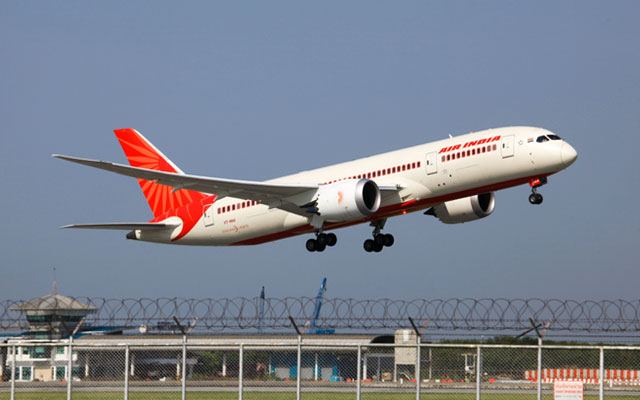
Starting December 4, 2018, Air India has disconnected its domestic inventory from Amadeus and will go on to pull its domestic inventory from other GDSs in 2019 – effectively continuing its inventory distribution with only Travelport.
Travelport wins tender for sole distribution supplier to Air India

A large section of Indian travel consultants polled by TTG Asia opined that the move will alienate the airline from the trade, as Amadeus is the GDS provider with the largest agency market share in the country at 40 per cent.

“Till recently it was easy for a medium-sized agency to offer a gamut of airline options, including Air India, to a client who could then make an informed decision. With this move, agencies like ours with no access to Air India’s choice of GDS will not be able to offer this airline as an option,” said Farah Raina, founder & CEO, Pink Elephant Sport & Pink Elephant Journeys.

“In the short run, due to this move and the resulting confusion, Air India will surely lose a lot of business to its competitors, which are more supportive of small- and medium-sized travel agents,” she added.

In a joint communication to Air India, two major Indian travel agents associations, Travel Agents Federation of India (TAFI) and Travel Agents Association of India (TAAI), expressed strong reservations about the airline’s decision.

“We were informed that Air India had to take this initiative to save on GDS costs, which are high. We explained that GDS cost is not as important as a seat sale. To lose out on the sale of a seat implies huge losses compared to the savings on GDS distribution,” read the communication.

Industry sources further speculate the move could have repercussions on Amadeus’ decision to continue its contract covering international bookings with Air India.

“If Amadeus decides to cancel its contract for international bookings, it will be a major jolt to Air India which is already under financial stress,” said a Chennai-based leading travel agent who wish not to be named.

However, it appears that Air India content is neither available domestically nor internationally.

An Amadeus spokesperson told TTG Asia: “Air India has decided to cancel its distribution agreement with Amadeus. The airline’s content is no longer available on the Amadeus system, in India or internationally. We have presented many options to Air India over recent months in an effort to give it access to the best technology with the broadest network of travel agencies globally and remain open to discussions.”

At press time, Air India was unavailable for comments.

Update: Amadeus has gotten in touch with TTG Asia to clarify that Air India content is not available domestically or internationally.

Myanmar rolls out VOA for Indian nationals

0

India nationals can now enter Myanmar with visa-on-arrival (VOA) at Yangon, Mandalay and Nay Pyi Taw International Airports, as part of the Myanmar government’s move to facilitate easier access for tourists visiting the country.

With VOA, passport holders are not require to obtain pre-arranged approval, and can apply for a visa which will be granted instantly. The fees for the visa on arrival is US$50.

In early October, Chinese nationals from the mainland were also granted VOA into Myanmar, while tourists from Japan, South Korea, Hong Kong and Macau were granted visa-free entry.

The visa relaxation measures were granted in a move to attract more Asian tourism into Myanmar, which this year saw a sharp drop in arrivals from key European markets.

In a statement, Myanmar Tourism Marketing (MTM) reiterated that although 2018 has been a challenging year for the destination, hopes are high that “tourism will bring positive change to this culturally diverse nation”.

May Myat Mon Win, MTM chairperson, commented: “We continue to believe that tourism is a good way to connect people and to bring development and peace all over the country for any race or religion, and we do call to tourists from all over the world to continue visiting Myanmar.”

Cox & Kings serves up Tour to Feast culinary experiences in India

0

Tour to Feast, spearheaded by Cox & Kings, has been launched to introduce travellers to journeys across India’s most popular culinary destinations, with a slice of history.

Each of these journeys is designed and accompanied by experts who will take travellers through the evolution of the indigenous cuisines of each region.

Culinary diversity is one of India’s treasures; an assorted range of Indian dishes pictured

Speaking at the launch, Debolin Sen, head, Tour to Feast, said the tours cover food tasting at bazaars, food walks, home dining experiences, opportunities to “cook like a local” and informative sharing of the origins of cuisine.

Karan Anand, head, relationships, Cox & Kings said: “Each region’s culture can be best introduced through its food. We see a substantial increase in the number of tourists integrating culinary tours as part of their travel experiences. In India, each state has unique flavours, delectable cuisines and stories of bygone eras and their influence on food – the richness of these experiences needs to be presented in a very unique way and through a niche offering like Tour to Feast.”

To begin with, Tour to Feast will offer journeys across the most popular culinary destinations in India like Mumbai, Delhi, Lucknow, Varanasi, Jaipur, Agra and Goa. Travellers can choose from an array of customised culinary holidays.

Tour to Feast itineraries fall under several categories. First, there’s Feast On, for an all-round destination experience including historical monuments, markets, cooking classes and sit-down meals with local chefs.

Cook like a Local is for those who enjoy or want to learn how to cook a region’s cuisine and get a deeper understanding of the produce on offer. Guests opting for this can expect a mix of cooking classes and demonstrations by local chefs and home cooks, market and farm tours, and cocktail workshops.

The third category is Forgotten Worlds with a heritage element. Itineraries will include heritage trails, cooking classes, home-dining experiences featuring forgotten recipes, and dying regional art forms.

Foodscapes takes participants through the various culinary pockets that make up a destination, giving a deeper understanding of the communities. Participants can meet locals and learn quintessential home-style recipes, set out on heritage trails, and enjoy street food walks served with a slice of history.

Finally, there’s Eat Retreat, where guests can slow down and enjoy organic farming activities, spice plantation tours, rustic meals, cooking workshops, and even yoga and meditation sessions.

Vietnam, South Korea rising stars for APAC travellers: Skyscanner

0

While Japan remains the top choice for travellers in Asia-Pacific, South Korea and Vietnam are rising fast as preferred destinations, according to Skyscanner data for eight of the region’s markets.

Regional travel dominates, with London the only destination outside APAC to make Sykscanner’s top 10 list.

Source: Skyscanner’s APAC Travel Trends 2018 report

Skyscanner’s APAC Travel Trends report revealed that Tokyo, Osaka and Okinawa all made the top 10.

In South Korea and Vietnam, the two fastest emerging destinations in the report’s top 10 ranking, Busan, Jeju and Nha Trang show the most growth compared against the major hubs of Seoul and Ho Chi Minh City.

With the Korea Tourism Organisation (KTO) revealing that Japan, Vietnam, and Thailand contribute the highest number of travellers to South Korea, Skyscanner said its data shows significant growth in flight searches from the same markets.

Gyeongbokgung palace in Seoul, South Korea

Vietnam, on the other hand, attracts a different crowd. Skyscanner also observed a trend to The Vietnam Tourism Board figures that show the largest numbers of visitors hail from South Korea, China, Japan and Taiwan.

Turkey showed the largest growth in popularity outside APAC, “most likely due to the market’s cultural attractions, entertainment options and a beneficial exchange rate drawing in visitors”, Skyscanner said.

Meanwhile, APAC demand for business and premium economy seats saw growth of up to 62% and 46% respectively with Skyscanner pointing out that reduced fares have encouraged travellers to book more comfortable seats
and longhaul flights.

Skyscanner also observed mobile use increasing by up to 3.5%.

In APAC, five out of eight markets start their flight search earlier, while also
making bookings closer to departure. With numerous travel sales, promotions and airline deals, decision making is becoming more complex for travellers, Skyscanner said.

The report looks at data from the period of October 2016 to September 2018 and covers eight APAC markets namely Australia, Hong Kong, Japan, New Zealand, Singapore, South Korea, Taiwan and Thailand.

Cybersecurity spend on the up in aviation amid threats

0

Cybersecurity remains high on the agenda and is a spending priority for both airport and airline CIOs, even though faster progress towards implementation of concrete cyber prevention and management initiatives remains a challenge, according to new research released by global IT provider SITA.

The 2018 Air Transport Cybersecurity Insights shows that 89% of airline CIOs plan a major programme around cybersecurity initiatives in the next three years, up from 71% last year.

There is a heightened focus on cybersecurity in the air transport industry

This is even higher for airports, with 95% of them planning major programmes by 2021. Business continuity, through the protection of operational systems and processes, remains the priority for more than half (57%) of airline and airport executives.

As a result of the heightened focus, spend on cybersecurity is increasing year-on-year, reaching US$3.9 billion in 2018.
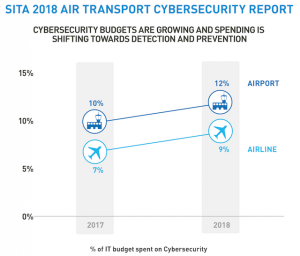
SITA’s research shows that airlines will spend an average of 9% of their overall IT budget on cybersecurity this year, up from 7% in 2017.

Similarly, airport investment in cybersecurity in 2018 is set to rise to 12% of their overall IT budgets in 2018, up from 10% last year.

The research also highlights that many executives are keenly aware that greater strides need to be made to implement proactive cybersecurity measures.

Barbara Dalibard, CEO, SITA, said: “The importance of cybersecurity is well recognised and airlines and airports are investing in building a solid security foundation. However, the number of cyberthreats continues to grow exponentially every year, as does the sophistication of those threats. Given the complexity and integrated nature of the air transport industry, we need to move far quicker in establishing proactive defences to ensure we stay ahead of the game.”

The most common cybersecurity spending priorities among airlines and airports today are; employee awareness and training (76%); achieving regulatory compliance (73%); and identity and access management (63%).

However, SITA’s insights identified several focus areas that need more attention over the next few years. These include proactive network monitoring and protection, securing the extended enterprise (Cloud, IoT) and protection from internal threats such as data leaks.

SITA’s research also indicates more can be done to raise the importance of cybersecurity. Today only 41% of respondents capture cybersecurity as part of a global risk register, while a further 42% of respondents plan to include cyber risk in their registers by 2021. Only 31% of the responding organisations have a dedicated chief information security officer, which is seen as crucial to ensure visibility of cybersecurity at executive level and effective implementation. Proactive monitoring through a security operations centre is also a core topic for many respondents with the majority having plans to quickly implement such services.


The biggest barrier to implementation is a lack of resources which affects 78% of air transport industry organisations. Another significant challenge executives face is the retention and recruitment of specialised skilled staff (47%) and the capacity for staff training (56%).

Solo travel more popular among Thais: Visa

0

Over a quarter of Thais (28%) have travelled overseas solo in the past two years, ahead of the global (24%) and Asia-Pacific (23%) averages, according to Visa’s Global Travel Intentions Study looking at international travel trends and behaviour of 17,500 global travellers from 27 countries including Thailand.

The study further identified those most likely to travel solo are the youngest group of travellers (18-24 years old) at 45%, and those combining business and leisure travel or bleisure travellers at 37%. Travellers aged between 25-35 years old and affluent travellers round out the group that is most likely to travel solo at 28% likelihood each.

Thais aged 18 to 24 years old most likely to travel solo, study finds

On the flip side, travellers aged 36-44 years old are the most likely to travel with other people throughout the entire trip at 71%.

When travelling with companions, bigger groups are common, and a group will typically comprise up to five people on average. Those travelling with others are most likely to be accompanied by their spouses/partners (49%) or friends/colleagues (42%). Travellers aged 45 years old and above (72%) are more likely to travel with their family and friends throughout the whole trip.

When it comes to travel activities, travellers from Thailand differ from their Asia-Pacific counterparts. The top three activities for Thai travellers are tours and attractions (71%), food and dining (69%), and shopping (68%). When it comes to food and dining, Thai travellers opt for eating at local casual and small restaurants (39%) and tasting street food (30%).

In addition, some of the key activities Thai travellers engage in are visits to cultural locales (52%), visits to theme parks and attractions (34%), and religious monuments (29%). Shopping for Thai travellers is all about venues that carry a range of brands and products, at duty-free shopping at destination airports (34%), at large and medium retailers (33%), and small retailers (30%).

On the other hand, top activities for Asia-Pacific travellers are food and dining (73%), shopping (69%), and tours and attractions (64%).

Asia’s second-tier cities on the rise as new go-to destinations

0

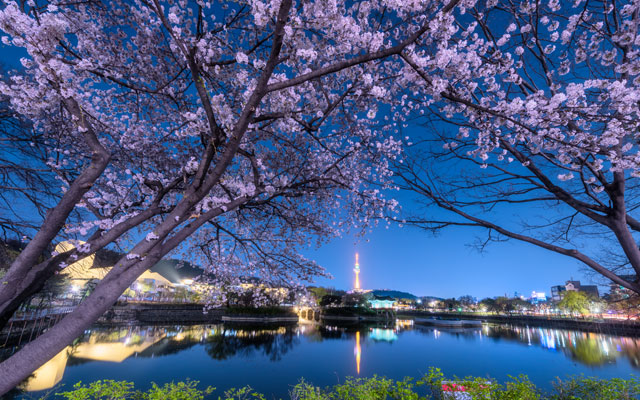
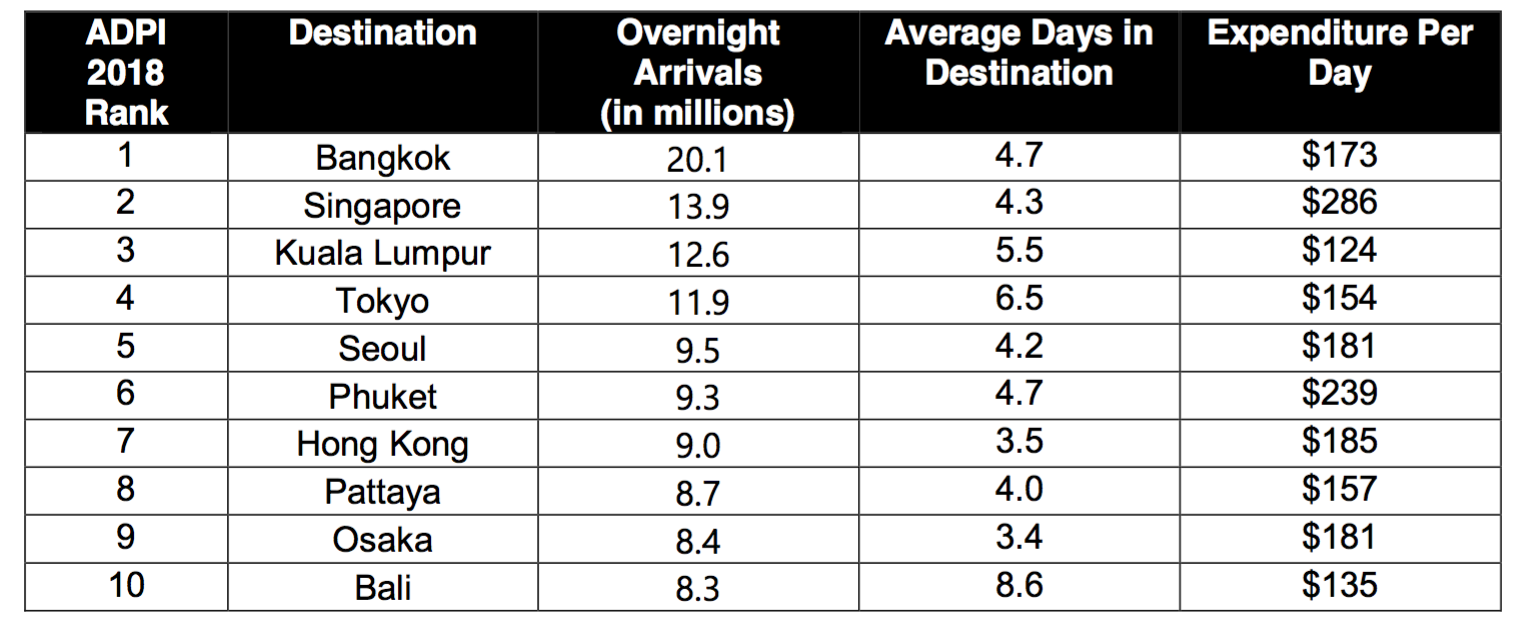
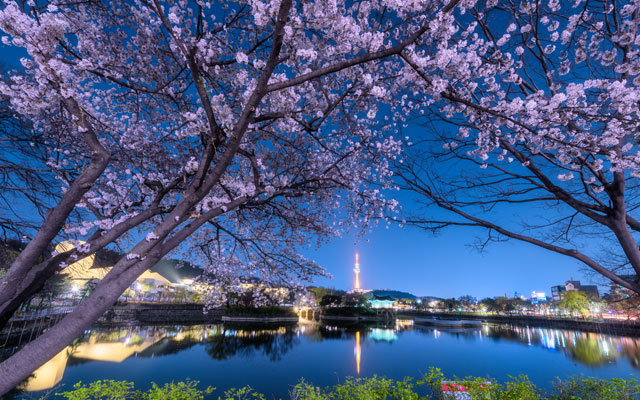
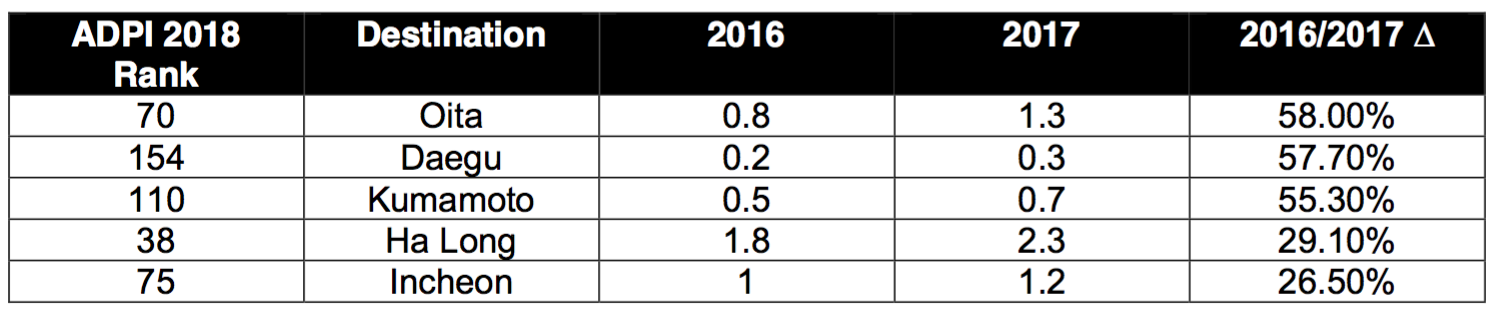
The traditional favourites of Bangkok, Singapore and Kuala Lumpur continue to dominate the list of Asia’s top 10 tourist destinations, based on findings from the Mastercard Asia Pacific Destinations Index (APDI) 2018, but travellers are increasingly seeking new and more off-the beaten track destinations such as Oita in Japan, Daegu in South Korea and Halong in Vietnam.

Secondary cities like Daegu (pictured) in South Korea are seeing more visitor arrivals

In 2017, the 160 Asia-Pacific destinations analysed in the APDI grew by 5.6% in international overnight tourist arrivals over 2016 and generated 333 million international overnight arrivals, with Bangkok retaining the top spot.

In particular, smaller tourist cities across the region are seeing a higher growth of international overnight arrivals for 2017 than their bigger city siblings. This is partly driven by travellers’ desire to visit destinations that are more unique and offer a more enriching cultural experience, the report added.
While these second-tier cities could become Asia’s next tourist hubs, Mastercard advises that strategic investment in travel infrastructure made to achieving and sustaining the rapid growth in inbound tourism, including the strategic development of basic infrastructure such as airports to public transport, cleaning up public spaces and ensuring access to clean water.
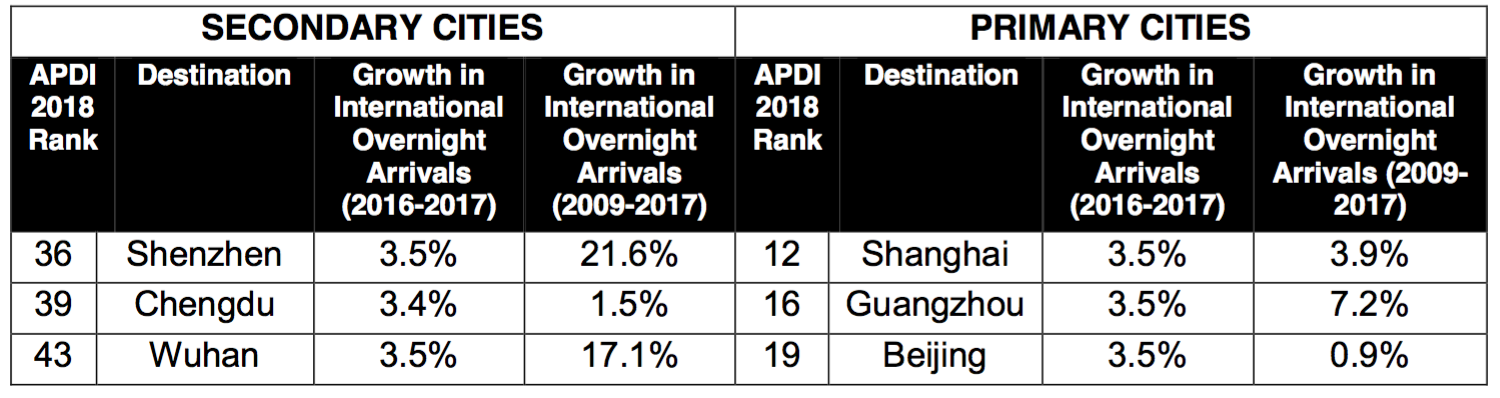
Notably, China stood out as the only country where its secondary cities are growing at a much faster rate than its primary cities. The findings revealed that the compound annual growth rate of visitor arrivals from 2009 to 2017 was more than double in China’s secondary cities (9.0 %) versus its primary cities (3.9 %).

The index also showed that tourists are increasingly visiting secondary cities in China, with tourist arrivals in Shenzhen, Chengdu and Wuhan growing faster than in popular destinations such as Shanghai, Guangzhou and Beijing.

Interestingly, in the last eight years (2009 – 2017), the average daily expenditure across Asia-Pacific destinations has increased by approximately 10% from US$135 to US$148, while the average length of stay has decreased by approximately 11% from 5.94 to 5.35 days.
This means on average tourists are staying for a shorter period of time but spending more on their trips. Cities will be able to channel additional tourist dollars earned into infrastructure investment for growth and development, the report added.

Tourism, aviation ties enhanced with Indian president’s first Vietnam visit

0

On a three-day visit to Vietnam, Indian president Ram Nath Kovind identified tourism and civil aviation as sectors that the two countries can build on together, alongside financial services, IT and the digital economy and more.

Speaking at the Vietnam-India Business Forum in the Vietnamese capital, the president pointed to the country’s historical friendly relations, and stressed that trade is a driving force of their diplomatic ties today.

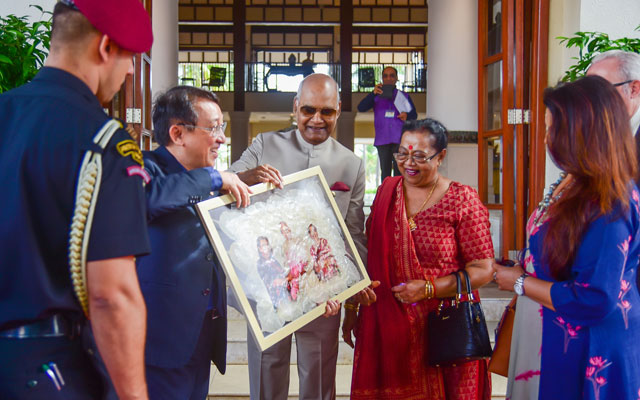
Furama Resort Danang’s board presented the Indian president with a photo of him and his family on 30 Indian Bodhi leaves from a tree in Danang

In the past eight years, there has been an almost four-fold increase in bilateral trade, from US$3.7 billion in 2010 to US$12.8 billion in 2017. With both Vietnam and India on a path of high growth, this trend is expected to continue.

The president added the Vietnam-India business relationship presents prospects for engagement in financial services, IT and the digital economy, hydrocarbons, defence, renewable energy, mining, healthcare, tourism and civil aviation, among other sectors.

The president and his spouse started their official visit at the Furama International Convention Palace.

He was welcomed by secretary of the party committee of Danang city Truong Quang Nghia and met with general secretary of the Communist Party of Vietnam Central Committee and president Nguyen Phu Trong, and separately with National Assembly chairwoman Nguyen Thi Kim Ngan and prime minister Nguyen Xuan Phuc.

The president also visited Danang Cham Museum, My Son world cultural heritage in the central province of Quang Nam.

This was his first state visit to Vietnam, and also his first trip to South-east Asia since he took office in July 2017.

Growing Muslim travel market shows preference for city breaks, shopping

0

City breaks and shopping are more popular with the world’s fast growing Muslim travel market than beach holidays and museum visits are, according to an IPK International study commissioned by ITB Berlin as part of the World Travel Monitor.

High growth of Muslims travelling abroad
The report identified “the most interesting source markets” when it comes to Muslim travel demand are Indonesia, India, Turkey, Malaysia and the Arab countries.

Source markets with a predominantly Islamic population showed growth rates that were 40% higher in the past five years, compared to the rest of the world.

Muslims are the world’s fastest-growing religious group and by 2030 will make up an estimated 25% of the world’s population.

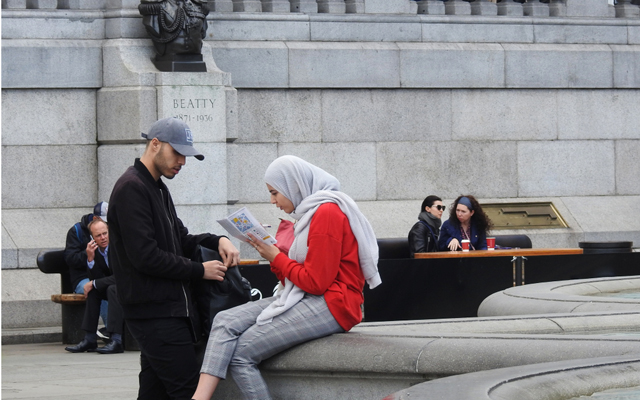
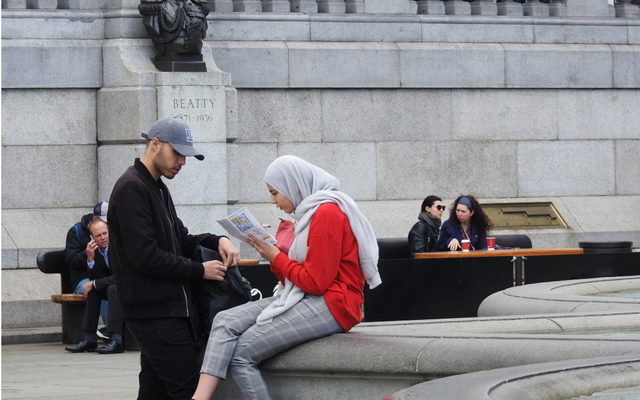
More of the tourists surveyed prefer city breaks than beach holidays; pictured, tourists in London

City breaks top the list
While city breaks and sun and beach trips are the most popular holiday types, the Muslim travel market presents a different picture, the report said.

For the segment, city breaks top the list with a market share of over one-third, followed by tour holidays and sun and beach holidays.

In general, the report said that holidays are less important for Muslim travellers, who take more trips for business, visiting friends and relatives, and other leisure reasons.

Religious trips and pilgrimages in particular play a much greater role and make up 10% of foreign trips – 10 times higher compared to the rest of the world.

More shopping, less sightseeing
Apart from preferring other types of holidays, Muslims also tend to pursue different activities when travelling, according to the study.

Whenever they visit cities, shopping is on top of the list. In contrast, sightseeing – the number one attraction for other travellers – visiting museums or seeking out good food is less important for this segment.

Also, tour holidays are shaped differently with less focus on sightseeing or museum visits and more focus on nature and shopping instead.

Germany the most popular destination in Europe
For Muslims traveling abroad, the UAE is the most popular destination worldwide. Germany comes second, followed by Saudi Arabia, Malaysia and Singapore.

Looking at each continent, over 60% of trips abroad by Muslims go to Asia (including the Middle East) and around one-third to Europe. By comparison, trips to Africa, North and South America only have a very small share of the market.

Young and highly educated
Measured against all other international travellers worldwide the percentage of female travellers from Islamic countries is below average. However, in recent years their numbers have increased steadily.

The study also revealed that Muslim travellers are much younger than average, with 75% aged between 25 and 44.

In terms of education, there is a larger share of those with high education levels.

The World Travel Monitor is based on the results of representative interviews with more than 500,000 people in over 60 global travel markets.

India mulls ways to boost disappointing Chinese arrivals

0

As current inbound arrival figures from China remain dismal, India’s Ministry of Tourism is stepping up its efforts to woo the Chinese market, including the relaunch of a tourism office and promotional videos in China.

“The current visitor arrivals from China to India are not satisfactory,” said KJ Alphons, India’s tourism minister. “Our aim is to attract 10 per cent of 144 million Chinese (outbound) tourists in the next five years.”

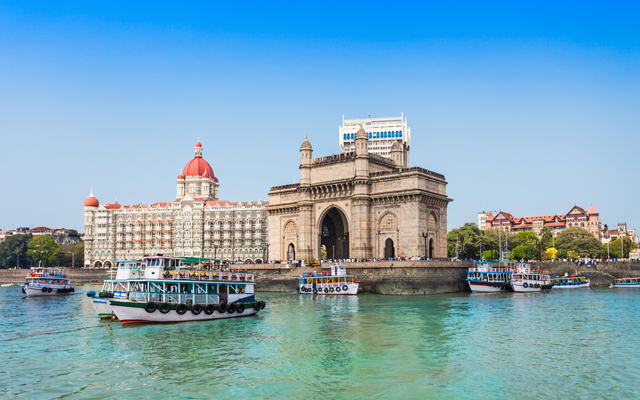
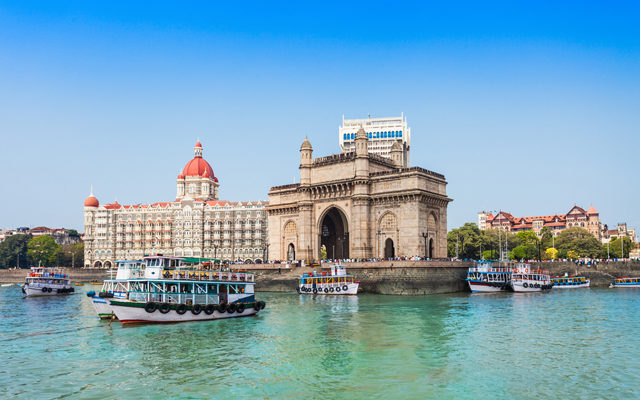
Gateway of India as seen from the Mumbai Harbour

The Ministry of Tourism has recently relaunched an India tourism office in Beijing that closed previously in 2016, in addition to organising a multi-city roadshow covering Beijing, Wuhan and Shanghai earlier this year.

A series of promotional videos has been shot in Mandarin to promote segments including wildlife, Ayurvada and luxury travel, while there are plans to host Chinese bloggers and journalists for a fam trip next year.

“We are also looking at ways to upgrade our tourism infrastructure in Buddhist sites including wayside amenities and a six-lane highway. We will also introduce theme-based marketing and promotional campaigns in the China,” said Alphons.

However, some tour operators remarked that much has to be done if India has to attract significantly more Chinese tourists, of which only 240,000 visited India last year.

“India is yet to become an aspirational tourist destination in the minds of Chinese tourists.There is a need for theme-based marketing campaigns to attract Chinese leisure travellers, whose numbers are far less than business travellers,” said Arun Anand, managing director, Midtown Travels.

The lack of Mandarin-speaking guides is another major bottleneck faced by Indian tour operators, Ravi Gosain, managing director, Erco Travels, pointed out.

“The Ministry of Tourism needs to look at ways to train guides in Mandarin,” said Gosain. “There is a lot of competition from shorthaul destinations like Thailand and Hong Kong and longhaul destinations like Australia and Europe in attracting Chinese tourists.”