Asia/Singapore Wednesday, 8th April 2026
Page 364

Cambodia-American deportees reconnect with motherland through new tours

0

A tour group is aiming to showcase Cambodia in a different light while highlighting the plight of deported Cambodian-Americans.

The seed for Zin Adventures was planted in April 2018 when its core founders decided to form a social enterprise to offer employment and support to their peers. The five men are a fraction of the more than 700 Cambodian-Americans who have been sent to Cambodia since 2002.

The majority have never set foot on Cambodian soil, born in refugee camps that dotted the Thai border after their families fled the brutality of the Khmer Rouge, under which almost a quarter of the population died between 1975 to 1979. In the 1980s, the US started accepting refugees, numbering over 178,000 arrivals. Many families were placed into under-privileged neighbourhoods where turf wars were rife. Growing up, children turned to gangs for survival.

Although refugees were given legal permanent residence, they did not automatically receive citizenship. In 2002, America and Cambodia signed a law that saw non-citizens who commit a crime, including minor offences, deported after serving jail time – in many cases, several years later. Today, about 1,800 people in the US are waiting to be exiled to Cambodia.

Having managed to turn tragedy into a second chance with the financial backing of two business people in Cambodia, the team – Buck Billy, Bobby Orn, Bunthoeun Ly, Khan Hin and Jimmy Hiem – hope through Zin they can do the same for others.

They plan to recruit and train up to 20 employees from their community, as well as an additional 20 locals, and expand their itineraries across the country.

Currently, they have developed a one-day tour – which can be extended to three – to Kirirom and a 90-minute walking tour through the capital’s Old European Quarter, followed by an optional boat tour with a Khmer dance class from members of award-winning Sophiline Arts Ensemble.
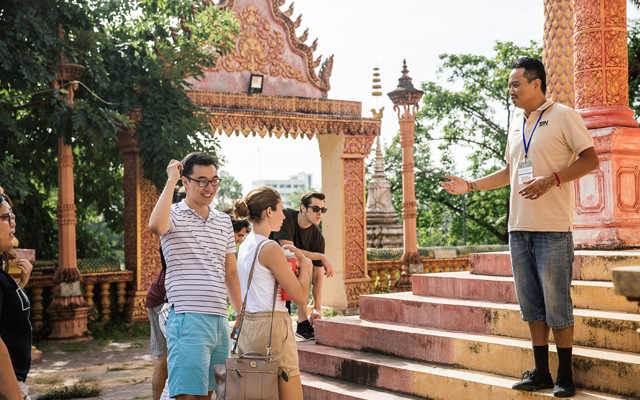
The team has spent almost a year carrying out extensive research to seek out hidden relics, spots and stories that cannot be found in the guidebooks. Months were spent trawling online resources, newspapers and books, carrying out site visits and extensively interviewing locals.

The route starts in Phnom Penh and goes on to Kirirom – a national park about 2.5 hours from the capital.

Zin also recently teamed up with bike tour operator Grasshopper Adventures to offer trips through Kirirom National Park.

Through the Gold Luck City tour, an itinerary has been curated to capture fading parts of the city’s more prosperous past. These include an ancient colonial church, a former Chinese assembly hall and a striking Chinese Hokkien temple.

To date, Zin has met with about 15 tourism companies, ranging from small travel businesses to large tour operators, with “much interest” shown in the Good Lucky City Tour.

Plans going forward include attracting more travellers from the US, as well as creating memorials and naming projects after relatives who made the refugee exodus and victims of the war and genocide.

Said Bobby, 44, who was deported in 2011: “We want to show the others when they arrive here that life isn’t over and there is hope, while showing some special places in Cambodia to visitors.”
F&B contributes nearly half of Indian hotel revenue: new study

0

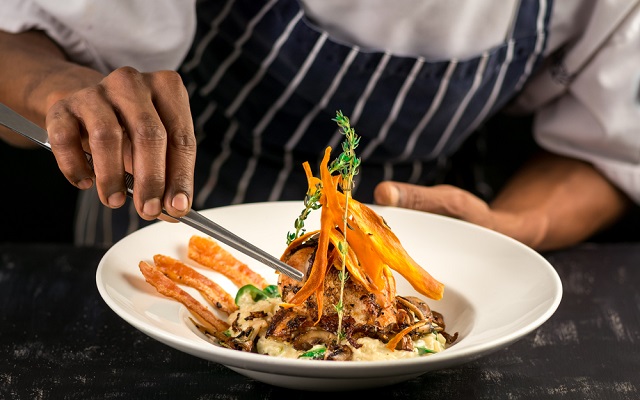
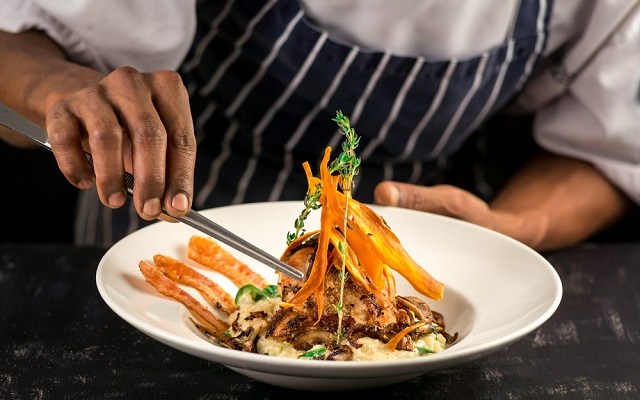
India’s hotels are heavily dependent on F&B as a revenue generator, and have a significant opportunity to boost foreign and leisure demand, according to findings from the 21st edition of the Federation of Hotel & Restaurant Associations of India (FHRAI) survey report.

The report, produced by STR and Horwath HTL, is based on survey responses from 475 hotels comprising 36,029 hotel rooms for the 2017-18 financial year.

F&B and banquet operations constituted 42.3% of Indian hotel revenue, survey shows

“Overall, hotel performance in India is thriving with India’s macros, which have been intact and looking up all through the year,” said Vidhi Godiawala, STR’s business development manager, Central & South Asia. “The hotel industry is riding on the back of the country’s resilient growth story with demand seen picking up from domestic travellers. With more disposable income and a rising middle class, Indians are travelling now more than ever before. And this reflects not just in the report’s KPI findings, but also the impact of F&B consumption as an overall contributor to hotels revenues.”

The report revealed that F&B and banquet operations contributed 42.3% of hotel revenue. Interestingly, revenue contribution from F&B outlets increased for the four-star and lower category hotels. This appears to be a contradiction to the expectation of lower-tier hotels being more select/limited service in character combined with lower rates. On the other hand, these figures reflect the F&B revenue potential in markets outside of the cities.

Revenue from F&B outlets made up 37.8% of total revenue in hotels with up to 50 rooms. This is higher than the total F&B contribution (outlets plus banquets) at hotels of larger size. Together with banquets, hotels with up to 50 rooms gain half of their revenue from F&B operations, the report showed.

Foreign guests represent only 22.8% of total hotel business. Goa and Mumbai are just past the 30% mark in terms of share of foreign guests. In Delhi, the number is higher, but still below 40%.

Also reflecting opportunity for development, the leisure segment currently represents just 41.5% of the country’s overall demand.

Supply increases in recent years have led to lower average daily rate (ADR). Specifically, ADR for five-star, deluxe hotels was below Rp9,500 (US$134), while five-star and four-star hotels reported ADR of Rp5,700 and Rp4,100, respectively.

These figures reflect India as a very affordable destination, although tourism numbers have not grown in a commensurate manner.

RevPAR for chain-affiliated hotels is 2.09 times the RevPAR for independent hotels.

Gross operating profit levels for 2017-18 remained comparable with 2016-17, but EBITDA margins are lower on account of higher management fees and other fixed charges, which is representative of a larger sample of branded management and franchise properties in the 2017-18 report.

Thomas Cook India to buy imaging solutions provider for attractions

0

Thomas Cook India Group is acquiring a 51 per cent stake in Digiphoto Entertainment Imaging (DEI), an imaging solutions and services provider, at an enterprise value of US$40.6 million.

The acquisition marks Thomas Cook India Group’s entry into an adjacent sector, complementary to its travel & travel related services portfolio.

Madhavan Menon, chairman and managing director, Thomas Cook (India), said: “Our acquisition of DEI, a global imaging solutions and services giant, presents the Thomas Cook India Group an opportunity to participate in an exciting new business space, adjacent to our core travel services portfolio that is both PAT and free cash accretive from day one.”

Elaborating on common markets and synergies, he said: “We see an immediate opportunity for our outbound customers from India and Hong Kong, as well as our inbound and DMS customers across our global network. With the growing demand for experiential travel and social sharing, DEI’s partnerships with attractions, theme parks, water parks and resorts will further enhance our travel services portfolio in line with our philosophy of creating long-term shareholder value.”

Established in 2004, Dubai-based DEI is a technology driven company with offices in Hong Kong, Singapore, Dubai, Mumbai, Orlando and Kuala Lumpur. DEI focuses on imaging solutions for the attractions industry with an end-to-end turnkey model providing equipment, software, talent and operational expertise consultation to partners.

With a network of over 120 partners, DEI is present at more than 250 venues across over 14 countries (Hong Kong, Singapore, the UAE, Macau, China, the US, Malaysia, Thailand, Indonesia, Mauritius, the Maldives, Egypt, India and Kuwait), and completed 3.6 million transactions in 2018.

The strategic location of its regional headquarters in Singapore since 2012 has enabled DEI to successfully securing the majority share of imaging partnerships in Singapore, including the Wildlife Reserves Singapore, One Faber Group and Marina Bay Sands.

DEI is aggressively expanding its presence into Greater China, including Hong Kong, and its proprietary imaging solution has enabled payment gateway localisation for the local Chinese market expanding into AliPay and WeChat Pay.

Their local hosting and content distribution allows guests to share memories on Chinese social media channels like WeChat, Sina Weibo, QQ and Qzone. DEI intend to focus on rapid growth over the preceding years in this Far East belt.

KS Ramakrishnan, founder CEO and president of DEI, said: “DEI is leading the digital transformation of the guest photo journey through NFC, facial recognition and other state of the art proprietary technology enabling the guest to receive and share their memories in real time.”

Germans take off for Asia this Easter

0

Hong Kong and China are winning intercontinental destinations for Germans for Easter this year.

According to ForwardKeys, intercontinental bookings from Germany are currently up 2.7% for the Easter holiday period compared to last year.

Figures show a 31.4% jump for Hong Kong bookings, and China 30.9%. Other favoured destinations are the US, ahead 20.6%, and Morocco, ahead 20.0%.

Thailand is the top performer for German bookings to Asia

While Thailand is not quite showing the strongest growth, it seems to be the top performer; as over 40% of all German Internet flight searches for travel to Asia include Thailand.

This summer, the Asia-Pacific region will benefit most from increased intercontinental scheduled seat capacity from Germany. Between May and October, it’s up 4.1% for the region, which has a 5% market share. The total international capacity increase from Germany is 0.7% on last year.

Capacity of flights to other European destinations, with an 82% market share, is up 0.4%.

Intercontinental destinations with the largest growth in scheduled flight capacity from Germany between May and October are Qatar (up 18.2%), Thailand (up 12.9%) and Hong Kong (up 10.0%).

The collapse of the German holiday airline, Germania, earlier this month, has had an impact on some destinations, but others are proving to be resilient.

Among those once served by Germania, but still showing capacity growth for this summer, are Serbia (up 5.9%), Egypt (0.2%) and Turkey (7.3%).

Olivier Ponti, vice president, insights, ForwardKeys, commented:“Despite very serious turbulence in the German airline industry, it’s encouraging to see air capacity still growing overall, particularly as capacity increases are a sign of economic confidence. Over the Easter holidays, Hong Kong and China look set to do particularly well from German visitors.”

India looks to SE Asia for tourism growth

0

To boost its tourism numbers, India is reaching out to South-east Asia with more unique tours and experiences.

In 2018, the country welcomed 15.5 million foreign tourists, who contributed some 30 per cent to the country’s total tourism revenue of US$234 billion.

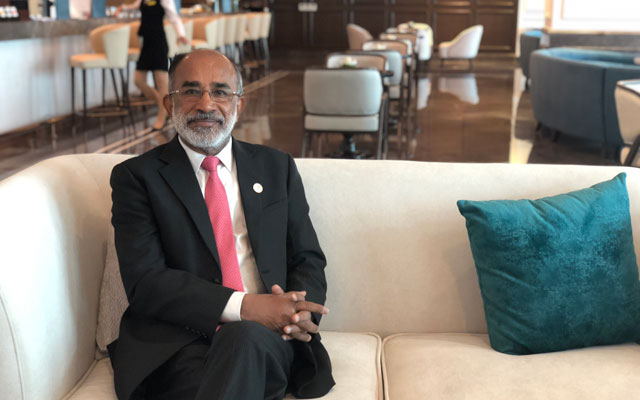
Still, minister of state (IC) for Tourism India, KJ Alphons, expressed the desire to see these numbers rise “dramatically higher”.

Alphons: more dramatic growth from SE Asia markets

He told TTG Asia: “ASEAN is an extremely important group of countries. Our prime minister said our first priority in international relations is to look east. Working very closely with ASEAN countries is very much part of our prime minister’s plan.”

Tourism India hopes to push the country’s large variety of natural landscapes, including 70 per cent of the Himalayas and wildlife sanctuaries, as well as its culinary and heritage offerings.

Tour agencies are also hedging their bets on such lesser-known attractions to draw travellers from across Asia. Sumit Mathur, director (sales & marketing), Top Travel & Tours, said: “We receive business from all Asian countries, and from what we have seen in the past few years, the market has developed and evolved a lot.

“Travellers – especially from a hub like Singapore – want something that’s beyond the traditional tours. We used to have Golden Triangle tours and visits to places like Kashmir, but this is not happening so often these days.”

Instead, an emerging destination is northern India, where travellers are flocking to for winter sports and its cool summer, when tourists can embark on motorcycle tours, said Mathur.

For now, India’s limited air connectivity remains its main barrier to growth, with a runner-up being the lack of “quality infrastructure”, especially compared to its neighbours in South-east Asia, admitted Alphons.

He shared: “Our infrastructure is not exactly world-class. Now, we’re building six-lane roads, convention centres and airports. All these are being put in place in the last four years, but of course, we need to take it much further.”

Also on the agenda is raising awareness of the country’s identity and tourism offerings across the world, remarked Alphons.

He said: “I’m happy to cooperate with the ASEAN countries so that people can see India and our people, and know that it is an incredible place, beyond just the Taj Mahal.”

Sherrilyn Charles now DOSM of Sheraton Grand Danang Resort

0

Sheraton Grand Danang Resort has appointed Sherrilyn Charles as director of sales and marketing.

She comes to the Vietnam resort from Samoa, where she was the complex director of sales and marketing for two connected Sheraton properties.

The industry veteran brings two decades of experience in the industry, gained from years of working in the Europe/Middle East/Africa regions.

The Caribbean native’s first position upon graduation was with Hilton Hotels in the Netherlands in sales. She grew her career in sales and marketing, taking on roles with progressive levels of responsibility at hotels and resorts in the EAME, Pacific and South-east Asia regions.

Charles then joined Starwood in 2008 where she served as international business development manager.

Taiwan steps up incentive push into India’s outbound market

0

The Taiwan Tourism Bureau (TTB) is working to promote Taiwan as a top-of-mind destination to incentive groups from India, as part of its overall aim to grow the Indian inbound market by 20 per cent by 2020.

“Taiwan and India have a close business relationship in fields like IT and technology. We want to promote Taiwan as an incentive destination among Indian businesses. Previously, we received an incentive group of 200 pax from India’s TATA group,” said Trust Lin, director, TTB Singapore Branch.

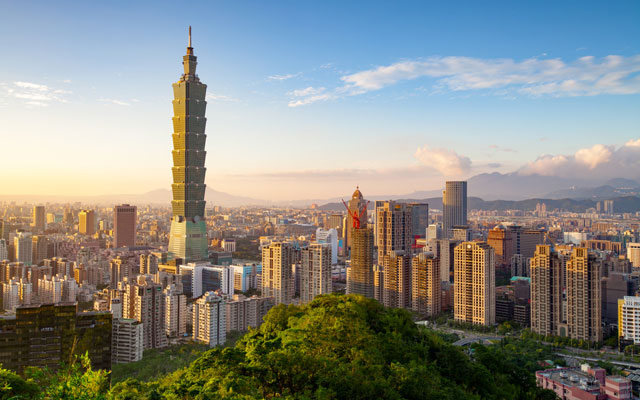
The country’s tourism bureau hopes to attract more Indian incentive groups; Taipei pictured

To lure incentive groups, TTB is promising help in the form of monetary offset, as well as its willingness to collaborate with private stakeholders, in a bid to “project Taiwan as a new incentive destination” to Indians.

“If one is handling a group of more than 50 pax staying in Taiwan for more than three nights, they qualify (for an incentive of) US$26 per pax. In addition, we can cooperate with PCOs for joint marketing,” revealed Lin.

This is part of Taiwan’s New Southbound Policy, which focuses on 18 international markets such as India, Australia, Singapore, Thailand, Malaysia and Vietnam. In total, these markets are 25 per cent of all overall international arrivals to Taiwan.

Among these countries, India holds the most potential for growth coming from its low base of 38,000 arrivals, Lin pointed out.

As such, the Taiwan External Trade Development Council has taken steps to court Indian outbound travellers by organising a Taiwan Expo in New Delhi for the first time last year. The expo was a key event aimed at enhancing economic and trade cooperation between the two countries.

Furthermore, TTB believes that growth in the Indian incentive market, apart from helping to increase overall tourist arrivals, will eventually result in more direct flights between the two countries. Currently, there is only a thrice-weekly service linking New Delhi and Taipei by China Airlines.

“We want to have direct flights from other Indian cities like Mumbai as well. However, the current traffic is restricting airlines to operate direct connections,” Lin lamented. “If segments like incentive travel can grow significantly from India, it will be a stronger case for more direct connections.”

The growing interest in courting the Indian market comes at a time as tourist arrivals from Mainland China – Taiwan’s traditional main source market – continues to dwindle.

In India, Uttarakhand revs up efforts to lure more international arrivals

0

A recently unveiled state tourism policy, coupled with the hosting of PATA Adventure Travel And Responsible Tourism Conference And Mart 2019 in Rishikesh last week, are expected to be stepping stones in attracting more international tourists to the northern Indian state of Uttarakhand.

The new tourism policy, which was released at the end of last year, came 17 years since Uttarakhand’s first tourism policy was released in 2001. The policy accorded industry status to the sector, which opened up incentives for investors, and focused on new segments and products such as adventure tourism and homestays. The new policy also aims to develop one new tourism destination in each of its 13 districts.

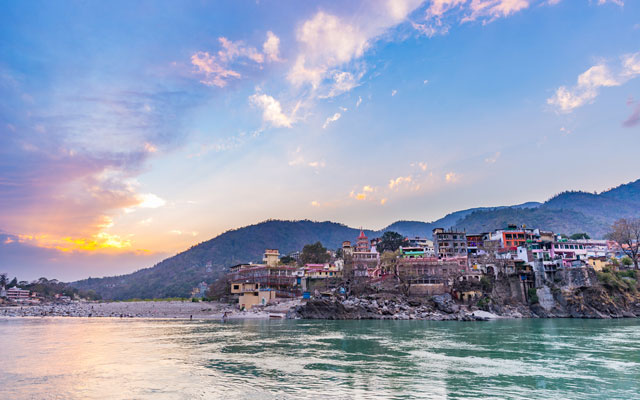
Rishikesh at dusk

“We have different products to offer to international markets but at present we are confined to yoga, wellness, high-altitude mountaineering and wildlife. New segments like adventure travel will be promoted,” said Dilip Jawalkar, secretary, tourism, religious affairs and culture department, government of Uttarakhand.

“We are also looking to host more international events in the future (like the PATA conference) so that so that local stakeholders know about best international practices,” he added. “Also, considering that we have ecological fragile areas, the focus is on increasing international arrivals in a sustainable way.”

Welcoming the proactive efforts that the state government have rolled out in recent time to promote tourism, Ravi Gosain, president, Uttarakhand Tourism Professionals Association, shared: “Interest from markets like France, Spain and Italy is picking up. The focus on homestays in the new tourism policy will help target international travellers interested in experiencing local culture. Events like PATA will also offer a global exposure to the destination and help in increasing inbound numbers.”

Rishikesh’s inbound arrivals are already mostly international, but there are a number of other destinations in the state that if can draw more international tourists with greater promotion, noted Anil Gusain, head, sales & marketing, Divine Resort & Spa Rishikesh.

In 2018, Uttarakhand received 120,000 international visitors, a growth of 20 per cent over the previous year. Key international tourist markets for the state include the US, Europe, Israel, Latin American and Central Asian markets.

International tour operators, such as Tom Parsley, personal travel consultant of UK-based Hays Travel, who attended the PATA event in Rishikesh, are already taking note of Uttarakhand’s emerging prominence for foreign visitors.

“Uttarakhand is a new, unheard of and diverse tourist destination. If infrastructure can be developed for easy access helping tourists to reach different points easily, it can become popular in overseas markets. Enough information on various tourism products and experiences available in the state should be made available to foreign tour operators,” Parsley said.

India raises adventure tourism profile but perceived cultural destination image lingers

0

Recent efforts by India’s Ministry of Tourism and state tourism boards to promote adventure tourism are expected to drive more international arrivals and promote the country as a destination for adventure holidays and activities.

Last year saw India making a visible push into the adventure tourism arena, with the Indian Ministry of Tourism declaring 2018 as the Year of Adventure Tourism while the state of Madhya Pradesh became the first destination in Asia to host Adventure Next in Bhopal in association with US-based Adventure Travel Trade Association (ATTA).

View from Nag Tibba basecamp, the highest peak in the lesser Himalayan region of Garhwal, Dehradun, Uttarakhand

Indian states like Uttarakhand, a state in northern India crossed by the Himalayas and which is better known for its Hindu pilgrimage sites and yoga offerings, are opening up to adventure tourism.

Uttarakhand is currently hosting PATA Adventure Travel And Responsible Tourism Conference & Mart in Rishikesh between February 13-15.

Dilip Jawalkar, secretary, tourism, religious affairs and culture department, government of Uttarakhand, commented: “Traditionally, we have been seeing demand from international markets for spiritual and wellness tourism. Adventure is a new segment for us and we want to promote destinations like Rishikesh and Auli for adventure activities.”

With the attention these recent trade events have brought to a previously under-tapped segment, travel operators and buyers alike are finally starting to realise the potential of India as a destination for adventure tourism.

Tom Parsley, personal travel consultant of Hays Travel, a UK buyer attending the PATA event in Rishikesh, expects the efforts of the Indian government and trade adventure tourism stakeholders will reap benefits in future.

“As an adventure destination, India is a new market for UK and in the past we have done tours of Golden Triangle and big monuments,” Parsely told TTG Asia. “Adventure is one of the fastest-growing outbound segments for UK, and India has jumped (ahead of) other countries to get to that market. I see demand coming from FITs to explore adventure tourism in India.”

Swadesh Kumar, president, Adventure Tour Operators Association of India, noted: “There has been a buzz created for adventure tourism in India and the promising future it holds. If India has to grow its inbound numbers rapidly, activity holidays need to be promoted. We as an association will try to bring more adventure tourism events in India.”

However, among the key impediments to the adventure tourism’s growth in India is the perception of the country as a cultural destination in the international markets.

“The perception of India remains as a cultural tourism destination and I don’t see it changing in the near future. If India wants to grow its adventure tourism segment it needs to adopt best practices from a market like Nepal,” Ambrose Bittner, founder & managing director of US-based Red Lantern Journeys, remarked.

Concurred Tejbir Singh Anand, founder & managing director, Holiday Moods Adventure: “At present international tourist arrivals for adventure are far less than cultural tourists in India. Traditionally, the image of India is (associated with) Taj Mahal, Kerala or Rajasthan, so international events like these will help to project the adventure side of India.”

It is hence vital for the Indian authorities to keep up its efforts of promoting Indian as an adventure tourism destination, Anand recommended.

APAC travel to US down in 2018 due to trade war tensions, Kilauea eruption

0

The number of tourists arriving in the US from Asia-Pacific fell by 3.2% last year, according to latest findings from ForwardKeys, which predicts future travel patterns by analysing 17 million flight booking transactions a day.

The Kilauea volcano eruption in Hawaii, a top destination for Japanese travellers to the US, contributed to a drop in US-bound tourism in the second half of 2018. In addition, the number of Chinese visitors to the US during the year remained flat amid the ongoing trade war between the two countries.

John F. Kennedy International Airport

Asia-Pacific represents a 20% market share of US inbound travel.

On the plus-side, the ForwardKeys figures show a 3.2% increase in European visitors to the US compared with 2017, representing a 38% market share. But German tourists stayed away, down 8.7% on 2017.

Overall, total international tourist arrivals in the US in 2018 showed very modest growth, up 1% on the previous year.

The European nations leading the tourism growth are Ireland (+14.1%), Spain (+11.8%) and Italy (+10.5%). Elsewhere, Brazil (+12.8%) and Colombia (+10.3%) helped account for a 1.3% growth from the Americas.

New York City consolidated its position as the top US destination for international travellers, up 2.1%. The North-east as whole grew by 2.8%. Fort Lauderdale, in the South, and Detroit, in the Midwest, were the fastest-growing destinations, up 12.8% and 12.5% respectively.