Asia/Singapore Saturday, 11th April 2026
Page 309

Sri Lanka gears up for its first virtual MICE Expo

0

Sri Lanka is preparing to host its inaugural virtual MICE Expo from December 1-3, 2021, where the announcement comes soon after the lifting of the islandwide lockdown on October 1.

The three-day event will comprise a virtual expo and interactive webinars to showcase what Sri Lanka can offer for business events, and corporate travellers.

Sri Lanka wants to tap the MICE sector for recovery; View from Adam’s Peak in central Sri Lanka

According Malkanthi Welikala, manager-marketing at the state-run Sri Lanka Convention Bureau, the event – promoted by Sri Lankan embassies in targeted tourism markets – has so far attracted 300 buyers from countries like India, China, the UK and Bangladesh. More than 50 business events suppliers have also signed up, and are ready to engage with buyers in a virtual business forum. International and regional associations are also said to be participating.

Sri Lanka Association of Professional Conference Exhibition & Event Organizers’ (SLAPCEO) president Imran Hassan, opined that Sri Lanka should focus and promote business events as it is a much safer sector during the pandemic.

“It is more structured, where guests come in groups and are taken around in a group which makes it more manageable during a pandemic as compared to individual tourists,” he elaborated, adding that Dubai and Singapore are also aggressively promoting business events tourism.

Separately, Sri Lanka tourism authorities have received a request from the Travel Agents Association of India to host a group of 500 travel agents for a conference and leisure trip in January 2022.

To which Hassan noted: “It would be a great boost to Sri Lanka if we are allowed to host this event.”

Since early October, the country has slowly returned to normal as restrictions have been eased. At press time, industry officials said they expect at least 450,000 to 500,000 tourists between November 2021 and April 2022.

Tourist arrivals have averaged just 4,213 per month up to September 2021 since the airport reopened in mid-January this year, compared to an average of 42,308 in 2020 (even though the airport was opened only for three months, January to March).

Emirates and Maldives reaffirm partnership

0

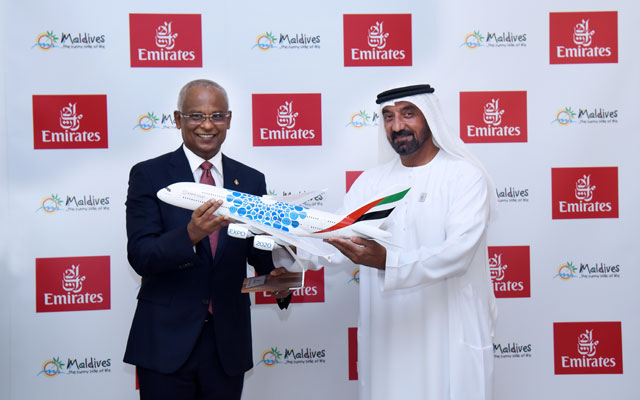
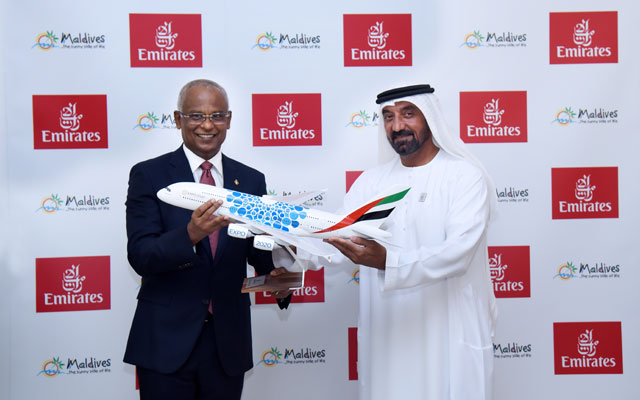
Emirates and the Maldives’ Ministry of Tourism have extended the MoU for cooperation on destination promotion and to support the country’s tourism recovery.

The extension of the MoU was signed at the Emirates Pavilion in Expo 2020 by Ahmed Khoory, senior vice president commercial West Asia & Indian Ocean at Emirates; Abdulla Mausoom, minister of Tourism Maldives; and Thoyyib Mohamed, CEO and managing director, Maldives Marketing and PR Corporation.

Emirates’ Sheikh Ahmed bin Saeed Al Maktoum presents an Emirates A380 aircraft model to Maldives’ Ibrahim Mohamed Solih

It was signed in the presence of Sheikh Ahmed bin Saeed Al Maktoum, chairman and CEO, Emirates Airline and Group; and Ibrahim Mohamed Solih, president of the Republic of the Maldives.

Emirates has served the Maldives for more than 34 years, and the airline currently operates 28 weekly flights to the island nation.

The agreement outlines key initiatives to be undertaken by the airline to continue supporting the country’s tourism recovery.

Since January 2021, Emirates has operated more than 1,000 passenger flights to the Maldives, connecting 170,000 visitors to the country, from over 100 destinations including the UAE, Russia, Germany, the US, and Czech Republic.

ACI APAC urges more govts to reopen borders to boost airport business

0

In order to prevent a repeat of a dismal year for Asia-Pacific and Middle East airports, Airports Council International (ACI) Asia-Pacific has urged more governments to reopen borders and relax quarantine requirements, especially in countries which have reached satisfactory vaccination rates.

This follows the release of latest figures forecasting sustained losses this year for airports in Asia-Pacific and the Middle East.

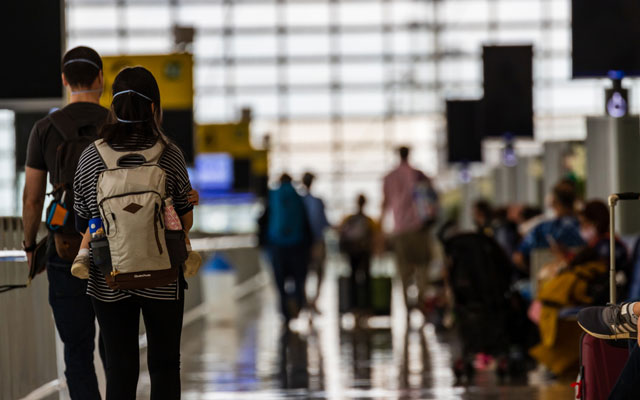
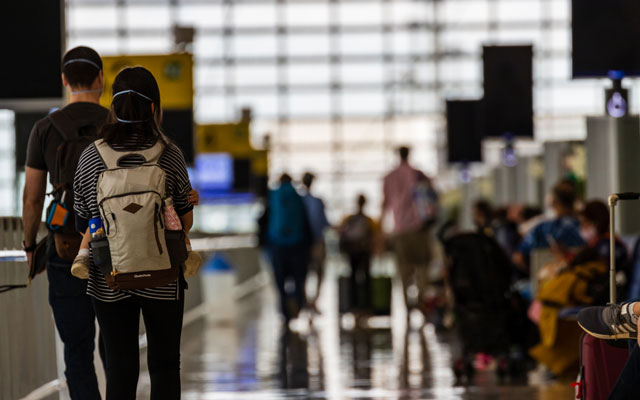
Airports in Asia-Pacific continue to be impacted by travel and quarantine restrictions across the region

Asia-Pacific, already adversely affected by constant lockdowns, stringent travel and quarantine restrictions, is forecasted to close out the year with around 56 per cent passenger losses, despite resumption of some domestic travel in a few markets.

Consistent with forecasts previously reported in 2020, the Middle East will be one of the hardest-hit regions globally with almost 70 per cent passenger losses.

Compared with ACI’s pre-pandemic projections for the same period, the two regions are forecasted to lose over 2.3 billion passengers by the end of this year. Similarly, airport revenues, a direct reflection of passenger traffic, are forecasted to decline by approximately US$34 billion in Asia-Pacific and US$11 billion in the Middle East by the end of this year.

“The latest ACI forecast shows that after a bad 2020 in terms of traffic and revenues, 2021 was even more dismal for Asia-Pacific and Middle East airports,” said Stefano Baronci, director general, ACI Asia-Pacific.

The particularly negative outcome in Asia-Pacific is a direct consequence of travel restrictions and quarantine policies observed in many countries in the region.

“A repeat of the dismal 2021 can be avoided for 2022 if more governments can adopt the risk-based, pragmatic approaches recommended by ICAO and the WHO. In pursuit of boosting international travel and stimulating economic growth, some countries are applying these approaches, such as Singapore, Thailand, Fiji and the Maldives along with several Middle East and European countries and the US,” Baronci added.

“By the end of 2021, more major economies in Asia would have fully vaccinated over 70 per cent of their populations, bringing an additional layer of protection against the coronavirus.

“With continued careful monitoring of public health situations through indicators such as hospitalisation and mortality rates, more governments are urged to expedite the calculated risk of relaxing quarantine policies, and follow the global trend of adopting digital health certificates with a view of supporting the resumption of international air travel.”

SPTO partners with ForwardKeys to enhance tourism recovery

0

The Pacific Tourism Organization (SPTO) and ForwardKeys have signed a MoU to develop a marketing partnership that will see both organisations collaborate to better support the SPTO members in data analytics.

A key objective of the partnership is to share how more relevant, timely and actionable data can be leveraged by SPTO’s membership of 20 Pacific Island countries to better monitor, plan and achieve real business outcomes within the shifting travel ecosystem.

SPTO’s partnership with ForwardKeys will allow its members to leverage big data to drive tourism recovery

“The MoU underlines the role of data analytics and intelligence tools towards tourism recovery, in a time when data-led decisions and strategies are more crucial than ever,” said Jameson Wong, vice president strategic clients & partnerships APAC at ForwardKeys, while delivering an industry update on “Pacific Islands’ Recovery Paths, Trends and Outlook” at SPTO’s tourism webinar.

“The decisions that government and private sector business leaders make today may impact the organisations’ trajectories for years to come. In these unchartered waters, where the tides continue to shift and targets (are) constantly moving, data-driven insights are no longer nice-to-have’s but must-have navigational tools,” he added.

SPTO CEO, Christopher Cocker, emphasised the importance of building partnerships to effectively address common challenges. “Collaborating with like-minded partners will be pivotal for regional tourism organisations, particularly against the backdrop of the pandemic. Innovative collaboration will fast-track tourism rebuilding and strengthen our collective resilience for the long run,” he said.

He added that SPTO’s partnership with ForwardKeys will guide its members on how to “better navigate risks and leverage opportunities through data solutions”.

Standard names Amber Asher as new CEO

0

The Standard has appointed Amber Asher as CEO of Standard International, parent company of Standard Hotels, Bunkhouse and Peri Hotels.

Asher succeeds Amar Lalvani who has been promoted to executive chairman, after serving as CEO for the past eight years.

Amber Asher

In her new role, Asher will be responsible for overseeing all aspects of the business. Her priorities include identifying and cultivating talent, building and mentoring successful teams and innovating in the hospitality sector.

Asher started her work with The Standard approximately 10 years ago as executive vice president and general counsel. In 2013, she led the sale of a majority stake in the brand to Standard International which was formed by Lalvani to make the acquisition and grow The Standard brand.

Following the successful closing of that transaction, she became the executive vice president and general counsel of Standard International and went on to be promoted to president in 2017.

Prior to joining The Standard in 2011, Asher served as the associate general counsel and senior vice president of Morgans Hotel Group where she oversaw all legal matters related to development, operations, intellectual property, employment, food and beverage, and financing.

Have vaccine will travel

0

The appetite for travel remains unabated as destinations across Europe report a steady summer of recovery for vaccinated travel. However, tourism across Asia-Pacific remains limited due to tight border restrictions and lagging vaccination rates.

Ahead of the peak summer months, countries across the west that were steaming ahead with vaccination programmes cautiously reopened their borders to foreigners. In spite of stringent sets of rules, travel rebound was a success as pent-up demand came into play.

In July, Spain received 4.4 million international tourists, a 78.3 per cent increase from 2020. In the same month, Switzerland reported a 300 per cent year-on-year rise from the American market. Throughout the summer, France received 150,000 applications for digital Covid certificates, mainly from North America.

Spain’s new regulations for re-starting international tourism came into force on June 7 and take in a raft of measures. These include EU-approved rapid antigen tests and vaccination and recovery certificates for travellers from the EU and European Economic Area countries, as well as vaccination certificates for tourists from non-EU countries.

According to figures from the National Statistics Institute, international visitors in July spent 5,231 million euros (US$6,052 million). The average expenditure per tourist was 19.3 per cent more than a year ago and the average stay was 8.3 days.

Monica Sanchez, director of Spain Tourism Board for Southeast Asia, Australia and New Zealand, said: “This reflects the gradual recovery of international tourism and shows Spain has managed to be perceived as a safe destination.”

Spain’s vaccination programme was key to its reopening, noted Sanchez. It has one of the best vaccination rates in Europe and the world. “The success of the vaccination programme and relaxation of restrictions are allowing the gradual reactivation of tourism, although still far from the levels of 2019,” she said.

Switzerland’s reopening to international visitors is also driven by vaccination rates. Under a raft of measures that are constantly being reviewed, fully vaccinated visitors can enter the country with no quarantine.

Its first bounce-back came from nearby markets, including Germany, the UK and France. From longhaul destinations, Americans started arriving in April 2021. In July, they generated more than 60,000 overnights.

Hurdles for Asians
While visitors from Europe and the Americas are driving rebound, arrivals from Asia-Pacific remain low. According to industry players, this is due to tight restrictions that remain in place across the region.

Batiste Pilet, director South East Asia, Switzerland Tourism, said: “We have not observed a noticeable bounce-back from South-east Asian markets due to discouraging time and money-consuming quarantine requirements upon their return.”

He added the gap has been noticeable. In 2019, South-east Asia accounted for 600,000 overnights in Switzerland and ranked the 10th foreign source market. China was the front runner, totalling 50 per cent of overnight stays from Asia-Pacific. South-east Asia made up 20 per cent; and South Korea, Australia and Japan, 10 per cent each.

Said Pilet: “Border restrictions are the main hurdle preventing recovery. Apart from these restrictions, customers are eager to travel.”

Sanchez said while arrivals from Asia-Pacific to Spain are “very incipient”, it remains a valuable regional market as they travel out of Europe’s high season. She added they are motivated by art, culture and shopping. Post-pandemic, Singapore is predicted to rebound first due to direct flights and the Philippines because of historical connections.

The introduction of the EU Digital Covid Certificate has also proved instrumental in reopening European borders for travel. The digital or paper certificate confirms the holder has been vaccinated, received a negative test result or recovered from Covid-19 in the last six months. It facilitates safe travel within the EU.

This is a factor Sinan Thourn, chairman of B2B Cambodia and PATA Cambodia chapter, said is difficult to achieve in South-east Asia due to geopolitics. “The two continents (Europe and Asia) are totally different,” he said. “The EU has no borders and there is the Schengen Area. All these countries have good bilateral cooperation. If we look at Asia, everyone is trying to be number one and is only looking out for their country, not the whole of Asia.”

He added heavy restrictions that remain in place across the region, such as quarantine on arrival, are a major “annoyance” for travellers. “It is this reason why tourism in Asia will take a lot longer to recover compared with Europe,” he added.

Thourn noted there is a lot of pent-up travel demand across Asia-Pacific, and once restrictions across the region are lifted, there will be a healthy mix of long and short-haul travel. He predicts Europe and the US will be popular longhaul destinations. However, outbound recovery to pre-pandemic levels will take time.

Yes to safety, no to quarantines
Alain
Brun, CEO of Cambodia Airports, said Vinci Airports’ European operations have reported a quick recovery since restrictions were lifted. In August, air traffic across Europe reached 71 per cent of pre-pandemic levels. In Costa Rica, the airport has returned to 2019’s growth levels.

“The introduction of the sanitary pass and health protocols have proved instrumental in this,” he said.

Nick Ray, product director of Hanuman Travel which has offices in Cambodia, Laos, Myanmar and Vietnam, said vaccinations are key to the safe reopening of borders. However, this has to be coupled with no quarantine.

“To be given a chance, there has to be entry without quarantine for vaccinated travellers. We’ve seen people want to travel, but destinations on both sides have to be fully open,” he said.

Sivlin Chhay, president of the Cambodia Association of Travel Agents, agreed that regional outbound travel is off the table until quarantine restrictions are lifted for vaccinated travellers. She added that pent-up demand in Asia-Pacific extends beyond leisure travel.

“There are a lot of people who want to travel within the region for business and health reasons,” she noted. “This will pick up fast, but quarantines and other restrictions discourage any non-essential travel.”

Blazing a trail

0

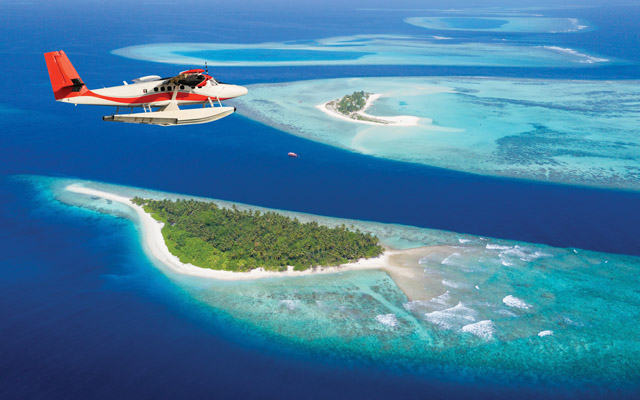
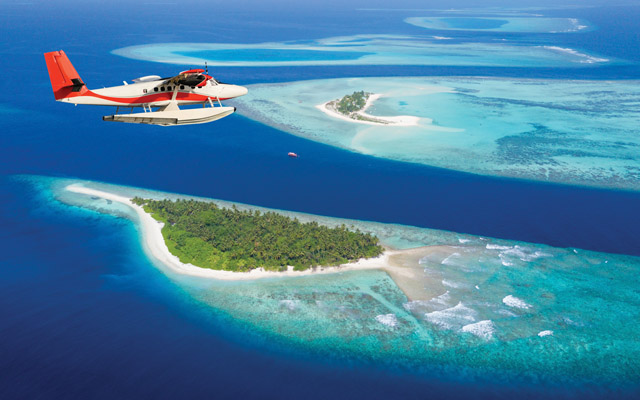
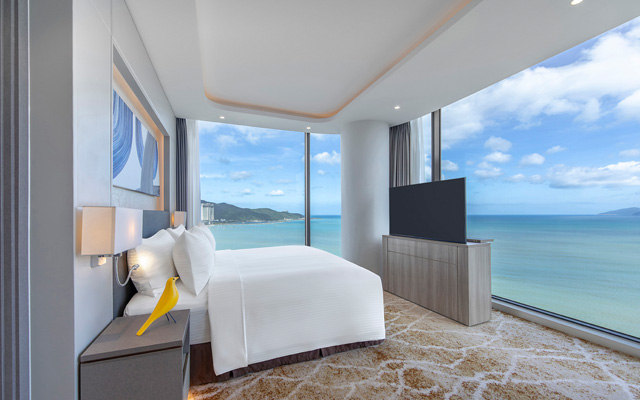
As one of the first tourist destinations in the world to relax entry requirements to facilitate tourism recovery, the Maldives has led a shining example in a post-pandemic world of travel and tourism.

The Maldives will celebrate her tourism golden jubilee in 2022 with numerous activities

With the Maldives’ golden jubilee of tourism coming up in 2022, the destination will continue to bask in the spotlight. A series of activities are lined up to celebrate the milestone, with marketing efforts kicking off in November 2021.

Thoyyib Mohamed, managing director of the state-run Maldives Marketing and Public Relations Corporation (MMPRC), said consistent destination development and marketing have established Maldives as a fierce competitor on the global travel market.

Despite travel challenges, the MMPRC has maintained aggressive marketing and ensured presence in several international trade fairs and roadshows.

Numerous partnerships have also been struck in 2021 to drive travel bookings. From July 2021 until June 2022, Visit Maldives and Qatar Airways will jointly promote the destination as a safe-haven for travellers from Europe, the Middle East and the Americas. With travel portal TripZilla, Visit Maldives will ensure that the destination remains top-of-mind among South-east Asian travellers.

In the year ahead, MMPRC will focus on courting the millennials, which make up 40 per cent of the global travel market. According to the Maldives Visitor Survey, nearly half of the visitors to the Maldives are below the age of 35 years, with 60 per cent of them discovering the destination on the Internet.

“This is an opportune time for the Maldives to reap the benefits of these trends by identifying our strengths, and refining our approach,” he said.

While the Maldives has first-mover advantage in courting travellers in the post-pandemic era, Dilip Rajakariar, CEO of Minor Hotels Group, warned that 2022 would be a competitive year as many other destinations reopen to global tourism.

Having said that, Rajakariar expects a “solid year” for the Maldives, building on the strong demand seen in 2021.

Most of the destination’s 200-plus resorts are open for business, and expectations are high that the target of 1.2 million arrivals will be met in 2021. The Maldives has set a 1.5 million arrivals target for 2022.

New GM for Sofitel Singapore City Centre

0

IHCL to rebrand heritage hotel in Jaisalmer

0

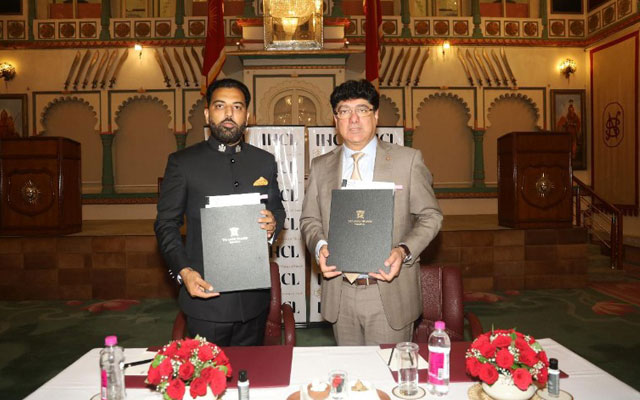
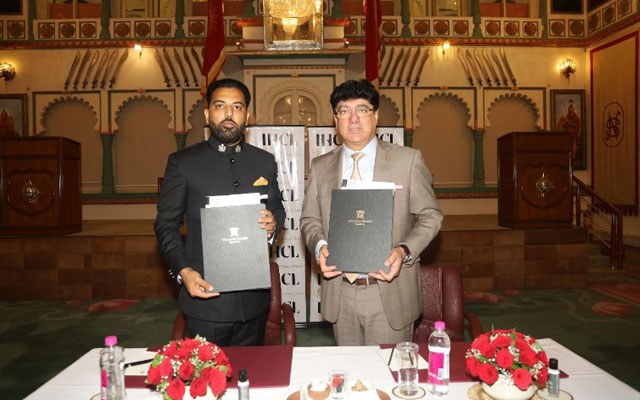
Indian Hotels Company (IHCL) has signed a deal with Historic Resort Hotels (HRH) to manage Gorbandh Palace in Jaisalmer, which will relaunch as a SeleQtions branded property in 2Q2023 after a comprehensive renovation.

Located in the heart of Jaisalmer, the 83-key yellow sandstone heritage hotel will have an all-day diner, bar, recreational facilities including a spa, as well as a banquet hall and gardens for social and business gatherings.

Maharaj Kumar Lakshyaraj Singh Mewar of Udaipur, executive director, The Lake Palace Hotels & Motels (left) ink deal with IHCL’s Puneet Chhatwal for Gorbandh Palace

This marks the third hotel in IHCL’s 50-year partnership with HRH, following Taj Lake Palace, Udaipur in 1971 and Taj Fateh Prakash Palace, Udaipur.

With the addition of this hotel, IHCL will have 21 hotels across brands in Rajasthan, including eight under development.

Driving social change

0

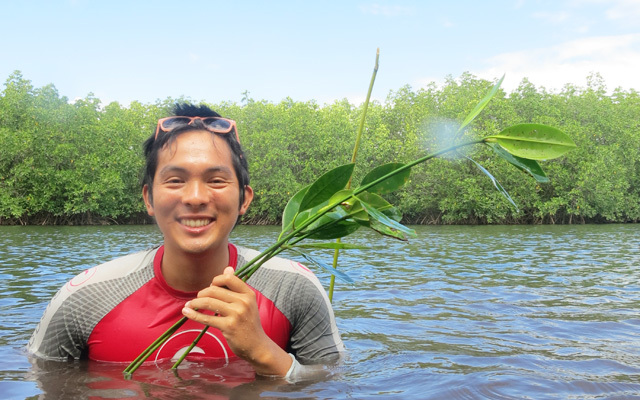
Your social enterprise Make A Difference Travel, along with The Circle Hostel, run alternative tours that support both the environment and the marginalised communities in the Philippines. In less than a decade, your team and clients have reforested thousands of acres of barren land by planting trees and seedlings, collected and repurposed plastic that would have trashed land and oceans, and gave livelihood to indigenous communities. What steered you towards the path of social tourism?
There are two reasons why I’m so into it. On the internal level, all the science shows it is for our human survival. If we don’t empower people to take care of our planet that takes care of all of us, then we’re (done for).

The other is connected to caring. I enjoy surfing, scuba diving, mountain climbing, trekking, swimming – and because I love these activities and the environment that allows these activities to happen, I care for the environment. At one point in Zambales, seeing the degradation caused by thousands of weekend tourists who didn’t care about the beach and threw trash into the sea, it was very painful for me to even go to the beach.

The rest of (my life) will be dedicated to creating a world that is more inclusive and more balanced with the ecology and our environment.

Is social tourism a profitable endeavour?
Of course. Just because we are trying to do good for people and the planet does not mean we are a non-profit. We are not. Neither are we a charity; we want to create profit for everyone. Profit is a reflection of value generated – for people and planet.

That’s the mindset we want to (instil). If your business is not good for people and planet, then you should not be in business. If your business just makes money off the backs of poor people and you are not making them move up and you destroy the environment, you are not creating value.

The premise of the social tourism and social enterprise movement is to create inclusive and holistic value. And the value chain is no longer just customers and owner of the business; it is now the customers and the communities affected by the business and the environment as we have seen.

Boracay is the best example of that. Clearly, not enough attention was given to (preserving Boracay). One can say that in general, businesses and the government did not care or know about the environment – or not enough, at least – (to take care of it,) therefore Boracay was destroyed, and with that, the loss of hundreds of millions of pesos in revenue. Hopefully, Boracay’s rehabilitation is a strong story that people can learn from.

What are your personal observations on the progress of tourism sustainability in the Philippines?
It’s very slow. Our tourism sector is not sustainable at all, but it can be.

Many players are pushing for sustainability, but you have to get the right people on board with the right tools and the right perspective. There has to be a way to really empower the local government units to implement the law and sustainability programmes. Put some teeth into existing environmental laws, or implement new laws as needed.

We need an education programme for tourism practitioners, including agencies, operators, accommodation providers, etc. If they are not empowered, how can we change?

While we try our best to protect the environment, it’s an uphill battle because of the convenience mindset that people have and a lack of facilities to responsibly manage the waste. But more people are now becoming aware of the need to protect the environment, and they want environmental (policies) from their political and corporate leaders.

The travel world has always been about glitz and glamour and what’s beautiful, but this generation is also looking for five-star experiences, which are more important than five-star hotels.

However, the divide is very big between the haves and the have nots and we feel it is our duty to show that you can connect up and down or left and right of the social classes. It is the disconnection of people from each other, and from the environment, that drives the destruction and exclusion.

I was very disconnected when I first started out, but I became friends with people in the countryside and they helped me understand the different parts of Philippine culture, and our environment.

What can be done to hasten sustainability?
I think the basic principle is that people need to see the numbers behind it. The poverty of the environment is the poverty of the people and the richness of the environment is the wealth of the people. If the beach is clean, no matter what you put there – be it a nipa hut or a hotel, it will make money. But if the beach is dirty, the money you lose could be billions of pesos, like in the case of Boracay. The world is more fun when it is cleaner.

(Philippine) tourism is 70 per cent water-based. We sell islands. We have to make even better efforts to save the ocean, especially with the advent of take-home delivery. Six out of 10 fishermen catch plastic. There is no vaccine for dirty oceans. The tourism industry can do something about it by teaching people how to love oceans so they protect it.

What advice do you have for aspiring tourism social entrepreneurs?
There is a body of knowledge, a mindset, and relationships that can be adopted by operators, agents, accommodation providers, etc. Take time to know the community. Take out their biases. They cannot walk in with a superiority complex, which I see happens a lot. The society in the Philippines raises us to have superiority complex (and look down on) farmers and fishermen and indigenous people, but we shouldn’t. Our perspective should be that we can learn from them in the same way that they can learn from us.

I once offered help to one of the elders from the indigenous community of Aetas in Bataan. The elder asked, “What kind of help?” And I said, “For you to earn money.” The elder replied that the kind of help she wanted was one where we both stood to benefit. If only she were to benefit, I would probably end up leaving her, so that (kind of help is) not sustainable.

What the elder wanted was for me to tell her how we can help each other so we are in a relationship of equals. That’s sustainability. Basically, she was saying, “Treat my community like a legitimate business partner, then we can create value together.”

Learn more about Dionisio’s social enterprise here.