 The Asia-Pacific travel sector has had a strong start to 1Q2024 so far. It continues to report the strongest year-on-year results when compared to other regions. Key markets like India have experienced an incredible travel rebound over and above 2019 levels, with China now steadily following suit.
While China’s domestic travel demand featured strongly on the cards in 2023, this focus has now shifted towards China outbound, as evidenced by the strong increase in outbound Chinese tourist numbers past the Lunar New Year holiday. The momentum is expected to continue in the months ahead, with Asia-Pacific destinations close to home already seeing the first wave.
India also continues to be a major contributor to the region’s tourism boom, with the market seeing increasingly significant outbound travel traffic since 2023. In response, Indian airlines have been working hard to keep up, expanding flight capacity to meet the surge.
Despite the overall rosy outlook, it is imperative for airlines, financial services and airports alike to look ahead and understand the psyche of consumers, who Collinson has identified to be the “new C-suite” of today, following our latest research report, The New Rules of Engagement: Customer Expectations Revealed. Operating in this customer experience era, winning the hearts and minds of customers is critical as this will enable brands to sustain their growth momentum and drive measurable business impact.
Knowing and meeting customer needs
By 2025, Gen Z and millennials each make up a quarter of Asia-Pacific’s population. Together, they will comprise half of Asia-Pacific consumers and, in turn, be a significant contributor to the demand for travel and its related services. In today’s unpredictable landscape, where loyalty is fickle, winning their hearts and minds is not just a nice-to-have – it is an imperative for brands.
In Collinson’s recent Asia-Pacific consumer insights report, more than half of the 4,750 consumers surveyed across the region expect brands to not only answer, but also anticipate their needs. Furthermore, 74 per cent of respondents expect personalised communications.
When it comes to travel, this translates into a unique demand, especially for millennials, who view travel as a right, not a privilege. This perception of travel translates into an enormous appetite for rewards and benefits that can enable positive travel experiences. Correspondingly, 93 per cent of respondents in the same Collinson survey indicated that the availability of such rewards encourages them to engage regularly with a brand.
Such rewards and benefits do not need to be grand gestures. Collinson’s Fear of Switching Off (FOSO) survey revealed there is an increased expectation towards seamless travel and pre-flight experiences. More than 61 per cent of travellers in Asia say pre-flight issues can initiate a fear of switching off for the rest of their trip. Clearly, the travel experience does not start from the destination, but from the airport.
The FOSO report also revealed that visiting an airport lounge, dining, and having a smooth check-in process are the top airport experiences that help travellers in Asia switch off pre-trip. The key to engaging with travellers today, then, is through providing an end-to-end tailored, seamless experience that adds value to their journey.
To cater to travellers’ expectations, and in response to the region’s travel resurgence, Collinson expanded their Asia-Pacific network of airport lounges and travel experiences by 40 per cent in 2023. Airport Dimensions (a Collinson company), for example, added Game Space in Dubai to the Priority Pass network – a 24-hour gaming lounge designed to provide a more engaging and diverse airport experience, directly aligned to the ever-popular e-gaming trend.
Tailored developments aside, there are key opportunities throughout the year that brands can tap into to engage with their most valued customers and in turn, generate positive impact to their business.
China and India: markets to look out for
Although China’s domestic travel is experiencing a steady recovery, international arrival figures are still well below pre-pandemic volumes; with estimates projecting inbound tourist numbers to recover to 50 per cent of 2019 levels in 2025. Chinese outbound tourism volumes, while on the uptick, are only expected to start returning to pre-pandemic levels next year. This in turn gives major airports in the region more time to prepare for China’s anticipated full return to travel; not only from an operational standpoint, but also in relation to being able to cater to the needs and wants of travellers.
In fact, China’s airport lounges have already been adapting their travel experiences. For instance, understanding that travellers are placing a heightened focus on F&B options and wellness services as part of their airport experience, Juneyao Air V6 Lounge located at Shanghai Hongqiao International Airport introduced an array of dishes prepared by Michelin-starred restaurant, Xiyue No. 8 to their airport lounge menu, and Comfort Zone was established in various airports in China to provide spa and beauty treatments.
Looking further ahead, India’s Diwali celebration is another key moment to watch for, as nearly half of Indian travellers plan to increase their travel spending in 2024. Research has shown that Indian travellers place a heightened value on travel experience related benefits; for instance, having access to airport lounges, being able to enjoy duty-free discounts, and gaming spaces at airports. This is also evident in Collinson’s year-on-year airport experiences visit data. When comparing 2019 Diwali season results with 2023, the number of Indian travellers enjoying Priority Pass airport experiences globally significantly increased by 254 per cent.
Formula 1 is also a prime 3Q to 4Q opportunity for brands to leverage travel and work with brands within the travel and hospitality industry to build a cohesive, memorable experience – especially for millennials, who are entering their prime spending years. Last year, Collinson saw a 76 per cent increase in the airport lounges in host cities during race weekends.
We’re gearing up for an exciting year ahead in the travel sector, with these opportunities on the horizon for brands to tap on and engage with their most valued customers who are ready to spend on what matters to them. For brands to be successful in the path ahead, it is key to dive deeper into what consumers want. In turn, they will reward you with their loyalty.












 Having joined Minor Hotels in early 2020, Abeyakoon was most recently general manager at Minor’s Oaks Ibn Battuta Gate hotel in Dubai.


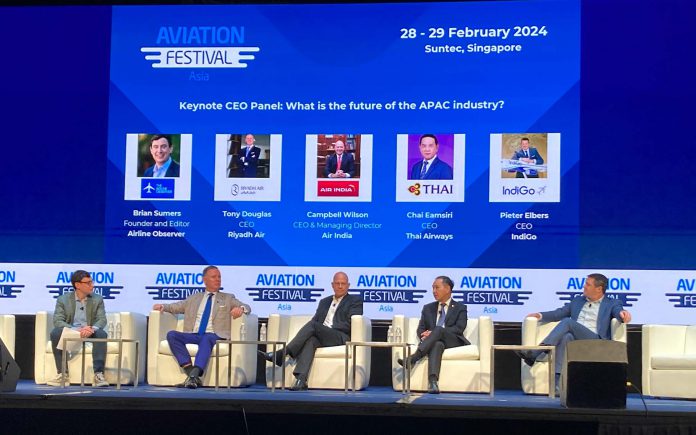
Airline chiefs of legacy, low-cost carriers (LCC) and new full-service start-ups, who spoke at the recent Aviation Festival Asia in Singapore, have one thing in common – the need for additional aircraft to meet growing passenger demand and expansion of their domestic and international networks.
Air India, under new Tata Group management since 2022, has 506 orders, 36 on lease and is accepting one aircraft delivery every six days. Air India CEO and managing director Campbell Wilson is expecting “some delays” on its orders 18 months into its five-year transformation, noting the airline is “undersized in relation to the market”.
IndiGo is the largest airline in India by passengers carried and fleet size, and the LCC has a 60 per cent share of the domestic market. IndiGo CEO Pieter Elbers reported growth of 20 per cent in the past year and its 2024 network will comprise 86 domestic and 33 international destinations, adding that the airline’s target is to grow from 300 to 1,000 aircraft to “double in size by the end of the decade”.
New player Saudi Arabia’s Riyadh Air was launched some 15 months ago and is in an alliance with Turkish Airlines. According to CEO Tony Douglas, the start-up is looking to fly to some 150 destinations, has an order for 72 aircraft, and expects to start operations by mid-2025.
On another panel, CEO of Really Cool Airlines Patel Sarasin said the new Thai full-service international player is scheduled to take off by the end of the year but shared he was facing challenges in finding aircraft.
Fellow panellist Mike Szucs, CEO of Cebu Pacific, said he was negotiating with Airbus and Boeing for 150 aircraft to tap domestic and international opportunities with major improvements in the country’s airport infrastructure under way.
However, airlines have little control over the delivery of their aircraft orders.
Douglas admitted Riyadh Air has “no Plan B” in the current situation of demand chasing supply; while Elbers acknowledged there were supply chain challenges and original equipment manufacturer issues.
On how Thai Airways is coping with passenger demand changes following China’s reopening, CEO Chai Eamsiri said Chinese state-owned enterprises were controlling the flow of outbound travel and the airline was managing its aircraft deployment by serving only 42 routes, less than 80 per cent of pre-pandemic levels.
For Riyadh Air, Douglas noted that China, described as a giant market, is on its “list of top priorities”, adding “we have to go to China and will use social media” to promote its appeal to football-mad supporters – Cristiano Ronaldo captains Saudi Pro League Al Nasser – and adventure seekers as host of the Dakar Rally.
Airlines also have no clear answer on how to get to net zero carbon emissions, identified as one of the industry’s biggest challenges even though low-carbon and sustainable fuel are available.
Chai commented carbon neutrality was not just the responsibility of airlines and “everyone has to pay for it”.
While the airlines are ready, where there are mandates in Europe and where the Schengen region and the US have also introduced incentives, he said more guidelines are needed in Asia.
Chai referenced the February announcement that flights departing from Singapore will be required to use sustainable aviation fuel (SAF) from 2026, in a move aimed at progressively decarbonising airline operations.
Singapore is aiming for a one per cent SAF uplift and passengers will have to pay more for their air tickets due to a levy imposed on the purchase of the fuel with fees paid based on factors such as distance travelled and class of travel.
The rest of South-east Asia, even the Thai government, Chai pointed out, have no comprehensive policy on SAF and the national carrier is pushing for clearer concrete solutions on its availability in the market.
While no mention was made during the panels on recent incidents of missing aircraft door plugs or tricky pilot seat switches having a knock-on effect on delivery and capacity rebuilding, passengers will have to brace themselves for higher ticket prices as airlines wait for orders and what else is to come as governments and the industry work out the route to net zero carbon emissions.