

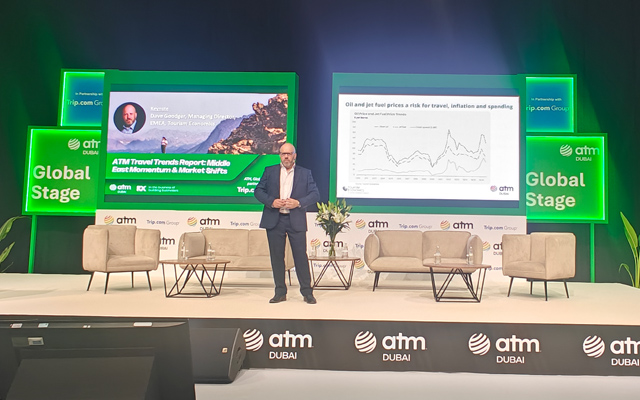
The highs of international travel into the MENASA (Middle East, North Africa, South Asia) region in 2025 will give way to a decline this year due to geopolitical tensions in the Middle East, according to Tourism Economics data.
Sharing its report on Middle East Momentum & Market Shifts during Arabian Travel Market (ATM) 2026 at Dubai World Trade Centre on Tuesday, Dave Goodger, managing director, EMEA of Tourism Economics, said: “Last year has been a record year for international travel. Inbound visitor nights to MENASA increased 61 per cent between 2019 and 2025, compared with just 12 per cent globally.”
However, the strong growth trajectory is expected to be disrupted this year. Tourism Economics forecasts a 14 per cent decline in international travel to MENASA in 2026. Arrivals into the Middle East are expected to fall by more than a fifth while travel into the Gulf Cooperation Council (GCC) countries will dip over 30 per cent, although this is partly buffered by modest gains in North Africa and South Asia.
Yet, the report retains an optimistic outlook: the GCC member countries will drive inbound growth in MENASA with visitor nights set to increase 10 per cent per year over the next five years.
Goodger said a combination of established long-haul markets and rapidly expanding emerging markets would underpin the Middle East’s future tourism growth.
“The long-haul markets like Germany, the UK and the US are going to generate a significant number of tourist arrivals into the Middle East. The region is also expected to see strong growth from emerging markets like India, China, Thailand, and Indonesia,” he added.
The report also states that visits to the Middle East from beyond the region are projected to grow 43 per cent between 2025 and 2030, compared with growth of 30 per cent from intra-regional arrivals.