

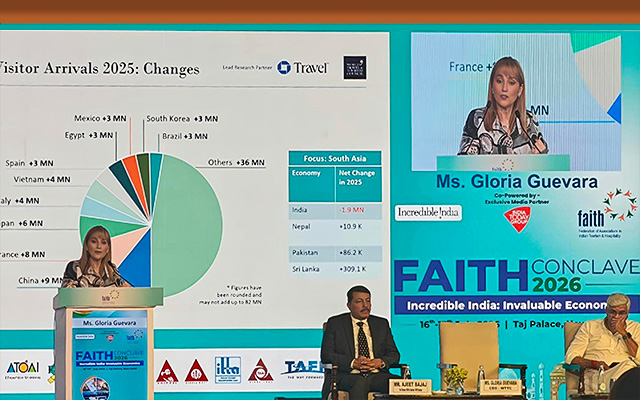
India has the potential to become one of the world’s biggest tourism destinations but must remove policy and infrastructure bottlenecks to realise that ambition, according to Gloria Guevara, president and CEO of the World Travel & Tourism Council (WTTC).
Speaking at the Federation of Associations in Indian Tourism & Hospitality’s (FAITH) conclave in New Delhi from July 16 to 17, she said India remains underrepresented in global tourism despite its rich cultural heritage, history and diverse experiences.

Delivering a presentation titled Travel & Tourism – A Global Powerhouse for Growth, Prosperity & Employment on the opening day of the conclave, Guevara highlighted that international overnight arrivals reached a record 1.54 billion in 2025, an increase of 82 million travellers over the previous year, representing 5.6 per cent growth. Globally, the travel and tourism sector expanded by 4.1 per cent, significantly outpacing overall global GDP growth of 2.8 per cent.
India’s travel and tourism economy also posted robust growth, expanding by 7.3 per cent in 2025, although it trailed China, which recorded 9.9 per cent growth. Japan’s travel and tourism GDP grew by 4.6 per cent during the same period.
“Global international visitor spending crossed US$2.02 trillion in 2025, registering a 3.2 per cent year-on-year increase. In contrast, India witnessed an eight per cent decline in international visitor spending to US$33 billion, while China recorded a 10.5 per cent increase and South Korea posted an 11.6 per cent rise,” she shared.
Guevara attributed India’s decline in international visitor spending to a series of adverse events during the year, including the Pahalgam terror attack in April, subsequent India-Pakistan border tensions, the Air India Ahmedabad-London crash, intense monsoon rainfall in several parts of the country and widespread flight disruptions in early December following the implementation of the government of India’s revised Flight Duty Time Limitation norms.
International visitor arrivals worldwide also reached 1.54 billion in 2025, growing by 5.4 per cent over the previous year. India, however, recorded a 7.4 per cent decline, receiving 18.6 million international visitors. WTTC’s figures include Indians residing overseas who visited the country during the year. In comparison, China welcomed 68.2 million international visitors, reflecting a 15.5 per cent increase, while Japan recorded 42.7 million arrivals, up 15.8 per cent.
“Despite the setback in inbound tourism, India’s domestic travel market remained a major growth driver. The country’s travel and tourism sector contributed US$263.6 billion to the economy in 2025, accounting for 6.6 per cent of GDP and supporting 46.2 million jobs. Domestic visitor spending rose by 10.3 per cent year-on-year to US$203 billion,” said Guevara.
India’s share of global international visitor spending slipped to 1.6 per cent in 2025 from 1.8 per cent a year earlier, underlining the country’s relatively modest presence in the global inbound tourism market.
Looking ahead, WTTC expects India to remain one of the world’s fastest-growing travel economies. The organisation forecasts India’s travel and tourism GDP to grow by 8.5 per cent in 2026, higher than China’s projected 5.3 per cent growth, though below Thailand’s expected 11.6 per cent expansion. International visitor spending in India is projected to rebound by 15.3 per cent to US$38 billion next year.
WTTC also projects India to become the world’s fourth-largest travel and tourism economy by 2036, up from 10th position in 2025. The growth is expected to be driven by sustained investment, enabling government policies, improved connectivity and continued expansion of tourism infrastructure. The sector is also forecast to create 15.4 million new jobs between 2026 and 2036.
However, Guevara emphasised that India must address several structural issues to unlock its full tourism potential.
“I don’t think that India has its fair share in the global tourism market considering the size of the country, its rich history, culture and gastronomy. India currently offers visa-free access to citizens of only three countries compared with around 70 countries in China and about 90 in Thailand. There is also a need to improve connectivity to secondary cities through high-speed rail networks and introducing a fully digital arrival process to make travel to India more seamless and attractive for international visitors,” she advised.