

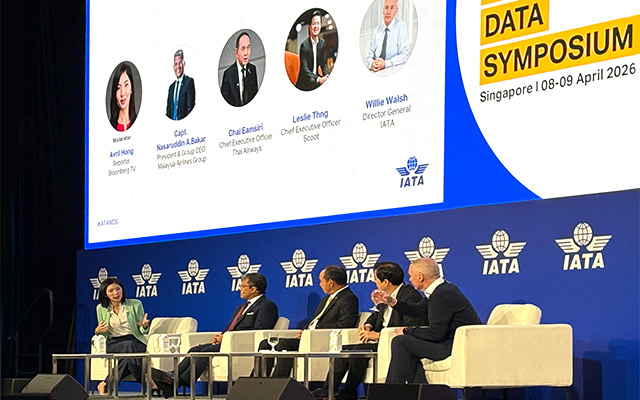
The disruption to airline operations caused by high aviation turbine fuel (ATF) since the outbreak of the Middle East conflict may take “many, many months” to normalise after the fighting stops, and nobody knows when, according to International Air Transport Association (IATA) director general Willie Walsh.
However, Walsh, speaking on April 8 at the IATA World Data Symposium held in Singapore, is confident of recovery and said airlines are not facing “an existential crisis”.
He said closed borders during the pandemic had a far greater impact, when 90 per cent of capacity vanished.
Citing the industry’s resilience, he noted it took four months for recovery after the September 11 attacks in 2001, and around 10 to 12 months after the 2008 global financial crisis.
Calling the jump in ATF a “wake-up call”, IATA senior vice president sustainability and chief economist Marie Owens Thomsen, in her Sustainability and Economic Outlook presentation, drew attention to the need for greater global energy investment, in particular low-emission fuels, which stood at just 1.2 per cent of 2025’s US$3.3 trillion total energy sector.
Venture capitalists, she argued, have yet to turn a profit on investments in AI, whereas the use of sustainable aviation fuel, a key part of the Carbon Offsetting and Reduction Scheme for International Aviation, is reducing emissions.
During the CEO panel discussion, airline chiefs from Malaysia, Thailand and Singapore highlighted the increase in ATF forcing capacity cuts and higher air fares.
“Fortunately, demand in the region is still strong but how can the fare increases be sustained,” Nasaruddin A Bakar, president and group CEO of Malaysia Airlines Group, quipped.
For now, the group’s strategy is to contain costs as much as possible.
Thai Airways CEO Chai Eamsiri said the airline is having to adapt to survive and is “not thinking of profitability”.
Meanwhile, Walsh said digital transformation can give airlines the opportunity to “better serve customers” and that the industry remains committed.
He cited the pandemic and how investment in technology such as self check-in kiosks away from the airport was a “win-win”.
Eamsiri noted customer service is a priority, and while investment in other projects is being postponed, the airline is proceeding with AI projects involving enterprise data.
For Scoot, CEO Leslie Thng said investing in Gen AI has helped the low-cost carrier improve customer engagement and work efficiency in optimising aircraft and crew deployment.
Scoot has set up a data department and data warehouse and is using data analytics to power business and manpower productivity, he added.
The industry has to continue to invest in digital transformation, he opined: “The airline industry cannot fall behind as the customers already expects it.”
He acknowledged Scoot’s chatbot had a low rating, but its adoption of Gen AI was better, and agentic AI is expected to be “even better” as data privacy is intact and the system is protected.
“(AI) Incidents outside the industry provide a good lesson and we continue to learn from outside and inside the aviation industry. The questions is when we will be attacked and how quickly we recover.”
Thng remarked that the aviation industry must have the appetite to experiment, as not all digital transformation efforts are successful.