
India’s Maharashtra state is developing new tourism circuits and infrastructure to attract investment, spread visitor flows across regions and support long-term growth
The state of Maharashtra, home to India’s financial capital Mumbai, is moving away from seasonal tourism towards “all-season circuits”. By developing 50 specialised tourism hubs, the government of Maharashtra is ensuring that economic benefits reach every district, from the Konkan coast to the hinterlands of Vidarbha.
“Our five-year strategy is aligned with the Vikasit Maharashtra (developed Maharashtra) vision, focusing on eight key themes including forts and heritage, flora and fauna, aqua (coastal and inland), experiential, growth hubs and MICE, island tourism, religious and spiritual, and global destinations,” said Sanjay Khandare, principal secretary, tourism department, government of Maharashtra.
The Maharashtra Tourism Policy 2024 sets a target of attracting 1 lakh crore rupees (US$10.6 billion) in private investment and creating 1.8 million jobs by 2034. Over the next five years, its immediate focus is on building resilient, high-quality infrastructure to support a US$1 trillion state economy.
“Maharashtra’s tourism sector is currently witnessing a period of growth, serving as a primary engine for our economic aspirations. If we look at the trajectory over the last few years, the momentum is clear. In 2022, the state recorded approximately 11.13 million domestic visits and 1.51 million international visits, and by 2024 our estimates show approximately 18.84 million domestic tourist visits and 3.71 million foreign tourist visits,” added Khandare.
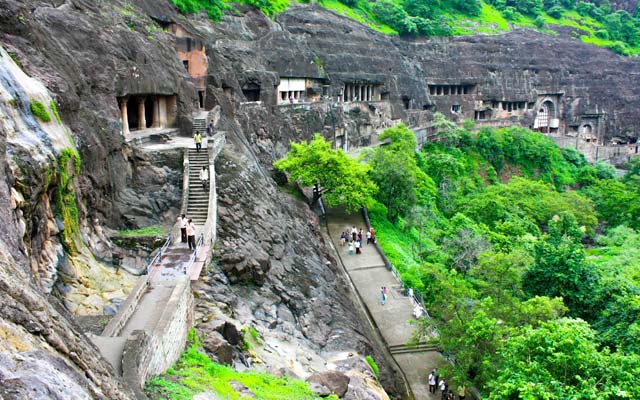
UNESCO sites such as Ajanta Caves and Ellora Caves are among the most visited heritage sites in the state. Recently, Maharashtra’s tourism department organised a fam trip for more than 100 foreign tour operators and influencers to showcase these flagship caves.
Maharashtra holds the highest share of Buddhist caves in the country, with more than 850 rock-cut caves. The state also has the highest number of forts in India and is looking to provide immersive experiences that position Maharashtra as the “Heritage Capital of India”.
“In recent years, driven by improved connectivity, growing domestic travel demand and the state’s diverse tourism offerings, Maharashtra has progressed. From the hospitality industry’s perspective, the state today presents a more balanced tourism ecosystem that caters to leisure, heritage, religious, adventure and business travel alike,” said Rishi Mehra, area nominee – Nashik, Hotel and Restaurant Association (Western India).
According to Mehra, destinations including Mumbai, Nagpur, Nashik and Pune continue to remain strong hubs for business and MICE travel, while leisure destinations such as Mahabaleshwar, Matheran and Alibaug are seeing rising demand for weekend tourism.
“At the same time, heritage and religious circuits including Ajanta Caves and Ellora Caves, as well as pilgrimage destinations such as Nashik, Shirdi and Kolhapur, among others, are attracting a steady flow of visitors. Newer and less explored destinations like Igatpuri and Sindhudurg, with improved connectivity, are expected to grow in the coming years,” stated Mehra.
Industry stakeholders note a shift towards experiential tourism, including eco-tourism, agro-tourism, culinary tourism and adventure activities such as trekking, fort trails and water sports.
Mahindra Holidays & Resorts India recently launched a new 96-key resort in Amba Ghat, a mountain pass on the Ratnagiri-Kolhapur road in Maharashtra. Vacation home brand EkoStay has, over the past two months, added eight new villas to its portfolio in the state, including three in Panchgani, one in Igatpuri, one in Dahanu and three in Alibaug.
Varun Arora, CEO and co-founder of EkoStay, said: “Our expansion strategy reflects a dual focus on strengthening established markets such as Alibaug while entering emerging lifestyle-driven destinations including Dahanu and Palghar, which are seeing increasing interest from urban travellers seeking short-drive getaways.”
Maharashtra is the first state in the country to form a State Convention Bureau. Mumbai already hosts many global events and is home to MICE facilities such as the Jio World Convention Centre.
“The establishment of a dedicated MICE Bureau was essential for strategic planning, promotion and positioning of the state in the global events market. The tourism department will facilitate the development of large MICE centres across Maharashtra,” said Khandare.
Infrastructure developments in the state, including the Mumbai Metro, Mumbai International Airport, Atal Setu or Mumbai Trans Harbour Link, India’s longest sea bridge connecting Mumbai to Navi Mumbai, and the Samruddhi Highway connecting Mumbai to Nagpur, have strengthened connectivity.
The tourism department is also focusing on curated events for wildlife and nature enthusiasts and slow travel concepts that emphasise longer stays. The state’s five Blue Flag beaches are being developed to attract inbound tourists interested in coastal and water sports activities.
“Our immediate key inbound tourism markets are France, Germany, Russia, the UK, Canada, Japan, South Korea, Sri Lanka, China and Central Asia. Our focus this year is targeted marketing to key markets and demographics for our varied offerings,” shared Khandare.
The year 2026 has begun strongly for the hospitality sector in the state, with both business and tourist hubs recording occupancies of more than 80 per cent during January and February.
“However, evolving geopolitical tensions in the Middle East and resulting flight disruptions to and from the region are expected to moderate tourism footfall in March and April. With international travel facing challenges, India is increasingly reliant on domestic tourists to drive both business and leisure travel,” said Mehra.
Meanwhile, the government of Maharashtra is encouraging community-based models such as homestays, eco-resorts and village tourism programmes to ensure direct income for local households.
“We also plan to launch state-wide campaigns on ‘Responsible Traveller Guidelines’ through signage, digital media and brochures, and partner with schools and colleges to promote responsible tourism values among youth,” concluded Khandare.