
Asia/Singapore Saturday, 4th April 2026
Page 50

ZOTrav: Navigating the new age of B2B travel

0

Could you please explain the recent developments in your company?
We are excited to share some key developments as part of our ongoing journey to reshape the B2B travel landscape. ZOTrav is evolving into a comprehensive tours marketplace, focused on making global travel products more accessible to travel agents and tour operators. We have taken a number of initiatives recently to strengthen our presence in the market. We have enhanced our supplier network through expanding our partnerships with DMCs and wholesalers across Asia, Europe, Africa and the Middle East to offer more curated, high-margin travel experiences. Our upgraded platform is being designed to support real-time inventory, quote-to-book functionality and customisation tools for FIT and group travel segments. Moreover, we are launching fixed departures and building a dedicated desk for MICE and events to support multiple destinations. These developments align with our vision of becoming a trusted B2B hub for international travel bookings, empowering partners with transparency, efficiency and innovation.

What makes ZOTrav different from other B2B platforms?
We believe that ZOTrav isn’t just another B2B portal; it is a curated tours marketplace built with a vision to simplify global travel selling for today’s travel professionals. Our key differentiators include a dynamic marketplace connecting agents with multiple destinations, transparent pricing and custom mark-up options, a blend of smart tech and human expertise for tailor-made solutions and real support for FITs, group departures and custom itineraries. ZOTrav is built by industry experts who understand the needs of today’s travel businesses, making it a smarter and a more connected way to sell travel.

Which are the destinations and experiences that you are seeing in high demand in the country?
At ZOTrav, we are observing notable shifts in demand across both destinations and travel experiences. We are noticing a momentum for shorthaul destinations. Countries like Georgia, Kazakhstan, Vietnam and the Philippines have recorded a 30 to 40 per cent rise in B2B queries and bookings, particularly for group departures and leisure FITs. On the other hand, demand for African safaris is on the rise. Destinations such as Kenya and South Africa are witnessing a 25 per cent increase in interest, driven by wildlife experiences and luxury group travel. There is also a growing preference for theme-based tours – culinary journeys, cultural trails and slow travel – especially among families, women travellers and repeat globetrotters.

A lot of small and medium travel agents in the country still find technology adoption as a challenge. Does ZOTrav help such travel agents in terms of tech adoption?
Absolutely, technology adoption remains one of the biggest hurdles for small and mid-sized travel agents in today’s fast-evolving travel ecosystem. Many agents struggle with complex booking systems not designed for their scale or lack of digital tools for quoting, customisation and CRM. There is also a challenge of limited visibility and reach to global suppliers. At ZOTrav, we recognise these issues and have built our platform with ease-of-use and accessibility at its core. We offer a Plug-and-Play platform which means that our intuitive interface requires no technical training, allowing agents to browse, customise and book global tours quickly. For agents not fully ready to go digital, we offer backend support, manual quotes, and guided onboarding to ease their transition. Our custom mark-up and quote tools allow travel agents to instantly apply their own margins. We actively conduct demo sessions, regional workshops and one-on-one onboarding to handhold partners through their tech journey.

Apart from India do you have plans to expand your presence in other parts of the world?
Yes, beyond India, we are actively working on expanding ZOTrav’s footprint into key international markets. Our immediate focus is on building strategic partnerships in the UAE, GCC countries and South-east Asia where there is a strong demand for curated B2B travel products and a growing network of outbound agents and operators. As we scale, our vision is to position ZOTrav as a globally connected, regionally rooted B2B tours platform, supporting travel agents, operators and group planners across multiple markets.

What kind of solutions do you offer to travel consultants dealing in the MICE market?
ZOTrav supports MICE consultants with custom group planning, access to a trusted global DMC network and end-to-end operational support from venues and logistics to local experiences. We offer fast quotes, flexible options and a blend of tech tools and expert assistance to help consultants deliver seamless and high-impact events.

What are your future plans?
We are working on integrations that will make the agent’s journey even more seamless; think real-time availability, live chat support with DMCs, instant quotation builders and AI-assisted itinerary suggestions. Another exciting area is multi-country itinerary planning, something that has always been complex for agents. We are building tools to simplify that process and give agents the edge to respond faster and smarter. And yes, a mobile version of the platform is coming soon to help agents work on the go.

Andhra Pradesh: Pursuing global tourism growth

0

Andhra Pradesh is ramping up its global tourism outreach with a renewed focus on international visibility, investment incentives and untapped segments like Buddhist heritage, beach experiences and wellness travel.

The state government’s roadmap is backed by the newly announced Tourism Policy 2024-2029. The policy aligns with the Swarna Andhra Vision 2047, a long-term plan to transform the state into a US$2 trillion economy with a targeted 15 per cent annual Gross State Domestic Product growth. Tourism is pegged as a crucial driver in this transformation.

Araku Valley offers trekking, camping and outdoor activities amid lush landscapes, attracting growing interest from adventure travellers

Ajay Jain, special chief secretary for tourism, Government of Andhra Pradesh said: “A key highlight of the new policy is that the tourism sector has now officially been granted industry status. This means all benefits applicable to industrial ventures from subsidies to infrastructure support are now extended to hospitality and tourism players. This move has already started attracting leading hotel chains and private investments to Andhra Pradesh.”

While Andhra Pradesh ranks among top five domestic tourist destinations in India, thanks to religious hubs like Tirupati, its international numbers remain low.

Rajeev Kale, president and country head, holidays, MICE, Visa, Thomas Cook (India) Limited remarked: “Andhra Pradesh’s tourism demand is driven by its spiritual circuit, beaches and emerging cruise tourism via Visakhapatnam. Tirupati remains a pilgrimage powerhouse, while destinations like Araku Valley and the coastal belt are drawing interest from leisure travellers. While Andhra Pradesh has a strong foothold in domestic tourism, international tourist arrivals are still in a nascent stage. However, with its unique offerings like Buddhist heritage, coastal beauty, spiritual destinations and offbeat experiences, the state holds substantial potential to attract global travellers.”

Jain candidly admitted that many international tourists do not even know where Andhra is on the map. The first challenge is visibility. To address this, the state is actively participating in global travel exhibitions such as ITB Berlin, WTM London, ATM Dubai, and others. A focused B2B approach is also being pursued, with plans to collaborate closely with Indian and foreign tour operators to integrate Andhra Pradesh into longhaul itineraries.

S D Nandakumar, president and country head, holidays and corporate tours, SOTC Travel Limited, said: “While the domestic segment remains strong, international footfall can be significantly boosted through focused efforts especially in promoting the state’s Buddhist heritage and wellness offerings. We are keen to work with the government to promote the hidden gems of Andhra Pradesh.”

In fact, with historical Buddhist sites like Nagarjunakonda, Amaravati, and Thotlakonda, Andhra Pradesh is positioning itself as a natural extension to India’s well-established Buddhist trail.

Jain pointed out: “Many pilgrims from Japan, Thailand and Vietnam already visit Bodh Gaya and Sarnath. Our goal is to create awareness about Andhra’s Buddhist legacy and include it in their itineraries.”

According to The Federation of Hotel & Restaurant Associations of India (FHRAI) the state’s facilitative business environment and proactive policy measures are strong foundations that can further unlock international tourism potential.

Jain: our goal is to create awareness about Andhra’s Buddhist legacy and include it in itineraries

“The hospitality landscape in Andhra Pradesh has been holding steady, mainly supported by domestic travel. Occupancy levels have been encouraging with visible improvement in recent months. Room rates have also started to rise, especially in places like Visakhapatnam and Tirupati where pilgrimage and business travel continue to drive demand. International tourism, however, remains limited. The potential is certainly there, particularly along the coast and at heritage sites, but improved air connectivity and stronger international promotion are essential,” said FHRAI president K Syama Raju.

Presently, the supply of branded hotels in Andhra Pradesh is relatively modest and concentrated in key cities like Vizag, Vijayawada and Tirupati, primarily catering to the mid-range segment.

“Several hotel chains are exploring opportunities, and if upcoming projects progress as planned, the state’s tourism infrastructure will see a significant boost. The state government has also been facilitative and taking proactive initiatives in Andhra Pradesh,” added Raju.

Beyond religious tourism, the state is also eyeing beach tourism, backwater experiences in regions like Konaseema and wellness tourism around Visakhapatnam where luxury resorts and Ayurvedic retreats are emerging.

“Adventure tourism is another growing focus. We have the Grand Canyon of India at Gandikota and lush destinations like Araku Valley that offer trekking, camping and other outdoor experiences,” added Jain.

Agoda data shows a 13 per cent increase in international accommodation searches to Andhra Pradesh between January and May 2025 compared to 2024. Much of this demand is driven by interest from the US, Malaysia and Singapore, accounting for 50 per cent of all inbound searches.

“Notably, the US remained as the top source market in both years, while Andhra Pradesh’s appeal broadened in 2025 with Taiwan entering the top five – overtaking the UK. Japan also emerged as a standout growth market, with searches nearly doubling year-on-year. This growth underscores the state’s rising visibility and attractiveness among new international traveller segments,” said Gaurav Malik, country director India, Sri Lanka and Nepal at Agoda.

In terms of traveller behaviour, Agoda is seeing trends where visitors to Andhra Pradesh are opting for shorter trips, often for quick getaways or business travel compared to other destinations across India.

“However, the growing diversity of international interest suggests that the state is an emerging destination for international holidays and is on the radar globally. As the state continues to invest in spiritual, heritage, and cultural tourism, there is a real opportunity to evolve beyond shorter local visits and attract a broader mix of travellers,” concluded Malik.

Saudi Arabia’s Aseer Region joins PATA membership

0
Aseer Region Development Authority wants to work with PATA to elevate Aseer’s profile on the global tourism stage

The Aseer Region Development Authority (ASDA), the government body leading the development of Saudi Arabia’s Aseer Province, has joined PATA as its newest member.

Known for its cool mountain climate, rich cultural heritage, and spectacular natural landscapes, Aseer, in the southwest of Saudi Arabia, is rapidly emerging as one of Saudi Arabia’s most distinctive tourism destinations.

Aseer Region Development Authority wants to work with PATA to elevate Aseer’s profile on the global tourism stage

ASDA’s decision to join PATA highlights the region’s growing visibility on the global tourism map and reflects a shared commitment to building an inclusive and sustainable visitor economy aligned with PATA’s vision.

PATA CEO Noor Ahmad Hamid said: “We are delighted to welcome the Aseer Region Development Authority to the PATA family. Aseer is a powerful example of how destinations can embrace tourism not only as an economic driver but also as a catalyst for cultural celebration, environmental responsibility, and community empowerment.

“As Saudi Arabia continues to diversify its tourism offerings, Aseer’s distinctive identity – rooted in heritage, nature, and innovation – offers meaningful inspiration to our global network. We look forward to learning from and working with ASDA as we collectively shape a more responsible and resilient future for travel.”

Hashem Al Dabbagh, CEO, ASDA, added: “Joining PATA represents a significant milestone in our journey to establish Aseer as a world-class sustainable tourism destination – renowned for its stunning natural landscapes and vibrant cultural heritage. We look forward to collaborating with PATA to elevate Aseer’s profile on the global tourism stage and to showcase the region’s exceptional visitor experiences.”

Saudi Arabia is a key region for PATA, and the association is collaborating with the Saudi Tourism Authority to support the Kingdom’s tourism goals.

More waterpark adventures now on Yas Island with attraction expansion

0

The expansion of Yas Waterworld Yas Island in Abu Dhabi has completed and welcomes first guests today. The new zone is a continuation of the park’s original story, The Legend of the Lost Pearl, and offers more than 20 new exhilarating rides, slides and experiences across 13,445m2 of space.

With this expansion, Yas Waterworld is now home to more than 60 rides, slides, and attractions, promising more aquatic adventures than ever before.

Families can now dive into an array of new adventures including Al Mafras, a twisting, desert water slide for kids; Red Dunes, a twisting, closed aqua tube slide designed for maximum excitement; and Al Falaj Race, the region’s first side-by-side duelling tube raft race, with high-speed drops, sharp twists, and head-to-head action.

The expanded waterpark also features Al Sahel Junior, the region’s first mini zero-gravity boomerango, featuring exciting drops, winding slides, and vertical zooms; young thrill-seekers can take on Dawwama Junior, a scaled-down version of the park’s iconic tornado slide.

Thrill seekers should make a beeline for Bahamut’s Rage, wshich offer exhilarating drops on a high-thrill log flume water ride.

For more information, visit YasWaterworldYasIsland.com.

Aviation roundup: AirAsia X, Hong Kong Airlines and more

0

AirAsia X announces new route to Uzbekistan
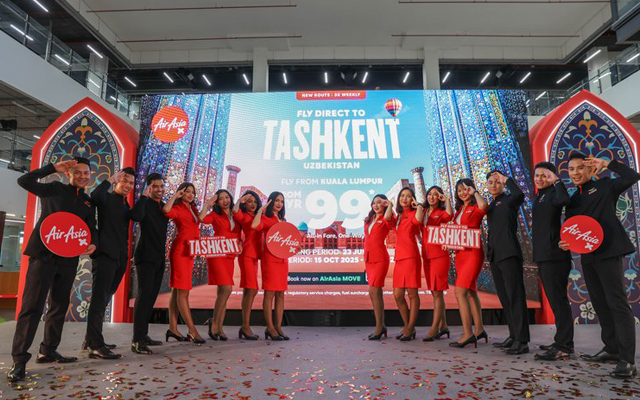
AirAsia X has craved out a brand new route to Tashkent, Uzbekistan, with three weekly flights between Kuala Lumpur and Tashkent to launch on October 15. The service is aimed at further facilitating air travel between South-east Asia and Central Asia, fostering stronger trade, tourism and business ties between the regions.

This connectivity will also enable more travellers in South-east Asia as well as Australia, to explore Uzbekistan affordably with AirAsia’s seamless Fly-Thru options, spanning over 130 destinations worldwide.

Hong Kong Airlines flies to Sydney
Hong Kong Airlines now connects Hong Kong with Sydney, Australia, marking the airline’s transformation to an international player.

The service is offered daily, with the flight departing Hong Kong at 22.25 and arriving in the Australian city the next day at 09.50. The flight then departs Sydney at 11.30 and arrives in Hong Kong on the same day at 19.15.

The route is operated with an Airbus A330 aircraft, featuring comfortable business and economy class cabins.

Royal Jordanian Airlines launches nonstop flights to Mumbai
Royal Jordanian Airlines has commenced a new nonstop route between Amman’s Queen Alia International Airport and Chhatrapati Shivaji Maharaj International Airport in Mumbai.

The new service operates year-round, four times a week – on Mondays, Tuesdays, Thursdays, and Fridays – aboard the modern Airbus A320neo.

This service strengthens connectivity between India and Jordan, and offers seamless onward travel to over 50 destinations across the Middle East, Gulf, and North Africa.

Vietjet eases Russia-Vietnam traffic

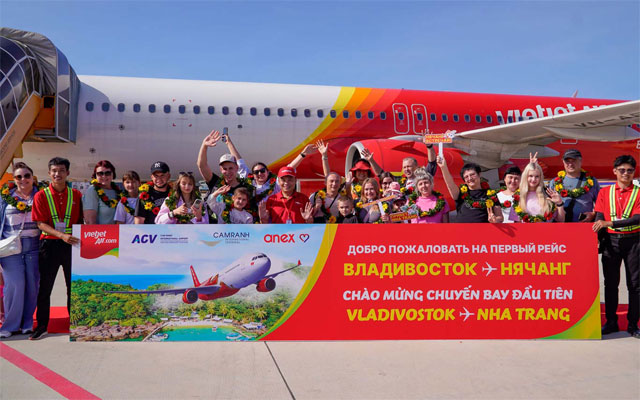
The popular coastal city of Nha Trang is now linked with three major cities in Russia’s Far East – Vladivostok, Khabarovsk, and Blagoveshchensk – following the commencement of new direct air services by Vietjet.

The inaugural flights took off on June 15 and June 18 from Vladivostok and Khabarovsk respectively, marking a new chapter in Vietjet’s international expansion.

The inaugural service from Blagoveshchensk is scheduled for July 9.

These flights are operated in partnership with leading international travel agencies as regular charter services. They are expected to meet the growing demand for travel between Vietnam and Russia, particularly as Russian tourism to Vietnam continues to recover. In the first five months of 2025 alone, Vietnam welcomed over 210,000 Russian visitors, with more than 100,000 arriving in Khanh Hoa province, home to Nha Trang, underscoring the destination’s strong appeal.

PATA’s mid-year tourism forecast shows 801 million arrivals expected by 2027

0

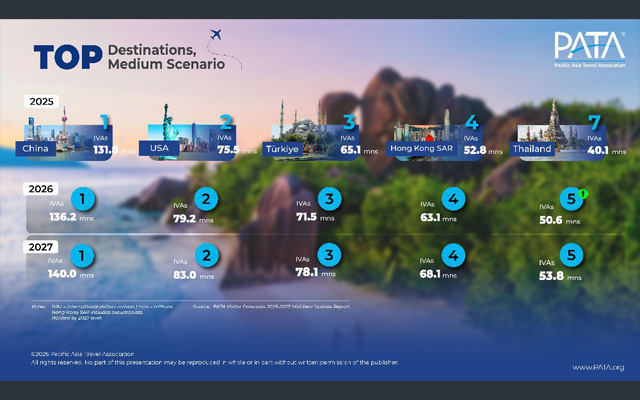
PATA’s newly released Mid-Year Update to its flagship Asia Pacific Visitor Forecasts 2025–2027 report, originally published in March, shows continued growth trajectory for international visitor arrivals (IVAs) to Asia-Pacific, with numbers set to reach 801 million by 2027, up from 692 million in 2025.

  • Strong recovery destinations: China remains the top inbound market, forecast to welcome up to 148 million visitors by 2027. The US and Türkiye follow closely. Notably, Türkiye and Mongolia are poised for the most robust recovery, outperforming pre-pandemic levels.

  • Evolving source markets: China continues to lead outbound travel, with the US, South Korea, and Japan showing stability. Meanwhile, India, the UK, and the Russian Federation are becoming increasingly significant source markets, reflecting a broader diversification in regional travel demand.

  • Policy and currency shifts reshape travel: Changes such as extended Chinese public holidays, evolving currency exchange rates, and tariff conflicts are reshaping outbound patterns and opening new regional corridors for travel.

  • Wellness tourism rising: With populations aging across many source markets, interest in wellness and preventative health travel is accelerating – creating an opportunity for destinations to develop more inclusive and health-focused offerings.

  • Digital influence driving demand: Social media, especially user-generated content, is rapidly influencing younger travellers, fuelling demand for authentic, experiential, and shareable travel moments.

The forecasts acknowledge the volatile environment – including ongoing geopolitical conflicts, economic uncertainty, currency volatility, and the intensifying negative sentiments of locals towards mass tourism.

PATA CEO Noor Ahmad Hamid said: “This mid-year update goes beyond forecasting – it’s a strategic guidance for tourism leaders across the region. As the industry grapples with unpredictable forces from geopolitics to global inflation, staying informed through timely, evidence-based insights is more important than ever.

“With the past six months having brought a wave of developments that directly impacted our industry, this report empowers destinations and stakeholders to anticipate market shifts, prepare for disruption, and uncover emerging opportunities – from wellness travel and digital influence to the shifting geography of source markets.”

The comprehensive mid-year update was developed in collaboration with the Hospitality and Tourism Research Centre of the School of Hotel and Tourism Management at The Hong Kong Polytechnic University, with contributions from PATA destination members and regional data partners.

Sentosa GrillFest 2025 returns with its biggest edition ever

0

Singapore’s Siloso Beach on Sentosa island will welcome the biggest GrillFest event to date, with 39 participating F&B brands across five zones and two new gastronomical experiences all lined up to deliver memorable evenings from July 17 to August 10.

A partnership with Offline Singapore, a homegrown social networking group, will elevate GrillFest 2025 from a food-centric gathering into a dynamic social experience. A series of GrillHouse Social Mixer Nights will be conducted, bringing 160 people together over four gatherings for social activities against a backdrop of live music, sizzling grills, and ocean breezes.

The pièce de resistance of GrillFest 2025 is the GrillHouse, an immersive dining experience that enables guests to become grill masters for a night with Ninja Foodi Smart XL Grill by Ninja Kitchen Singapore and premium ingredients from lyhseafood. There are three different curated platters to choose from, all featuring fresh and premium ingredients for guests to grill at their own pace.

Another new addition to GrillFest 2025 is Marketplace, where guests can handpick premium fresh ingredients and then have their selections cooked by expert chefs.

Further, in collaboration with Singapore Food Agency, Singapore Agro-Food Enterprises Federation, Seafood Industries Association Singapore, and Parkroyal Collection Pickering hotel, GrillFest 2025 will showcase how fresh seafood and other produce from local farms can be transformed into exceptional dishes.

Sensible and sustainable food sourcing at the event is joined by other efforts to reduce carbon footprint. Along with local start-up Staxx, Marketplace will have 25 per cent of its seats made from 100 per cent upcycled ocean-bound plastic. Guests are encouraged to bring reusable utensils, cups, or food containers for their meals – and efforts will be rewarded with a S$5 GrillFest voucher, limited to the first 50 redemptions daily. Washing points will be available at the event grounds to facilitate the use of such reusables.

Other highlights at GrillFest 2025 include International Grills, where flavours from around the world can be found; and Local Grills, where 18 of Singapore’s most exciting F&B brands will be showcased.

All are welcomed at GrillFest 2025, as event organisers have planned for smooth and barrier-free access for wheelchair users and families with strollers, as well as carving out 25 per cent of the seating areas for guests with mobility impairments.

GrillFest 2025 takes place from 16.00 to 22.30 on July 17, 18, 19, 20, 25, 26, 27, and August 1, 2, 3, 8, 9, and 10.

For more information, visit www.sentosa.com.sg/grillfest.

Amadeus, World Sustainable Hospitality Alliance join hands on education support

0

Amadeus and the World Sustainable Hospitality Alliance are deepening their collaboration to improve youth employment and promote inclusivity by providing young people with the skills and experience needed to embark on a hospitality career.

The initiative is part of Amadeus’ Community Impact programme focused on advancing digital inclusion and building skills for jobs in the travel industry as well as World Sustainable Hospitality Alliance’s Employability Program.

Amadeus and World Sustainable Hospitality Alliance are helping students in India with education needed for a hospitality career

Amadeus will commit to a long-term collaboration as a global partner in the Employability Program, helping to grow it across multiple countries, delivering impactful change to communities worldwide and transforming lives.

The first pilot project with Amadeus began recruiting students in April in India, in collaboration with the local non-governmental organization Kherwadi. This project will provide support to 200 disadvantaged young people in Bengaluru, Mumbai, Pune, and Delhi, and will engage local hotels and global brands.

In addition to financial support, Amadeus will contribute employee volunteering activities, mentoring, and hospitality software.

The Employability Program is currently operational in three countries – India, Egypt and Sri Lanka. It has seen over 6,000 young people graduate with the skills and experience needed to embark on their careers.

Glenn Mandziuk, CEO of the World Sustainable Hospitality Alliance, welcomes the generous support from Amadeus.

“We’re delighted to be working with Amadeus on this pilot, which will have a tremendous impact on local communities and serve as a model for the industry. This partnership with Amadeus illustrates how the hospitality sector can play a vital role in removing access barriers to employment and ultimately change lives. We look forward to expanding our program globally and transforming the landscape of our industry.”

Francisco Pérez-Lozao Rüter, president, hospitality, Amadeus, added: “At Amadeus, we believe sustainable hospitality means caring for the world around us and making a positive contribution to people, places, and the planet. This partnership is a testament to our commitment to drive social impact in communities where we operate all around the world.”

Middle Eastern air hubs lose shine amid ongoing conflict in the region

0

The Iran-Israel-US conflict, which started on June 13 when Israel launched a surprise attack on Iranian soil, has disrupted air travel in the Middle East and forced airlines to reroute long-haul flights to safer airspaces.

Providing an overview of airlines’ reaction to the instability in the Middle East, Mayur Patel, head of Asia at OAG Aviation, said: “Major airlines including Lufthansa, British Airways, Emirates, and Singapore Airlines have had to cancel or reroute flights. Singapore Airlines, for instance, suspended its flights to Dubai from June 22 following an internal security assessment, with the suspension remaining in effect at the time of writing (on June 25).”

He added that there has been “a significant drop in flights operating via key Middle Eastern air hubs, particularly Doha, Dubai, Abu Dhabi, and Manama” since June 13.

“The temporary closure of airspace over Iran, Israel, Jordan, Iraq, Syria, and briefly across parts of the Gulf led to widespread flight cancellations, diversions, and delays. For instance, Hamad International Airport in Doha saw over 250 cancellations and more than 200 delays on June 24 alone.”

This has resulted in preferred air corridors and air hubs shifting to other regions. Turkey, Egypt, and Saudi Arabia air corridors are favoured while European hubs such as Frankfurt, Istanbul, and Amsterdam, as well as Asian major gateways are processing higher transit traffic.

Patel also told TTG Asia that overall flight bookings to the Middle East have likely declined since June 13, driven by widespread cancellations and rerouting in response to the Israel–Iran conflict.

“Evolving airspace restrictions and heightened security advisories have led both businesses and leisure travellers to scale back their travel plans, even though precise booking data is not yet available,” he stated.

Ongoing conflicts in both the Middle East and Russia, along with a fragile ceasefire between Israel and Iran, have deeper operational impact on airlines, beyond an upset flight schedule and inconvenienced travellers.

Subhas Menon, director general of the Association of Asia Pacific Airlines, told TTG Asia: “The frequent closures and diversions as well as cancellations in some cases cause costs to go up and affect schedule reliability, not to mention the reaccommodation costs and cost to crew scheduling. Additionally, capacity which is already constrained will be further affected while demand remains resilient.”

Similarly, Patel also warned of a cost impact – carriers forced to adopt longer flight paths to avoid restricted zones will incur higher fuel consumption, extended crew duty hours, and increased operating costs. These burdens come on top of complicated crew scheduling and stretched operational resilience.

“These adjustments have triggered widespread delays, particularly on long-haul routes connecting Europe, Asia, and Australasia,” he noted.

Patel said: “Managing these changes amid evolving NOTAM (Notice to Airmen) advisories and congested air traffic control has further strained airlines – especially those operating hub-and-spoke models that depend on tight schedules and quick turnarounds.”

With the US now drawn into the Israel-Iran conflict amid its abrasive stance on global trade, Subhas said travel to the US “has definitely seen a downturn” while “traffic and trade flows on other routes are holding firm”.

He expects June’s air traffic report to show some short term effects due to the frequent disruptions to capacity.

As of this morning, several Persian Gulf states, including Qatar and the UAE, have reopened their airspace and resumed flights. Further, Flightradar24’s update on X stated that Iran has partially reopened its airspace to permitted international flights to and from Tehran.

A spokesperson from Royal Jordanian Airline told TTG Asia that operations had resumed after the second day of the conflict, and that the airline is among the few that continue to operate flights to the Levant region and Jordan. The airline launched its first non-stop service between Mumbai and Amman on June 19.

Frequent volcanic activities fluster tourism operators in East Nusa Tenggara

0

Intermittent eruptions of Mount Lewotobi Laki-laki in Flores, East Nusa Tenggara (NTT) over the past two years have significantly disrupted travel to the surrounding region, even though the volcano is not located close to popular tourist locations like Bali and Lombok.

Wind-blown ash commonly leads to cancellation of flights bound for and leaving surrounding airports. During the most recent major eruption on June 17, several airports on Flores Island were shut. Although Bali’s Ngurah Rai International Airport remained open, 32 domestic and international flights to and from Bali were cancelled, highlighting the volcano’s widespread impact.

Airports on Flores Island were shut when Mount Lewotobi Laki-laki erupted on June 17

Tour operators are frustrated with the unpredictable nature of Mount Lewotobi Laki-laki and the resulting business disruption.

Awan Aswinabawa, chairman of A&T Holidays, Lombok, told TTG Asia that he is still selling tours to NTT, but remains cautious of disruptions.

Oyan Kristian, CEO of NTT DMC, recalled the immediate drop in bookings for the region following Mount Lewotobi Laki-laki’s eruption in late-2024. While bookings for 2025 summer has picked up, he is worried about cancellations over the coming high season; there are travellers who had booked long in advance for destinations like Labuan Bajo

“We are afraid that our guests would not be able to fly in (if Mount Lewotobi Laki-laki erupts again),” he said.

Paul Talo, managing director of Floressa Bali Tours, said the frequent eruptions necessitated evacuations of tourists. He recalled having to take three tour groups out of Flores hastily by boat due to an eruption. His consolation is that tourists would choose to return to Flores when it is safe.

Industry players say there is a need for better preparedness to cope with the active Mount Lewotobi Laki-laki.

A&T Holidays, Lombok shares frequently updated information and recommends all customers to purchase travel insurance.

Floressa Bali Tours have alternative routes on stand-by, such as sea travel from Labuan Bajo to Bali, or ferry and land connections to Bima or Lombok.

“Rebooking after a cancelled flight is often difficult due to limited seat availability, making alternative modes of transport essential,” Paul said.

Industry players also urged improved support from airline and hotel partners.

According to Awan, flexibility is lacking in airlines when it comes to itinerary changes, especially when disruptions arise during peak season. He hopes that the Indonesia Ministry of Tourism could encourage airlines to be more adaptive to force majeure events.

Oyan also urged clearer policies on hotel refunds during natural disruptions. He recalled an experience with a hotel that refused a full refund for a cancelled group. The hotel partner reasoned that the airport was not officially closed, even though conditions were unsafe to fly and the group could not get to the destination.