
Asia/Singapore Sunday, 5th April 2026
Page 385

Terror impact on travel to London saved by weak pound

0

London bookings for the period between July 1 and October 31 are 14 per cent ahead of where they were at the beginning of July last year, with the increase led by markets in the Americas (+21 per cent) and Asia-Pacific (+14 per cent), according to ForwardKeys.

ForwardKeys noted that the growth trend, evident from the first half of 2016, was further sparked by the sterling exchange rate falling to its lowest level in 30 years against the dollar in mid-October last year.

View of London’s financial district

Only the Middle East is lagging, currently 20 per cent behind July-October in 2016, due mainly to a fall in oil price hurting Middle Eastern economies and the timing of Ramadan, which fell earlier this year.

Benchmarked against its European competitor cities, London has the biggest market share of longhaul bookings for arrivals between July and October at 12 per cent, versus nine per cent for Paris and seven per cent for Rome.

Bookings from BRIC (Brazil, Russia, India and China) are returning. All show double-digit growth in forward bookings for London and, with the exception of India, their citizens are showing greater interest in London than the rest of Europe, ForwardKeys observed.

Looking at the more significant origin markets, i.e. those with a share of 0.5 per cent or more, Chile is the one showing the greatest growth in forward bookings, 67 per cent ahead. It is followed by Brazil (48 per cent ahead), Taiwan (43 per cent ahead) and China (35 per cent ahead).

Olivier Jager, ForwardKeys co-founder and CEO, said: “This is an obvious and clear demonstration of how currency fluctuations affect travel, even in the face of other significant factors. London is great value at the moment and people are springing at the opportunity for a holiday, costing less than they might have anticipated.”
GBTA forecasts pricier airfares, hotels in 2018

0

The 2018 Global Travel Forecast released by by Carlson Wagonlit Travel and GBTA Foundation projects a 3.7 and 3.5 per cent increase in global airfares and hotel prices respectively, although ground transportation costs are expected to rise only 0.6 per cent, significantly less than the three per cent inflation rate forecasted.

“The higher pricing is a reflection of the stronger economy and growing demand,” said Kurt Ekert, president and CEO, Carlson Wagonlit Travel. “The global numbers from this forecast should be considered strong leading indicators of what 2018 will mean for global businesses, as we anticipate higher spending.”

Across Asia-Pacific, hotel prices are expected to be up 3.5 per cent – with a large discrepancy as Japanese prices are expected to fall 4.1 per cent while New Zealand is set to rise a full 9.8 per cent.

GBTA also cautioned that buyers should anticipate more challenging rate discussions with newly merged hotel groups, especially in high-volume markets such as Bangkok, Beijing, Shanghai and Singapore.

Hotel prices across EMEA are likely to also rise – 6.6 per cent in Eastern Europe, 6.3 per cent in Western Europe, but only 0.6 per cent in the Middle East and Africa. Within Latin America however, prices are expected to fall 1.2 per cent.

North America hoteliers may be banking on economic growth as demand has levelled off since mid-summer 2016, but supply is expected to continue growing steadily through 2018.

In air travel, Asia-Pacific could see a 2.8 per cent rise in airfares with domestic demand increasing, particularly in China and India.

Air travel is anticipated to continue growing across EMEA, with prices rising 7.1 per cent across Eastern Europe and 5.5 per cent in Western Europe. However, Middle East and African countries are projected to see only a three per cent increase as they face ongoing security threats and an oil industry that is still in recovery.

In North America, GBTA forecasts a modest 2.3 per cent rise in price. Canadian airlines are expected to aggressively compete given new market entrants. With the region’s air travel market nearly flat year-over-year in early 2017, competition is fierce between carriers who now compete on branded fares rather than bundled fares or by carrier type.

Meanwhile, minute increases are projected for ground transportation prices globally. In Asia-Pacific, continued uncertainty in mining and a cautious recovery in the oil and gas industry will result in flat rates for 2018.

As well, sharing economy suppliers Didi Chuxing in China, Ola in India and Grab in South-east Asia have all achieved economies of scale that make them key competitors to more traditional car rentals firms and taxis.

Hong Kongers, Russians most forward-planning travellers: Agoda

0

An analysis of Agoda data from 2016 revealed that Hong Kongers book the furthest in advance and Saudi Arabians the most last minute, as the trend on the OTA shifts towards in-advance bookings.

Contrary to the perception of being in an age of ‘instant gratification’, lead-time for Agoda bookings on average increased by two days compared to 2015, said Andy Edwards, Agoda’s global director brand and communications.

“Price and choice play a driving factor when booking travel… Popular culture portrays this image of the adventurous, last-minute traveller, but in reality consumers are investing more time preparing for their holiday to get the most out of their well-deserved break,” he explained.

In Agoda’s ranking of forward planners by nationality, Hong Kongers took top spot for the second year running, on average booking 49.4 days prior to travel. In second place are Russians, who have moved up two rungs from fourth position in 2015, with a booking lead-time of 46 days.

Australia follows in third place (44.3 days), then Taiwan (43.3 days) and the UK (37.2 days) respectively.

In the bottom five spots are Malaysia (24.4 days), India (21.7 days), Vietnam (18.7 days), Indonesia (18 days) and Saudi Arabia (16.9 days).

Meanwhile, when it comes to booking accommodation overseas versus domestic travel, Singapore and Hong Kong took joint lead due to the city size, with nearly all bookings (99 per cent) being outbound. The UK came in third, with 38 per cent of hotel bookings outbound and 62 per cent booked domestically.

On the other hand, findings from the powerhouse markets of the US and China go in the other direction. In the US, just eight per cent of all hotel bookings support international travel and 92 per cent support domestic travel, while some 98 per cent of China’s bookings are placed domestically.

Companies overspend on last room availability rates: CWT Solution

0

There’s an approximate five per cent gap between perceived and actual value of last room availability (LRA) rates, according to an analysis of over 7.3 million bookings across 97 countries by CWT Solutions Group, the consulting division of Carlson Wagonlit Travel.

When companies have negotiated LRA rates, they have the right to buy a room at their contracted terms and prices even if the hotel only has one room left in that category. Without a negotiated LRA clause, it’s at the discretion of the hotel as to what price they sell the last rooms.

“LRA rates have been the gold standard for hotel agreements since the 1980s, and no one has ever really questioned that. But we have now looked into this in great detail and it seems like the gold has lost some of its shine,” said Eric Jongeling, director, hotel solutions.

“Our research shows between five and 11 per cent differences in some markets so travel managers should bear this in mind when negotiating global rates.”

Some 44 per cent of hotels charge a premium for including an LRA clause, although there’s a 12 per cent chance the traveller will not be able to stay at the contracted rate even with an LRA agreement in place, the study further revealed.

CWT Solutions Group opined that the availability of multiple hotels in a target market negates the need for an LRA clause. Furthermore, the perceived value differs considerably between premium and economy hotels and between cities.

Singapore hotel rates in June slump to lowest in recent years

0

Singapore hotels saw absolute ADR and RevPAR levels hit their lowest for the month of June since 2010, according to preliminary data from STR.

The country has posted year-on-year declines in ADR each month since February 2016, which STR analysts attribute to growing hotel supply and economic challenges.

In June 2017, ADR fell 2.5 per cent year-on-year to S$258.03 (US$188.56), while RevPAR was up 1.5 per cent to S$203.62.

This was despite a 4.1 per cent increase in occupancy to 78.9 per cent, alongside a 6.5 per cent demand increase and 2.3 per cent supply growth.

STR analysts noted that Singapore’s strong demand for the month was likely boosted by an 11-day calendar shift in Ramadan. With an earlier Eid Mubarak, the usual influx in foreign visitors from key tourism source markets like Indonesia occurred in June as opposed to July.

An easier road from Mandalay drives Bagan’s tourism growth

0

In 2016, international visitors into Bagan grew 17 per cent to 282,387, with the largest increase coming from overland tourists due to improved Mandalay access, according to C9 Hotelworks’ Myanmar Tourism Market Overview June 2017 report.

While Nyaung U Airport is currently Bagan’s main gateway, accounting for 44 per cent of total foreign visitors, C9 reported that the share of overland arrivals grew from 24 per cent in 2013 to 38 per cent last year on the back of improved access from Mandalay, the second largest city in Myanmar and with its own international airport.


Htilominlo temple, Bagan

Bagan’s top five source markets were the US, the UK, Germany, France and Japan. Overall, Europe and the US represent approximately 24 per cent of international markets followed by Asia at 14 per cent.

FIT bookings currently make up 38 per cent of hotel stays, with the remaining coming from agents.

“Hotels are also experiencing stronger visitation from the domestic market, (as) local destinations become popular vacation spots on national holidays such as the Water Festival. The trend is anticipated to increase tourism demand during the low season, which falls in the second and third quarters of each year,” added Bill Barnett, managing director of C9 Hotelworks.

Within the next two years, 804 additional keys are expected to come on-stream, with a trend towards smaller scale development, the report revealed.

However, the growing hotel supply is set to stabalise in the mid-term especially in the outer area of Nyaung U and New Bagan due to the prohibition of new developments within the city’s Archaeological Zone, Barnett said.

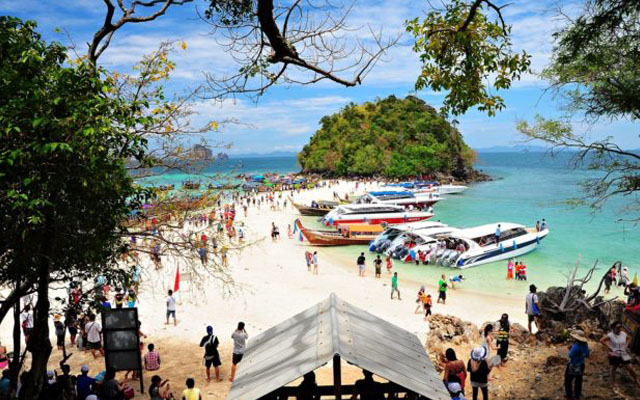
Krabi hits record arrivals with China claiming lion’s share

0

Airport passenger arrivals into Krabi rose from 376,000 a decade ago to 2016’s record high that eclipsed two million, according to the latest Krabi Hotel Market Update by C9 Hotelworks.

“While the market has steadily moved forward during the past decade, tourism revenue went into overdrive in the last five years. In 2016, tourism receipts hit 84 billion baht (US$2.4 billion), which has more than doubled the figure in 2010 of 30 billion baht,” added Bill Barnett, managing director, C9 Hotelworks.


Market share of international passenger arrivals from Greater China rose from 38 per cent in 2014 to 61 per cent in 2015, and hit 66 per cent in 2016.

The report shows a total of 14,352 direct and connecting flights bound for Krabi International Airport last year, 27 per cent of which departed from Greater China. International flights from South-east Asian countries accounted for 13 per cent, led by Kuala Lumpur, Singapore and Penang.

“Krabi’s legacy tourism markets of Sweden, France and Germany have been marginalised by a remarkable rise of Chinese tourists,” Barnett commented.

Such change in visitor profile contributed to the destination’s best performing months shifting from the traditional December peak to February in 2015 and 2016, according to the report.

Meanwhile, citing numbers from STR, C9 revealed that Krabi’s international hotel market for FY2016 outperformed that of Phuket in terms of market-wide ADR.

Despite a decline of 1.9 percentage points in occupancy rate to 71.5 per cent last year, RevPAR grew to 3,069 baht driven by an increased ADR of 4,292 baht.

Some 438 new hotel keys were added to the market in 2016, which represented a two per cent rise in total supply.

A total of 598 additional keys are expected to enter the hotel market throughout 2017, with 160 keys already introduced in Q1.

APAC hits record 597 million inbound arrivals: PATA

0

Foreign arrivals into Asia-Pacific increased three per cent to 597 million in 2016, led by Asia with almost 436 million international arrivals (70 per cent), followed by the Americas with close to 147 million arrivals (34 per cent) and the Pacific with 24.5 million international arrivals (12 per cent), according to PATA’s Annual Travel Monitor 2017 Early Edition.

Intra-regional travel flows were extremely strong for Asia and the Americas, the report stated, with 94 per cent and 78 per cent of their inbound volumes respectively arising from within the same region.


South Korea among 17 destinations that saw double digit growth; Bukchon Hanok Village, Seoul pictured

Seventeen of the 47 destinations surveyed in the study saw double-digit growth rates, including Nepal and South Korea which each saw increases of more than 30 per cent, and over 20 per cent for Mongolia, Japan and Vietnam.

Growth was once again not uniform across Asia-Pacific with seven destinations reporting contractions. However, despite significant challenges, Turkey’s tourism sector saw nearly 18 million additional arrivals added to its foreign inbound count year-on-year.

Origin markets in North-east Asia were the largest generators of absolute volumes, led by China and Hong Kong which generated 108.5 million and 93.7 million arrivals respectively, followed by Macau (24.4 million arrivals), South Korea (23.2 million), Japan (20.3 million) and Taiwan (19.8 million).

Singapore was the only South-east Asian origin market within the top 10 feeder markets, generating close to 19.9 million visitors.

Among the origin sub-regions, North-east Asia topped that list with an additional eight million arrivals within its own sub-region between 2015 and 2016, and 4.4 million additional arrivals into South-east Asia.

The reverse was also true with South-east Asia generating 2.2 million and 1.8 million additional foreign arrivals into North-east Asia and South-east Asia itself respectively.

Mother-daughter, father-son travel a trend to watch for Australian families

0

Results from a recent Virtuoso survey of 772 travel advisors show a strong trend towards mother-daughter and father-son getaways, reflecting greater demand for experiences and signalling “an important time for bespoke travel agents as they move from selling packages towards listening to (clients)”.

Travel advisors say they are being asked to curate experiences, often a holiday that incorporates the particular interests of all family members rather than the traditional fly-and-flop holiday, shared Virtuoso’s Asia-Pacific managing director, Michael Londregan.

“As a society we are moving out of the commodity economy of more ‘stuff’ into an experiential one where our desire for experiences out-rates the things we might buy,” Londregan opined.

“This is being reflected in the decisions we make about what we do together. When we ask ‘what can we give mum or dad as a gift?’, we are thinking less about a new ‘thing’ and more about personal experiences such as a weekend escape or a pampering experience.”

The survey also revealed that the top five destinations for Australian families are Fiji, the US, Singapore, Italy and Hawaii.

Agents still wanted as Chinese get more involved in travel planning

0

Amid burgeoning information and greater opportunities to travel, Chinese travellers are wanting more personalised holidays while still valuing support from travel service providers, according to Sabre’s Evolving Chinese Traveller Study.

Today, nine out of 10 Chinese travellers say they have the means and are hoping to travel more frequently as compared to five years ago, with top contributing factors being better disposable income (20 per cent), enabling technologies that make travel more convenient (17 per cent) and access to relevant information (15 per cent).

Sabre refers to this as “a new era of ‘mass tourism’”, with travellers starting to pay attention to quality and become more inclined towards personalised travel experiences.

Seventy four per cent of respondents expressed they are willing to spend time and energy on their travel plans, although this does not come at the expense of external support. In fact, 78 per cent of respondents still welcome support from friends, relatives and travel service providers.

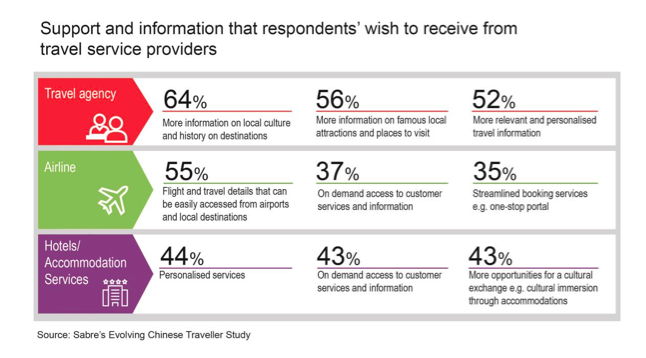
From travel agents, respondents mainly wish to get more information on local culture and history (64 per cent), famous local attractions (56 per cent), and more relevant and personalised travel information (52 per cent).

Three to five years ago, respondents felt that there was a lack of travel information available to them (60 per cent). Now, 46 per cent believe there are too many travel options and information available.

Meanwhile, the report noted that the new generation of travellers – comprising digital natives who grew up with the Internet – tend to be more demanding when it comes to travel experiences, and are motivated beyond traditional sightseeing.

The top travel motivations for these travellers are to find an outlet where they can relax (25 per cent), have a good time with friends or family (22 per cent), and seek a better understanding of foreign cultures (17 per cent).

Sabre observed there are two overarching attitudes toward travelling. While 49 per cent of the respondents see travel as a means of personal improvement, over half (51 per cent) say it has become a new form of social currency.

For the latter, this means that travel has become a platform to connect and build stronger emotional bonds (57 per cent), and a way of enriching their life experiences to share with friends and family (56 per cent).