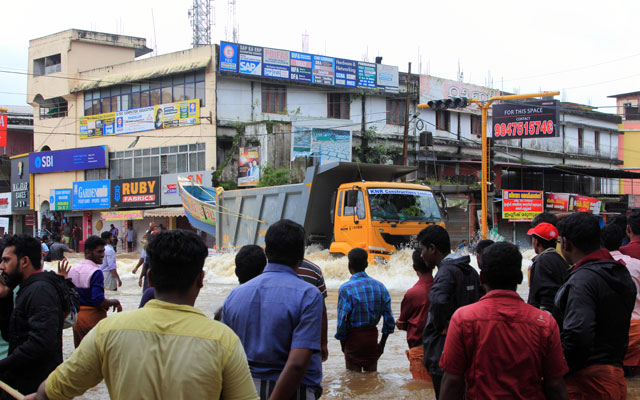
The tourism sector of Kerala, already reeling under pressure in the wake of the Nipah virus outbreak in the state, received another jolt when the recent torrential rain resulted in floods.
“Kerala, which is generally one of the hotspots for both domestic and international tourists, has had a bad time these last few months. First it was the Nipah virus (though it was confined to certain parts of North Kerala) that affected the domestic tourism season of May and June, and now it is the devastation caused by the floods,” said Kapil Goswamy, managing director, Trans India Holidays.
Kerala has been badly affected by the floods during the monsoon season
“During the monsoon season (July, August and September), Kerala normally gets a good number of domestic tourists, a small number of international tourists, and a significant number of Ayurveda or wellness seeking international tourists. The last month or so have unfortunately, been a washout for tourism, and even though the situation is improving now, it will be a few months before we see any upswing in tourism numbers,” he added.
Access to many of the tourism destinations like Munnar, Idukki and Periyar has been severely affected because of the worst floods in a century in the state. Kerala’s busiest and biggest airport in Kochi has been shut from August 16 and will be opened on August 29.
GDP generated by the state is expected to fall to 6.5-7 per cent from the budgeted 7.6 per cent this fiscal year, according to a report by Care Ratings. The tourism and hospitality sector contributes 40 per cent of the state’s GDP.
“The ongoing floods will have a deep impact on the tourism business to Kerala and everybody will wait for the situation to improve. The tourists who had booked their tours for the coming few months will definitely either change the destination or postpone their visit. This all depends on the situation after the flood water recedes and the situation becomes clearer,” said Arun Anand, managing director, Midtown Travels.
Tour operators have already started receiving cancellations. “From international markets we are experiencing cancellations from travellers booked during the months of late September to November, and from the domestic market there are hardly any queries for travel to Kerala during the coming months. All of us in the tourism industry hope that Kerala recovers soon,” added Goswamy.
Despite the devastation wrecked by the floods, Kerala-based EM Najeeb, senior vice president, Indian Association of Tour Operators, remains positive for the coming inbound season prospects.
“Our expectations are still high and our outlook of a productive season is intact despite many challenges. The tourism industry feels that the season would go normal without much damage, unless there are last-minute cancellations closer to the season,” he said.
Some tour operators see an opportunity to combine Kerala with neighbouring states in their tour packages. “The situation in Kerala calls for a greater innovation and efforts to sell the destination. We have to include other states or innovate with itineraries and ensure to convince international tourists to place their trust in this region, but we are determined to sell Kerala and support are partners there,” said Rajat Singhal, director, Leisure World Tours.
The PATA Adventure Travel and Responsible Tourism Conference and Mart 2019 (ATRTCM 2019) will be held in Rishikesh, Uttarakhand, India from February 13-15.
The three-day event, hosted by the Uttarakhand Tourism Development Board, comprises a one-day travel trade mart and one-day conference that brings together public and private sector tourism professionals involved in adventure travel and responsible tourism.
Rafting in the River Ganges, Rishikesh
“The PATA ATRTCM has enjoyed outstanding success in recent years in Thimphu, Bhutan; Chiang Rai, Thailand; Luoyang, China, and Al Ain, Abu Dhabi, UAE and we (now have) the opportunity for the first time to focus upon the opportunities for adventure travel and responsible tourism in Rishikesh, Uttarakhand, India,” said PATA CEO Mario Hardy.
Guarded by the hills of northern Uttarakhand, the city of Rishikesh has been dubbed `Yoga Capital of the World’. It shot to fame in the 1960s when The Beatles came to stay with their guru, the Maharishi Mahesh Yogi.
But besides its temples, pilgrimage sites and the Ganges River, Rishikesh is today becoming known for adventure sports such as white-water rafting, cliff-jumping, kayaking and camping. It also serves as a gateway to the Garhwal Himalayas, being a designated starting point for treks to numerous Himalayan pilgrimage centres and shrines.
PATA is offering early bird discounts for all registration fees until October 31, 2018, while special rates are available for Uttarakhand delegates.
For more information or to register for the event, please visit www.PATA.org/ATRCM or email ATRTCM@PATA.org.
US president Donald Trump’s tit-for-tat trade war with China appears to have caused a significant slump in Chinese visitors to the US that could cost the American tourism sector dearly this year, according to ForwardKeys.
Weekly bookings from China to the US were up 2% from the last week of February (after the Chinese New Year holiday) to March 23 when the first tariffs took effect.
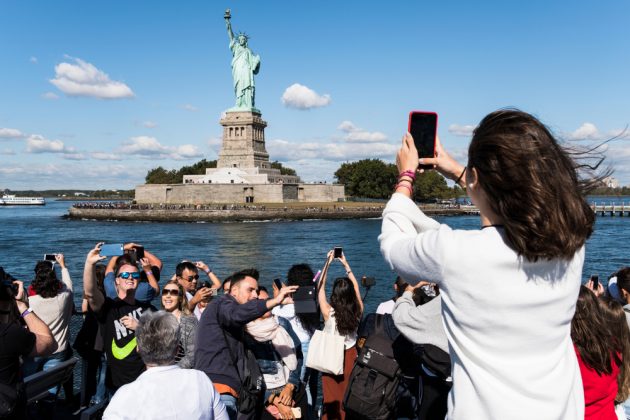
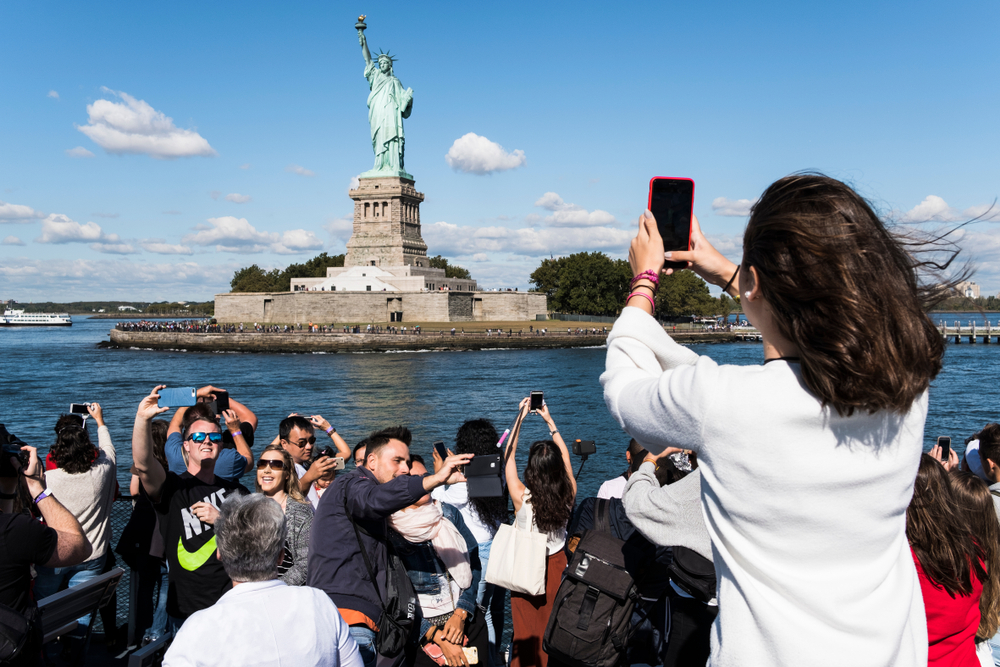
Chinese tourist taking a photo of the Statue of Liberty in New York City
Since then, ForwardKeys data shows the year-on-year figure to August is down by 8.4%, falling further as new rounds of tariffs have been announced.
ForwardKeys said the negative impact on the Chinese currency, which has fallen 7.5% against the US dollar since tariffs were introduced – meaning tourists’ money buys less – and warnings from Beijing about US travel security risks, have likely further influenced the trend.
ForwardKeys’ data reveals that for the rest of the year, Chinese outbound bookings to the US are 9.6% behind where they were at the same time last year, whereas Chinese outbound bookings worldwide are ahead by 5.5%.
This pattern of growth worldwide but slowdown to the US is consistent in every month except October. A general setback in October is due to this year’s Mid-Autumn festival falling at the end of September, which draws departures at the start of the busy National Day Golden Week holiday into September from October.
The biggest impact has been on bookings for group travel (six or more passengers) from China to the US, currently behind for the rest of 2018 by 34.4% compared to last year.
FIT bookings are behind 3.9%, with leisure travel being worse affected than travel for business or travel to visit friends and relatives, ForwardKeys pointed out.
By way of a benchmark, Chinese bookings for travel to Canada were up 4.8% to the end of July and are currently ahead 8.0% for August to December.
ForwardKeys CEO and co-founder, Olivier Jager, said: “Our findings strongly suggest that president Trump’s trade war has had a significant impact on Chinese tourism to the US. Looking at the year to date, we see a setback in Chinese tourism arrivals of just under 5%. If that continues to the end of the year, we estimate that the cost to the US economy will be north of half a billion US dollars in 2018.
“Chinese spending in this sector is significant – it amounts to the largest category of US services exports to China. It is unquestionable that the Chinese appetite for visiting the US is diminishing, and that is bound to worry the US travel industry.”
Nearly one in five Hong Kong couples who have argued during travel have considered breaking up after arguments, while 13% argue about photo taking, according to a recent survey by Skyscanner.
With this year’s Double Seventh Festival, also dubbed the Chinese Valentine’s Day, falling on Friday, Skyscanner surveyed 1,100 travellers from Hong Kong who take trips with their partners to find out where the points of friction are.
Getting lost tops the list of common reasons for couple to argue
The survey shows that most couples travelled with their partner for the first time after dating for less than a year, with 36.6% saying their first trip with their partner happened in the first one to six months and 27.2% saying six months to a year. Only 4.6% waited less than one month to embark on their first trip together.
When it comes to arguments, these can take place at any time during the trip. 36% of respondents argue during the trip, while 12% fight about trip planning when creating travel itineraries and booking tickets.
A larger proportion of respondents (44%) said they had never argued with their partners for the trip.
However, among those who do argue during holidays, almost one in five (18.9%) said that the fights had been so serious that they had even thought of breaking up after the trip.
The findings reveal that not getting to attractions on time and getting lost tops the list of the most common reasons for couple to argue (17%), followed by different expectations on the travel experience (14%).
Notably, 13% of respondents either argued about their partner’s ability to take nice photos or that they were taking too many photos during the trip.
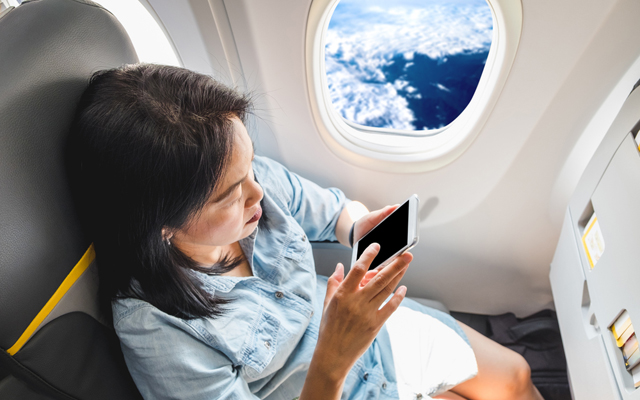
Over three quarters (78%) of passengers would more likely rebook with an airline if high-quality inflight Wi-Fi is offered, according to the fourth annual global Inflight Connectivity Survey published by Inmarsat in association with market research company Populus.
It should be noted that Inmarsat is a provider of global mobile satellite communications services; the findings thus might be self-serving.
Wi-Fi is considered the second most important factor for passengers in Asia-Pacific when choosing an airline, behind only reputation
Nevertheless, the study shows that almost three quarters (72%) of Asia-Pacific passengers who had access to inflight Wi-Fi in the past year chose to use it – the highest uptake of any region globally. Almost nine in 10 (86%) passengers in Asia-Pacific would use inflight Wi-Fi if it were available on their next flight.
With two thirds (67%) of Asia-Pacific passengers describing inflight Wi-Fi as crucial, meeting the demand for Wi-Fi in the skies is key to improving passenger experience and driving loyalty in the region, the report argued.
In fact, inflight Wi-Fi is considered the second most important factor for passengers in Asia-Pacific when choosing an airline, behind only airline reputation, said the report.
Onboard Wi-Fi could also lead to more productive business trips, as almost nine in 10 business travellers (88%) in the region would use inflight Wi-Fi to continue working on the plane. Access to Wi-Fi is also an important driver of choice for nervous flyers, as two thirds (64%) said that they would use the technology to remain in contact with family and friends on the ground.
An earlier Inmarsat survey published in 2016 showed that the majority of airline passengers would sacrifice other inflight amenities for Internet access, with 54% saying they would choose Wi-Fi over an inflight meal.
Notably, today’s passengers are adding alcohol to the list of inflight amenities they would sacrifice to get online, with more than half of passengers in Asia-Pacific (51%) suggesting they are even prepared to give up their inflight alcoholic drink in exchange for access to Wi-Fi.
More than 9,300 passengers from 32 countries across Europe, the Middle East, Asia-Pacific, and North and Latin America were surveyed.
Advanced flight bookings to airports around the holy city of Mecca ahead of this year’s Hajj have rose from Asia, Europe and Oceania, according to a Travelport report, even as bookings from North America are flat on last year and travel from South America and Africa is slightly down on 2018 numbers.
As part of its study, Travelport analysed bookings made through all GDSs to King Abdulaziz International Airport, Ta’if Regional Airport and Prince Mohammed Bin Abdulaziz International Airport, as of July 21, 2019, arriving from July 9, 2019 to August 8, 2019. The company then ran comparable data for last year’s Hajj, so trends could be identified.
According to Travelport data, Asia recorded the greatest growth in flight bookings made through GDS to airports around Mecca this year in terms of volume, with bookings up by 11,284 (+5 per cent).
Overall, bookings made in Asia represented 64 per cent of total bookings globally.
On a country level, the greatest growth came from Bangladesh, with bookings up by 13,906 (+171 per cent). The South Asian country is one of five countries (Bangladesh, Indonesia, Pakistan, Malaysia and Tunisia) benefiting from the Mecca Route initiative, a new service offering immigration pre-clearance for pilgrims at their points of embarkation.
The UAE recorded the second highest rise, up 3,981 (+17 per cent); followed by Qatar, up 3,278 (+217 per cent), a country where pilgrims can now register for their Hajj using dedicated “electronic gates”.
The greatest number of flight bookings made through GDS in Asia were made in India (44,611).
Damian Hickey, global vice president and global head of air travel partners at Travelport, said: “There are many things that influence the decision to travel, especially when it comes to something as personal as performing the Hajj. For some, economic conditions and increased allocations from the government in Saudi Arabia could make this year the ideal time for this once-in-a-lifetime opportunity. Others may be looking at their situation and thinking that it might be better to wait. This diversity of push and pull factors was certainly evident in the travel trends that we’ve seen around the globe.”
Hickey added: “In recent years, we have seen an increase in efforts to introduce policies and technologies that make the Hajj, which has often been compared to hosting an Olympics Games each year, a more convenient experience for the global Islamic community. Our analysis suggests that these initiatives may well be having a tangible impact, which is encouraging from a technological standpoint.”
Every year, more than one million people from all over the world fly into western Saudi Arabia to perform Hajj, making it one of the largest annual spikes in global air traffic. To manage numbers from overseas, Saudi Arabia sets quotas for countries based on their Muslim population. Local governments and licensed private travel companies then begin allocating places for citizens.
Researchers at The Hong Kong Polytechnic University (PolyU) conducted a study to evaluate if Airbnb complements existing accommodation provision or presents disruptive competition that may threaten the traditional market in Singapore.
The findings were presented in Accommodating the Sharing Revolution: A Qualitative Evaluation of the Impact of Airbnb on Singapore’s Budget Hotels by Professor Brian King and Edward Koh, student of the Doctor of Hotel and Tourism Management programme, of the School of Hotel and Tourism Management at PolyU.
Orchard Road in Singapore
Threat looms over ‘clear benefits’
Homesharing sites allow homeowners to “optimise their assets” and offer consumers diversified accommodation options, thus facilitating entrepreneurship, supplementing incomes and widening consumer choice.
However, there is concern over how these developments threaten industry incumbents, particularly those in direct competition at the budget end of the market.
The researchers note that Airbnb entered the market in 2008 and has since undergone “exponential growth”: between 2010 and 2015, the number of rooms booked increased by 105 times and revenues by 115 times.
Staying in local residences offers tourists more localised experiences at prices that compete with one and two star budget hotels, which may need to “differentiate with a view to ensuring their survival”.
Disruptive or complementary?
To evaluate the impact of Airbnb on the traditional market, the researchers started out by searching the platform to identify the available accommodation options in Singapore and compared prices with those offered by traditional hotels and hostels. The average price of S$90 (US$66) for a private room was roughly equivalent to the price of an economy hotel with an average rate of S$105.
Shared rooms on Airbnb averaged S$55, slightly above the average room rate for hostel beds, which started at around S$20. The average Airbnb price for an entire home, S$229, was also higher than the equivalent mid-tier hotel price of S$174.
The researchers also conducted interviews with managers or representatives of four mid-tier hotels, three economy hotels and three hostels, and with a representative from Airbnb’s Asia headquarters in Singapore.
All the hotel and hostel representatives surveyed felt that competition had increased in recent years, and all but one attributed this to the “entry of new mid-tier and economy hotels”.
The increased capacity has not only resulted in lower occupancy rates for mid-tier and economy hotels and hostels, but has also created a price war that had seen prices drop by as much as 50%.
As one hotelier noted, “owning and operating standalone hotels is making increasingly less commercial sense”, while others said that they were finding it increasingly difficult to recruit personnel because of the increased demand from new hotel entrants.
Nevertheless, a majority of the mid-tier and economy interviewees did not perceive Airbnb as posing a direct threat to their business, and were unconcerned about a “prospective glut” of rooms.
Although two of the hostel operators listed their rooms on the site, they said that the associated revenues were insignificant, leading the researchers to conclude that “Airbnb consumers are generally uninterested in hostel options” and that hostel users are “not active Airbnb users”. Rather than representing a threat to existing operators, it seems that Airbnb has generated new markets by attracting budget-conscious families. This, the researchers note, has “expanded the tourism economy for the benefit of all industry players”.
Striking a balance between regulation and competition
All of the interviewees agreed that regulations are needed to guide the home rental market. In particular, they suggested that third party management companies should be allowed to “transact on behalf of home owners and tenants”, which would allow them to be held accountable by the local authorities and ensure compliance in terms of “tax payment and other regulations”.
Airbnb rentals should also be made to comply with standard safety regulations, such as maintaining guest registers and installing CCTV cameras, because poor safety standards could compromise Singapore’s reputation as a safe city. Another problem area that was highlighted by the interviewees is the employment of foreign domestic workers as chambermaids, which is “in clear contravention” of employment laws.
According to the interviewees, the current lack of regulation in the home rental market means that traditional operators and Airbnb hosts are not competing on a “level playing field”.
For instance, serviced apartment operators are only allowed to accept guests for a minimum of a week, while hostel operators must have at least six beds per room, making it impossible for them to offer single and twin-bedded rooms.
Still, interviewees supported the Singapore government’s “belief in fair competition and advocacy of extended consumer options”. Hence, they did not want to see overly cumbersome regulation that would prevent market entry. If the market continues to be unregulated, however, the interviewees expressed concern that conversions of private housing into home rental accommodation may proliferate and that such rapid expansion could certainly represent a future threat.
The Airbnb interviewee did not see the company as a direct competitor to traditional hotels, but rather as “filling a demand gap, namely the budget-conscious family segment”. The interviewee emphasised that the company is quite different from a hotel chain, and merely offers a platform to facilitate transactions, with revenues flowing directly to homeowners. In response to calls by hoteliers to regulate the home rental market, the representative said that the company is “keen and ready to operate within a fair regulatory framework” and would adhere to any new legislation.
Airbnb not a threat – at least not yet
Overall, the researchers say the findings of the study should be of some reassurance to economy and budget hotel operators who are concerned about the rapid rise of the sharing economy.
Despite impressive growth, home rental accommodation sites do not seem to represent a direct threat to existing operators. The main concern is the lack of market regulation, with new hotels and hostels posing the main competitive threat. The researchers argue that governments should introduce legislation to level the playing field so that Airbnb and similar sites can operate as collaborators rather than competitors in future and the market can expand for the benefit of all.
The threat posed by the rapidly growing home rental market could intensify unless the government introduces regulations to “level the playing field” in the near future, the researchers say.
Though some European cities have introduced legislation to regulate the growth of the sharing economy, the researchers note that the market is largely unregulated.
In Singapore, the government recently enacted a law that makes it “illegal for private homeowner to rent out entire apartments and rooms for less than six months” without approval from the Urban Development Authority, but is currently considering a new category of private homes that will be permitted to offer short-term rentals.
The recently released publication, New Horizons IV: A global study of the youth and student traveller, has revealed six trends for the under-30 travel market, the millennials and Generation Zs.
The report is based on the New Horizons Survey, which is conducted by WYSE Travel Confederation every five years. In 2017, the survey had more than 57,000 responses from 188 countries and territories.
Travel splurging
When the New Horizons Survey asked millennial and Gen Z travellers what they were willing to splurge on during their trips, they were clear about their preference for experiential purchases.
Thirty-seven percent of respondents were willing to shell out extra cash for food and drink experiences. Traditional travel luxuries, such as airfare upgrades, were favoured least.
The 2017 New Horizons Survey also revealed a 26% jump from 2012 in the level of activities young travellers undertake while in a destination. As such, adding unique, one-of-a-kind experiential elements to the basic travel journey might be more productive than trying to develop premium travel products aimed at millennials.
Those who journey beyond their home region reported being happier than those travelling within
Growing information intensity and utilisation of OTAs
The number of different information sources used to research the main trip has climbed steadily, from three in 2002 to more than 10 in 2017. Friends and family were still the most used information sources in 2017, but the importance of social media and comparison or referral websites grew significantly from 2012.
A decade ago, physical travel agent offices took over 70% of youth travel bookings – in 2017 much of this business had shifted online, either directly to suppliers or via OTAs.
Hence, new media and booking platforms will be crucial travel planning resources for the next generation of youth travellers, Gen Z. These digital natives have grown up with smartphones and Wi-Fi and are significantly less likely to use tourist information offices or tour operator brochures. Nearly 75% of Gen Z respondents made at least one booking via smartphone in 2017.
Top destinations for young travellers
Although the top destinations remain largely the same as in 2012 and 2007, a few noteworthy shifts are revealed in the survey. While the US remains the top destination for young travellers, it lost some of its share from 2012. Also, Australia came back into the top 10 for the first time in a decade.
Young people are still interested to visit the US, but they are also deciding to explore other less-visited destinations. Given the slight decline in long trips of 120-plus days and an increase in shorter trips, longhaul destinations will need to rethink how to attract young travellers undertaking longer stays for study, working holidays, au pairing and other cultural exchanges.
Rise of digital nomadism
In 2017, only 0.6% of millennial and Gen Z travellers labelled their travel style as ‘digital nomad’ over more traditional labels such as ‘backpacker’ or ‘traveller’. However, 0.6% of all youth travel represents 1.8 million trips.
Digital nomads manage their location independence by making extensive use of Airbnb (56% used on their last main trip). They are the most likely group to book their air travel via computer, smartphone or tablet (85%) and they often use OTAs to book accommodation (55%). Digital nomads are thrice as likely to use a co-working space than other travellers.
The digital nomad is beginning to transform some destinations. More co-working spaces are springing up and high-speed Wi-Fi is a given. Although still small in numbers, digital nomads have an influence on other young travellers through blogging travel and lifestyle advice.
The three keys to millennial and gen Z traveller happiness
Millennial and Gen Z travellers indicated three significant factors in their travel happiness: destination, trip length and activities.
Traveller happiness hits fever pitch at one month, however, travellers also reported an uptick in happiness on trips from three to six months’ duration. The 2017 New Horizons Survey found that the more in-destination activities and experiences people have while travelling, the happier they are. Trips to Mexico, Japan, Indonesia and Peru make millennial and Gen Z travellers the happiest.
Travelling to a different world region and for a longer period seems to lead to greater levels of happiness for young travellers. In general, those travelling outside of their home region reported being happier than travellers on journeys within their home region.
Generation Z is the future of youth travel
Gen Z is already on track to become the largest generation of consumers by the year 2020. These digital natives are bringing their own flavour to the youth travel market. For example, Gen Z is just as likely as Gen Y to make online bookings. However, they use OTAs and third-party websites less. Gen Z travellers are also more social than millennials and more likely to want to connect with locals.
Gen Z already seem to be more activity-focused than millennials. The use of social media for information searching and booking is also likely to increase and morph as new channels emerge.
The serviced residence scene in Bangkok’s trendy Thonglor neighbourhood is transforming along with a marked shift away from the traditional Japanese long-stay segment, according to C9 Hotelworks.
The demand for serviced apartments in Thonglor is being driven by expatriates, the majority of whom are Asian.
Hotel Nikko Bangkok among the handful of confirmed properties to rise in the neighbourhood
Today, Thonglor continues to be the preferred location for the expatriate community in the Thai capital. However, where Japanese residents once accounted for 90% of the serviced residence market, today the number has reduced to 65%, C9’s market research shows.
In 2017, the number of Japanese expatriates grew marginally at 0.3%, in contrast to the 8% increase in Indian expatriates.
As well, the proportion of long-stay business “dropped dramatically” to 38%, while the short-stay ratio now dominates at 62%.
“Many serviced apartments, therefore, have adjusted their business model and designs to short/leisure-stay and transient focused guests versus the traditional Japanese long-stay business client,”said Bill Barnett, managing director, C9 Hotelworks.
Besides Japan, other key long-stay sources are Europe and Singapore, while many short-stay guests are from South Korea and China.
Meanwhile, C9 also notes that despite a 2.2% drop in occupancy, serviced apartment average rates bumped up 3.8% in 2017 and rose another 1.2% in 1Q2018.
There are three confirmed properties or 1053 keys in Thonglor’s pipeline, including Ascott Thonglor Bangkok, Hotel Nikko Bangkok and StayBridge Suites Bangkok Thonglor.
Asia-Pacific travellers are the heaviest planners of all global regions, according to Sojern, with 45 per cent of travel searches starting more than 60 days out from the departure date.
Sojern’s Third Global Travel Insights Report of 2018 covers searches looking back at 2Q2018 and looking forward at 3Q2018.
Nearly half of Asia-Pacific travellers begin planning at least 60 days in advance
It further shows that 65 per cent of travel searches in Asia-Pacific start more than 30 days in advance of the departure date. In comparison, 63 per cent of travel searches in Europe and 61 per cent in Latin America started more than 30 days in advance of the departure date, while in the Middle East and Africa it was 43 per cent.
Another highlight is the finding that while mobile devices are abundant, global consumers are still using desktop for the majority of their searches while planning travel. In North America, 72 per cent of travel searches happened on desktop during Q2. For Asia-Pacific, it was 67 per cent and in Latin America it was 64 per cent.
Mobile search is “king” in two regions – Europe, with 53 per cent of European travel searches happening on mobile and 52 per cent in the Middle East and Africa.
“Even with mobile devices nearing global saturation, we continue to see that travel planning search volume remains desktop-heavy,” said Jackie Lamping, vice president of marketing at Sojern. “While there’s clear evidence that mobile is playing an increasing role in the dreaming and inspiration phases of trip planning – mostly driven through social sharing on Facebook and Instagram – travellers still come back to their desktop in order to research options in more detail, compare prices, and ultimately arrive at a confident decision.”
He explained that many consumers still feel that price comparison is better done on desktop—whether that’s due to faster website load times, access to more content, or the ability to open multiple browsing windows simultaneously.