Dusit International has announced new heads for its global sales offices (GSO) in India and Europe, including a new office in Germany.
Recently appointed to take over the reins of Dusit’s GSO in Mumbai is Snehal Koli. As director of sales – GSO India, Koli will be responsible for providing sales and marketing services to the Dusit group across all market segments in India, including leisure, MICE and corporate business. Her primary focus is on tier one and two cities, such as New Delhi, Mumbai, Bangalore, Ahmedabad, Kolkata and Chennai, but she will also cover emerging cities for outbound travel.
With over a decade of international hospitality experience, Koli has worked in sales and marketing for global hotel chains such as Onyx Hospitality Group (Amari Hotels), Accor Hotels, Carlson Rezidor Hotel Group, and Sarovar Hotels, as well as Costa Cruises.
In Europe, Dusit has enhanced its sales structure to include a GSO in Germany to complement the company’s existing GSO in the UK.
Based in Neu-Isenburg, the new office is headed by Rolf Hinze, director of sales – GSO Germany, who will oversee sales and marketing activities across Austria, Switzerland, Benelux and his native Germany.
Hinze brings to the role more than 30 years of experience leading GSOs for hotel companies such as Shangri-La Hotels & Resorts, Six Senses Hotels & Resorts and Minor Hotels.
Further enhancing its presence in Europe, Dusit has appointed Anthony Vale as director of sales – GSO UK. Based in London, Vale is responsible for Dusit’s sales and marketing activities across France, Italy, Spain, Scandinavia, and the UK.
Vale has worked in sales for international companies such as Mövenpick Hotels & Resorts and Qatar Airways, as well as key UK-based tour operators like Tradewinds.
Rosmalia Hardman has been named the new director of revenue, sales and marketing for Wyndham Destinations Asia Pacific’s managed properties across South-east Asia.
From the company’s corporate office in Singapore, Rosmalia will lead a team focusing on building strategic marketing campaigns, strengthening revenue channels and driving sales growth at Wyndham’s collection of properties in South-east Asia.
The Singaporean joins Wyndham with more than 30 years of experience driving revenue improvements and creating cross-sector partnerships in a range of industries including hospitality, business services, property development and education across Asia and the Middle East.
Prior to her appointment, Rosmalia was chief brand and marketing officer at SIS Group of Schools in Indonesia.
Previously, she developed experience in marketing and sales in the hospitality industry through senior executive roles in companies like Starwood Hotels & Resorts, Mandarin Oriental Hotel Group, Melia Hotels, Pan Pacific Hotels and Resorts and Kempinski Hotels.
She also worked as the chief marketing officer at property developer, Lippo Karawaci, where she oversaw the expansion of Aryaduta Hotel Group.
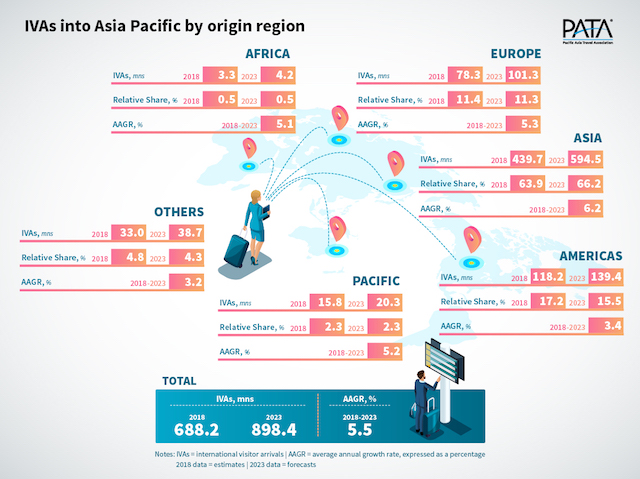
Asia-Pacific destinations could see foreign visitor arrivals grow an average of 5.5% per annum between 2018 and 2023 to close to 900 million foreign visitor arrivals in 2023, according to projections by PATA in its Asia Pacific Visitor Forecasts 2019-2023 released last week.
Looking at 40 destinations within Asia-Pacific, the report said the overall annual growth rate for international visitors is estimated to have been around 7.8% in 2018, generating an inbound volume of around 688 million for the year – almost 50 million more foreign arrivals than in 2017.
Caucasian travellers in Nepal’s Patan Durbar Square
Asia will continue its strong growth momentum with an expected annual average growth rate for foreign visitor arrivals of 6.2% between 2018 and 2023, while the Pacific and the Americas follow with average growth rates of 4.4% and 3.1% per year respectively, over the same period.
Driven by its strong average annual growth rate, Asia is expected to receive the bulk of the foreign arrivals between 2018 and 2023. After capturing a relative share of close to 74% of foreign arrivals in 2018, the proportion into Asia is expected to increase to over 76% by the end of the 2023 forecast period.
The impact on the Americas and the Pacific is a slight contraction in their respective relative shares from 22.4% in 2018 to just under 20% in 2023 for the former, and from 4% to 3.8% for the latter, even as their respective numbers of foreign arrivals increase.
Asia will also be the strongest generator of foreign arrivals into Asia-Pacific over the forecast period, improving its relative share of arrivals from 63.9 percentage points in 2018, to over 66 percentage points in 2023.
Intra-regional travel flows remain important for both the Americas and Asia, with the former destination region seeing over three-quarters of its foreign arrivals originating within that region in both 2018 and 2023.
IVAs into APAC by origin region
Similarly, for Asia, where intra-regional travel flows will increase in relative terms, from almost 94% in 2018 to over 94% by 2023.
The Pacific destination region differs, in as much as more than half of its inbound international visitor arrivals originated in Asia in 2018 with that proportion forecast to increase to around 57% by 2023. Even so, the intra-regional flows from the Pacific to the Pacific remain significant at over 30% in 2023.
PATA CEO Mario Hardy commented: “Asia continues to be the engine of growth for foreign arrivals into Asia-Pacific, with intra-regional flows in particular, remaining important. This intra-regional activity is true for the Americas as well, but less so for the Pacific which is rapidly becoming more popular with Asian markets.”
He added: “In developing a service mindset we need to ask ourselves are we preparing to welcome 898 million foreign arrivals into Asia-Pacific in 2023, or should we think of that instead, as one very special visitor, 898 million times. Your perspective on that can make all the difference.”
Taiwan Tourism Bureau (TTB) is stepping up its marketing and trade efforts in India as it sets a 20 per cent growth target from this part of the world by 2020.
The tourism bureau has come up with a new strategy for the Indian market termed ‘2 20:20’. By targeting two per cent of the high-income population in India as well as cooperate with the country’s top 20 top tour operators, TTB aims to increase tourist arrivals from India by 20 per cent by 2020.
Sixty Stone Mountain in Hualien, Taiwan
“Our main objective is to create awareness about Taiwan as a leisure destination in India. For example there are about 268 mountains in Taiwan higher than 3,000m, while in a destination like New Zealand there are only 10 such mountains. Taiwan is also very popular for its food tours. So, we will be promoting such sides of Taiwan through outdoor advertising and partnering with seven-star multiplex chain Inox,” said Trust Lin, director, TTB Singapore Branch.
TTB last year increased its marketing budget for India by six times, taking it to US$1.2 million annually. “We are looking to further increase the budget for the Indian market going ahead,” added Lin.
Taiwan’s growing interest in the Indian market also comes amid dwindling tourist arrivals from mainland China, Taiwan’s traditional main source market.
This is also in line with Taiwan’s new Southbound policy, which focuses on the 18 international markets making up 25 per cent of the destination’s international arrivals. India, with its base still relatively low with 38,000 arrivals, will be the main target market.
“Taiwan is still a new market to India. A market like Singapore which has almost same flight time from India as Taiwan receives 1.3 million Indian tourist arrivals, while our numbers are very low. We will also collaborate with other destinations like Singapore to have twin city tours to promote Taiwan in India,” said Lin.
“A lot of Indians opt for cruise holidays. We are the number two cruise destination in Asia and every year we have more than 600 ports of call to visit Taiwan. So, we will be promoting Taiwan as a cruise destination in India as well,” Lin further said.
TTB is also keen to promote Taiwan for film and television serial shoots in India which it believes will go a long way in promoting Taiwan as a leisure destination here. It plans to introduce this year a new online training programme for Indian travel agents which will provide certificates to agencies who successfully complete the training and a chance to win complimentary trip to Taiwan. TTB will also promote its incentive scheme aimed at Southbound countries in India.
“If one is handling a group of more than 50 pax staying in Taiwan for more than three nights, they qualify (for an incentive of) US$26 per pax. In addition we can cooperate with PCOs for joint marketing. We are keen to project Taiwan as a new incentive destination in India,” said Lin.
“The challenge still remains of the perception about the destination and awareness among travellers. Taiwan will have to constantly engage and work closely with the tour operators and on the other hand continue with marketing initiatives promoting Taiwan as Asia’s best kept secret,” said Vineet Raina, founder & managing director, Pink Elephant Sport & Pink Elephant Journeys.
The newly released Mastercard-CrescentRating Halal Travel Frontier 2019 (HTF2019) Report has identified top trends expected to shape the next phase of development in the fast growing halal travel sector.
The report predicts that more millennials and Gen Z travellers will book “instant noodle trips” – affordable, impromptu short trips.
‘Rising authority’ of women when planning travels one of the trends that will change Muslim travel, report says
Another trend with the potential to “dramatically change the Muslim-friendly narrative” is the rise in popularity of non-OIC destinations, such as South Africa, Japan and Taiwan. Competition and dynamism are expected lead to innovations and developments that will benefit both destinations as well as Muslim travellers, according to the report.
In addition, heightened awareness on social causes and the rising authority of female influencers when planning trips, are expected to change how Muslims travel.
Finally, the report foresees the consolidation of Muslim travel service providers that will potentially result in the emergence of stronger Muslim lifestyle and travel brands.
The global Muslim traveller expenditure is projected to reach US$220 billion in 2020 according to the Mastercard-CrescentRating Global Muslim Travel Index (GMTI) 2018. It is expected to grow a further US$80 billion to hit US$300 billion by 2026.
In 2017, there were an estimated 131 million Muslim visitor arrivals globally – up from 121 million in 2016 – and this is forecasted to grow to 156 million visitors by 2020, representing 10 percent of the global travel segment.
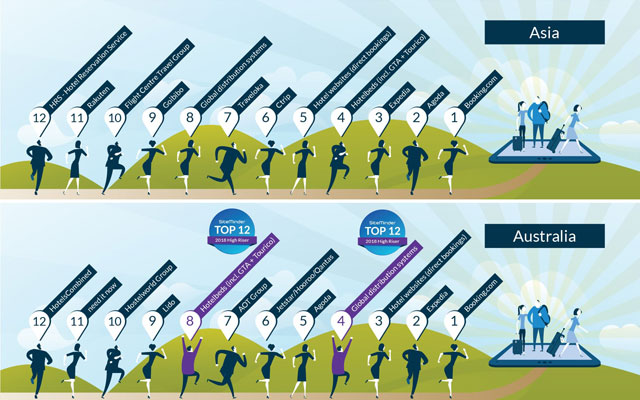
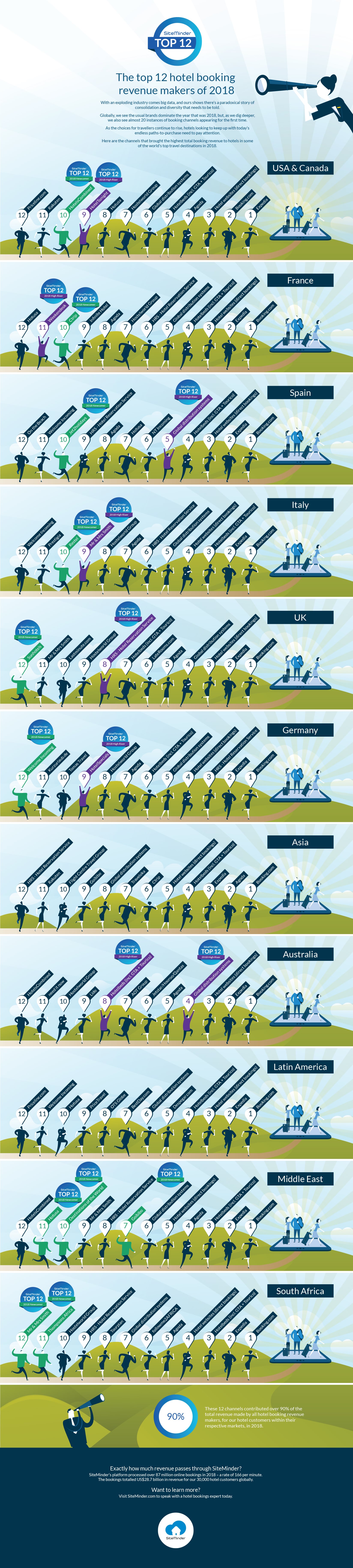
SiteMinder, provider of guest acquisition software solutions for the hotel industry, has unveiled its 2018 rankings of the channels that brought the highest booking revenue to hotels in some of the world’s top travel destinations.
Varying from direct hotel websites to a new host of third-party channels, the diversity of the lists this year reflects a rise in consumer choice that is forcing hotels to compete for business on more booking channels than before, the company said.
SiteMinder’s managing director, Mike Ford, said the increased diversity is also indicative of a booking landscape that has exploded in recent years and is showing no signs of slowing.
“This year we found almost 20 instances of booking channels making a first-time appearance in our lists. So, while the more popular brands continue to dominate, we are seeing a broader range of players emerging. This trend reflects not only the growing list of options now available to travellers booking their stay, but the subsequent need for hotels to be on more booking channels than ever to keep up with today’s endless paths-to-purchase.”
Based on total gross revenue made for those customers, the top 12 hotel booking channels in 2018 were:
Citing figures from Euromonitor International, SiteMinder shared that global online hotel sales surpassed US$264 billion to represent 170% growth in the last decade, including over 13% over the past year alone.
“While 2018 saw tourism slow in parts of the world, we are undoubtedly in an age where the travel industry, as a whole, is exploding. Yet, the growth we are witnessing in online hotel sales is one story that remains largely untold. Hotels are key enablers of travel and what our findings show is the unlocking of economies everywhere, from the outbound Chinese and Japanese markets to lesser known travel markets across Europe,” said Ford.
SiteMinder’s platform processed over 87 million online bookings in 2018 – a rate of 166 per minute. The bookings totalled US$28.7 billion in revenue for its 30,000 hotel customers globally.
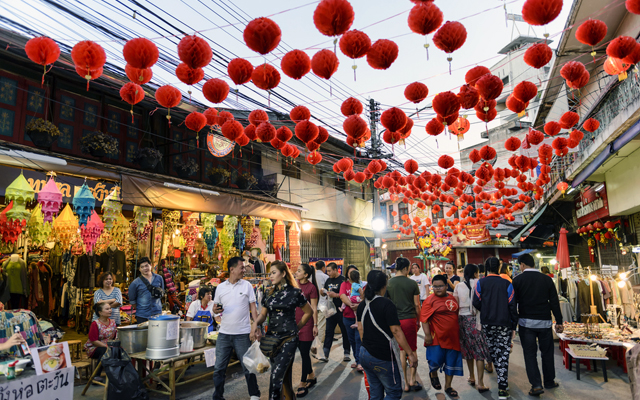
With Chinese New Year round the corner, travel companies reveal the top holiday picks in the Asia-Pacific markets during the holiday period starting on Monday, February 4.
At Hotelbeds, Chinese traveller booking data from its platform shows Thailand is the most popular destination, with Japan and Singapore ranked second and thirdly respectively.
Chiang Mai shopping street during the festive period
These are followed in order by Malaysia, the US, Indonesia, Philippines, Australia, Vietnam and South Korea.
The wholesale giant also observes Chinese travellers visiting a wider range of countries, with hotels in 102 countries reserved, up from 88 last year.
Around seven million Chinese travellers are expected to venture abroad during this festive period.
Spain and Italy this year dropped out of the top 10 countries – replaced by Vietnam and South Korea – but remain popular at 11th and 12th spots respectively this year.
Meanwhile, in the Hong Kong market, the top longhaul destinations booked through GDSs are Australia, the US and Canada, according to analysis by Travelport.
For return flights between January 28 and February 13, the top 10 longer haul destinations (and corresponding number of GDS flight bookings from Hong Kong) are as follow:
1 Australia (17,103)
2 US (7,666)
3 Canada (5,608)
4 UK (5,279)
5 New Zealand (4,416)
6 UAE (2,590)
7 India (2,330)
8 Germany (2,230)
9 Italy (1,800)
10 Switzerland (1,729)
The top longhaul destinations which had seen the greatest year-on-year percentage increase in flight bookings around the Chinese New Year period were Germany, up 72% to 2,230 bookings (ranking from 12th to eighth); New Zealand, up 29% to 4,416 bookings (ranking from sixth to fifth); and the UAE, up 20% to 2,590 bookings (ranking from seventh to sixth).
Ming Foong, regional managing director of Asia, Travelport, said: “This year, long-distance travel has been particularly popular among Hong Kong travellers, because the almost full-week public holiday makes it easy for travelers to plan a long vacation.”
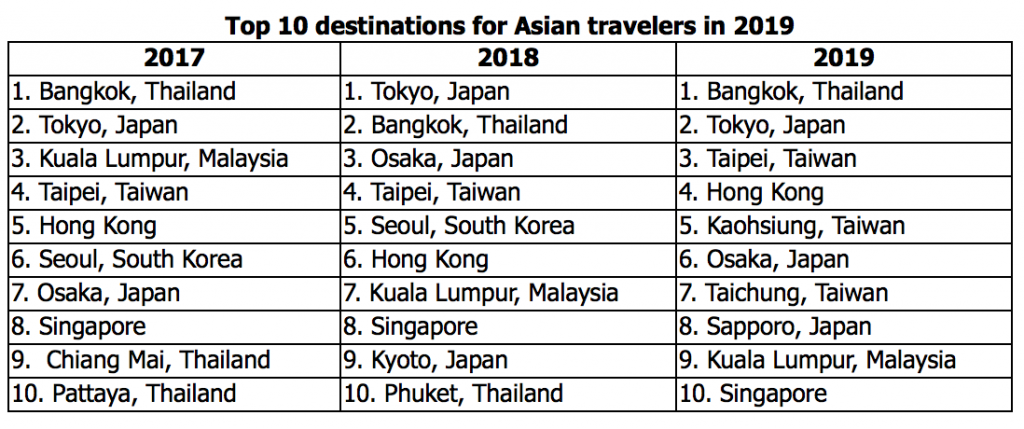
For Agoda, which analysed its own Asia-Pacific booking data, top destinations for the holiday period are Bangkok, Tokyo and Taipei.
This year, Osaka slipped from third spot in 2018 to sixth. Taiwan scooped three of the top 10 destinations with Taipei in third place, and Kaohsiung and Taichung in fifth and seventh respectively.
The severe flooding that ravaged Kerala in August 2018 might have washed out the tourism sector in its immediate wake, but the keen sense of collaboration and optimism from the state’s travel and hospitality players are buoying recovery progress.
Key among the promotional efforts the local trade undertook was the Kerala Travel Mart, which took place in September 2018, not long after the devastating floods.
Traditional Kathakali dancers during a New Year carnival in Kerala
E M Najeeb, chairman of Airtravel Enterprises, said: “Tourism and hospitality players (in Kerala) came together and showcased their products in the event. More than 600 overseas buyers and 1,100 domestic buyers attended the mart. The We Are Ready campaign was also projected by the industry and the government on media platforms.”
Najeeb – who is also senior vice president of the Indian Association of Tour Operators – added that it was a message of readiness shown among tour operators and hoteliers at the mart, as they sought to convince overseas buyers and partners to continue selling Kerala to their clients.
Going ahead with the Kerala Travel Mart was also deemed a good move by Dipak Deva, managing director of Sita – the inbound arm of Thomas Cook India – as it gave a “positive sign to foreign tour operators” that it was business as usual in the state.
The DMC “did not receive a single cancellation from the Kerala floods”, suggesting the “confidence” clients had of the state as well as in the company, said Deva.
“The best way forward would be for the entire industry to come together and send a positive message about Kerala being an important tourism destination of India, and encourage travellers to take a holiday to Kerala, thereby contributing to its recovery,” he opined.
Meanwhile, Thomas Cook India has lent its support to Kerala’s tourism players during the crisis period by pre-paying, as well as making deposits to its ground suppliers and vendors. The company also undertook the pre-purchasing of inventory for its 4Q winter bookings way in advance, as early as September 2018.
With recovery now underway in the state, the tourism authorities are also keen to brandish an image of normality for Kerala.
P Bala Kiran, director, Kerala Tourism shared: “We have restored the connectivity, infrastructure and tourism experience… All the major tourism destinations – Kochi, Munnar, Thekkady, Athirapally, Wayanad, Alappuzha, Kumarakom, Varkala, Trivandrum, Kovalam and Poovar – are back to normal and receiving guests.”
Hospitality players in the state have also reported an uptick in business, a result of active efforts to rebuild tourism to Kerala from both the government and private sector players.
“We have many Germans and Russians clients coming in for Ayurveda (packages) and staying a minimum of 14 days,” shared Raja Gopaal Iyer, CEO, UDS Group of Hotels.
The continued arrivals of these foreign tourists in turn helped to spread the word that Kerala is fine to visit, Iyer pointed out, as the hotel group also shared guests’ testimonies on social media platforms.
Iyer added: “We are seeing a lot of foreign tour operators coming to Kerala for finalisation of the properties that they are working on. We are also working with tour operators to come up with competitive packages for international markets.”
While Najeeb foresees “natural calamities like floods have only a short-term impact on tourism” for Kerala, an effective international promotional campaign could be a much stronger strategy to improve Kerala’s branding on the global stage.
The Kerala Department of Tourism is far from idle though, as it has participated in 12 international tradeshows beginning with Saudi Arabia and Bahrain since October 2018 to aggressively promote the destination on the global stage.
Last year, the average budget and actual spending of 2,806 Chinese outbound travellers surveyed in a study by Nielsen and Alipay increased to US$6,026 (+6%) and US$6,706 (+15%) respectively.
Outbound Chinese tourists travelled to more destinations in 2018, with respondents visiting an average of 2.8 countries/regions, up from 2.1 in 2017.
Of those surveyed in the Alipay study, more transactions were made using mobile payment than cash
The study further showed that more Chinese tourists are adopting mobile payment while travelling overseas with more than two-thirds (69%) paying with their mobile phones abroad, up 4% from the previous year.
On their most recent overseas trips, Chinese tourists paid for 32% of transactions using mobile payment, overtaking cash for the first time.
In 2018, about three-quarters of Chinese tourists used mobile payment on their most recent trips to Singapore, Thailand or Malaysia, surpassing that for the US and Canada (61%), the UK, France and Germany (60%), as well as Australia and New Zealand (68%).
What this indicates, according to Alipay, is that South-east Asian merchants are leading when it comes to benefiting from Chinese mobile payment.
The study revealed that 90% of surveyed merchants in Singapore, Malaysia and Thailand reported encountering Chinese customers who asked if mobile payment was accepted in their stores. Meanwhile, 93% of surveyed Chinese tourists indicated they would likely increase their spending if mobile payment was more widely accepted – a higher figure than that in 2017’s survey.
Some 58% of surveyed merchants located in areas frequented by Chinese tourists in Singapore, Malaysia and Thailand accept mobile payment, with 70% of that number accepting Chinese mobile payment. By comparison, only 12% of them accepted Chinese mobile payment in 2016.
Retail merchants in particular, saw the highest adoption rate of Chinese mobile payment solutions, with 75% of supermarkets and convenience stores and 71% of duty-free stores now accepting mobile payment.
The region’s airlines recorded a firm 7% increase in number of international passengers carried to 356.6 million in 2018, a stronger growth than was seen in the preceding year, according to preliminary figures released by the Association of Asia Pacific Airlines (AAPA).
In revenue passenger kilometres (RPK) terms, demand increased by 6.9%, reflecting broad-based demand on both short- and longhaul markets. After accounting for a 6% increase in available seat capacity, the average international passenger load factor edged 0.6 percentage points higher to 80.6% for the year.
APAC airlines carried a combined total of 356.6 million passengers last year
Commenting on the improved growth, Andrew Herdman, AAPA director general, said: “New routes and frequencies provided more options to travellers, sustaining the growth in demand. In addition, while airfares rose in response to higher oil prices, ticket prices remained relatively affordable, capped by stiff competition.”
After several years of declines, passenger yields were lifted by higher average airfares and record high load factors, he further shared.
However, cost pressures continued to increase, with higher fuel expenditure driven by a 30% increase in jet fuel prices which averaged US$85 per barrel for the year, despite falling back significantly towards the end of the year.
Looking ahead, Herdman said: “Whilst expectations of continued moderate growth in the global economy should lend further support to travel markets in the coming months, there are some downside risks including weakness in trade activity and potential erosion in business and consumer sentiment. The region’s airlines are alert to such factors which may affect the market environment, but remain focused on cost management, and investing in future growth opportunities.”