
Asia/Singapore Thursday, 9th April 2026
Page 357

India publishes first MICE study, considers industry roadmap

0

India’s Ministry of Tourism has released its first-ever MICE Study Report which spells out business events’ contribution to the Indian economy and will help pave the way for the creation of a roadmap for the implementation of strategies and policy amendments to advance the industry.

Initiated by the India Convention Promotion Bureau (ICPB) and conducted by a market research agency, the report finds that the country’s business events are valued at 375.8 billion rupees (US$5.2 billion), with 60 per cent coming from meeting, incentive travel and conference verticals. Space rental contributes 48 billion rupees.
A fund may be set up to help ICPB and state tourism boards bid for international conferences

The study also notes that business events have a multiplier impact on India’s economy, in terms of accommodation, travel, advertisement, remuneration to skilled workforce, and more.

According to ICPB vice chairman, Chander Mansharamani, the MICE Study Report also provides a recommended structure for the bureau, based on interviews with 18 to 19 CVBs across globe.

“We contacted (them) to know how they function, their structure and how they are marketing their destinations,” he said.

“We have since changed our constitution, bringing it in line with the structure recommended by the study. Recommendations to the government have been made accordingly in the report.”

Some of the recommendations for ICPB include positioning it as a single point of contact for business events in India and the development of market intelligence that can help the country bid for international conferences.

Mansharamani also noted that most international CVBs are funded by the government while ICPB depends on membership fees.

With the change in ICPB’s constitution, it can now bid for international conferences. However, the study advises ICPB to refrain from bidding on its own. Instead, it should engage state tourism boards and PCOs in the process.

Presently the Ministry of Tourism is looking to create a corpus fund in association with state tourism boards in order to bid for international conferences.

Amaresh Tiwari, honorary secretary, ICPB, revealed that a request for 200 million rupees has been made to the Ministry of Tourism for the creation of the fund.

“We expect the respective states to contribute equal amount to the fund. It will help us in activities like offering incentives to international conference organisers,” said Tiwari.


China’s online hotel reservation market buoyed by post-90s generation

0

China’s online hotel reservation market continues to grow rapidly, with huge potential in the rise of online rates as compared to developed markets such as Europe, the US and Japan, according to the latest research from Trustdata’s Mobile Big Data Monitoring service.

Monthly active users reached 100 million in 2Q, while room nights reserved in 1H were up 20 per cent year-on-year, based on data from the report.

China’s online hotel reservation market continues to grow rapidly, with Meituan the forerunner in terms of room nights reserved in 1H2019

China’s per capita GDP is expected to exceed US$10,000 in 2019, accelerating the increase of new tourists and boosting the demand for hotel reservations.

The report also showed that the age composition of Chinese online hotel reservation users has changed, with post-90s and post-00s becoming the main consumers, while the potential for post-2000s are huge.

Young users born in the 1990s and 2000s, who carry less financial burdens and have strong willingness to spend online are driving the growth of online hotel reservations.

It added that young users’ needs and scenarios for online hotel reservations are becoming increasingly diversified and personalised.

Online hotel reservations have continued to penetrate in country-level markets in 1H2019, with “small town areas” registering multiple growth and 70 per cent of new users from third- and lower-tier cities.

Other performance insights from the report include:

In 1H2019, Meituan led the industry in terms of room nights reserved, accounting for 47.3 per cent of the market, more than the total share of Ctrip, Qunar and eLong combined. Coming in second place is traditional OTA Ctrip.

Meituan and Fliggy led the industry in terms of the number of young users, with post-90s and post-00s accounting for more than 50 per cent of users.

Ctrip ranked first in user retention, while Tongcheng-eLong and Meituan ranked second and third.

Qunar ranked first in terms of daily opens, followed by Tongcheng-eLong and Meituan.

OTA players around the world form a four-pole competitive landscape, and leisure travel is the key area of battle. Similar to Expedia, Ctrip has been developing for 20 years and focusing on business travel. Meituan, though young, is similar to Booking in nature, focusing mainly on the leisure and vacation market.

APAC hotel trading hit US$4.5 billion in 1H2019, underpinned by strong domestic investment

0

APAC hit US$4.5 billion in the first six months of 2019, with more than half of the capital originating from domestic buyers in Japan, China and Australia, says global real estate consultancy JLL.

According to JLL’s latest Hotel Investment Highlights report, investors are facing mounting pressure to deploy capital amid geopolitical uncertainty. To generate target returns, a number of investors have adjusted their risk expectations to explore opportunities within their home countries.

APAC hotel investments hit US$4.5 billion in 1H2019, with over half the capital from domestic buyers in Japan, China and Australia

Japan’s hotel market recorded the highest domestic transaction volumes in Asia-Pacific at US$1.1 billion in 1H2019. Of this, Japanese REITs accounted for almost half of the total amount invested in the market. This was from deals such as Japan Hotel REIT Investment Corporation’s US$563.5 million acquisition of the Hilton Tokyo Odaiba and its US$25.2 million purchase of Hotel Oriental Express Osaka Shinsaibashi.

“Demand from Japanese institutional investors is growing due to low borrowing costs and expectations of continued market growth on the back of upcoming large-scale events such as 2019 Rugby World Cup, Tokyo 2020 and the 2025 World Expo,” says Mike Batchelor, CEO Asia, JLL Hotels & Hospitality.

He added: “We believe that the 12 per cent forecast increase in international visitors to Japan in 2019 will continue to spur local investors to explore hospitality opportunities in major cities such as Tokyo and Osaka over the rest of the year.”

Following closely behind as the region’s second most traded market is China, registering US$1.1 billion in domestic investment volumes. In Q12019, local internet giant JD.com purchased the Beijing Jade Palace for an estimated US$400 million. The hotel is slated to be converted into a mixed-use office development later in the year.

Batchelor said: “This deal is part of a wave of domestic investors buying hotel assets for conversion to alternative uses such as offices. As hotel deals are driven by a price per square metre basis in China, they tend to be priced lower than other commercial properties. Given the low-yield profile of such transactions, foreign investors are likely to be priced out of the hotel market, leading to more domestic transactions in China.”

Traditionally a hot spot for offshore buyers, local investors dominated the Australian hospitality market in 1H2019. Comprising close to 80 per cent of the total US$388.2 million invested, domestically-traded deals included the Next Hotel Brisbane, Hilton Surfers Paradise, MACq 01 Hotel and the Mayfair Hotel Adelaide.

Craig Collins, CEO Australasia, JLL Hotels & Hospitality explained: “The size, location and type of assets that were traded in the first half suited the mandates of larger local investors, which explains their level of dominance. From 2018 to June 2019, Australian buyers more than tripled their level of capital invested in hotels.”

He added: “Whilst domestic investors will continue to be very active, the Australian hotel investment market remains a firm focus of offshore groups. Based on expected transaction activity for the second half of 2019, we expect international capital to dominate hotel acquisitions over the rest of the year.”

Stark contrast in hotel performance for HK, Singapore in July 2019: STR

0

It was a tale of highly contrasting results when it came to hotel performance for Hong Kong and Singapore in July 2019, STR’s latest data showed.

In Hong Kong, occupancy decreased -4.1 per cent to 83.4 per cent, while average daily rate (ADR) fell -9.1% to HK$1,163.21 (US$148.29) and revenue per available room (RevPAR) plummeted -12.9% to HK$970.42.

STR’s latest data shows a dip in hotel occupancy in Hong Kong while Singapore’s hotels surpassed 90% occupancy for the first time in history

STR analysts note that ongoing protests in Hong Kong have affected performance levels in the market. Hotel demand for the month fell three per cent, and preliminary figures show a double-digit decline in visitor arrivals during the second-half of July, according to the Hong Kong Tourism Board. That steep drop follows a first half of the year that showed a 13.9 per cent increase in visitor arrivals.

In Singapore, one of Hong Kong’s fiercest rivals, hotel occupancy rose +1.9 per cent to 91.8 per cent while ADR was up +0.5 per cent to SG$268.79 (US$193.40) and RevPAR increased +2.4 per cent to SG$246.80.

The country eclipsed 90 per cent occupancy for the first time in history. STR analysts note that the transient segment (bookings of less than 10 rooms) produced strong demand growth (+7.1 per cent) during the month, while group (bookings of 10 or more rooms) demand fell 7.2 per cent. According to the Singapore Tourism Board, the country welcomed 9.3 million international visitors during the first six months of 2019.

Overall, hotels in the Asia-Pacific region reported mostly negative results across the three key performance metrics in July 2019. Region-wide occupancy increased +0.2 per cent to 73.2 per cent, while ADR dropped -1.5 per cent to US$95.48 and RevPAR fell -1.3 per cent to US$69.91 when compared to July 2018.

Okinawa poised to take on Bali and Phuket as international arrivals surge: C9

0

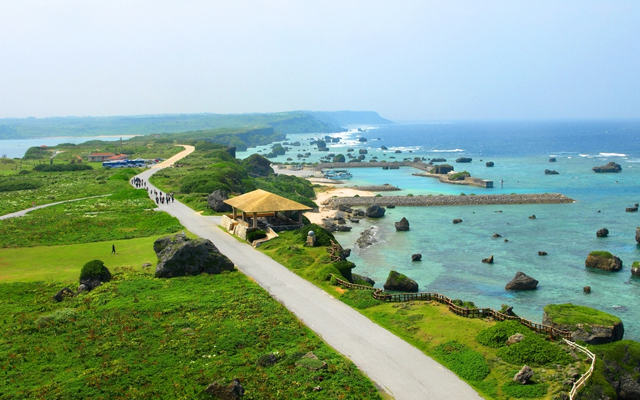
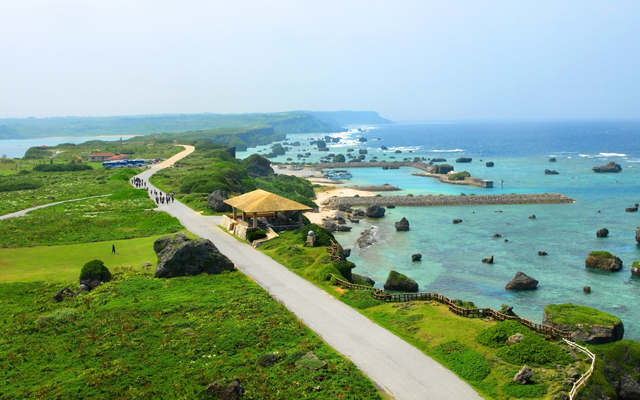
Often called the Hawaii of Japan, Okinawa is attracting a rising number of regional tourists, thanks to greater air connectivity driven by LCCs to the resort destination, according to a recent report by C9 Hotelworks.

Visitors to Okinawa hit a record 9.8 million last year, elevating the market to the likes of Asia’s twin icons of Bali and Phuket, the Okinawa Hotel Market Review revealed.

Okinawa is gaining popularity as a tourism destination among inbound travellers, with visitors to the island hitting a record 9.8 million last year

The demand was mainly driven by overseas source markets, which grew 14.2 per cent year-on-year compared to domestic arrivals of 1.2 per cent. This has pushed total market share of international travellers from 4.1 per cent in 2008 to 29.5 per cent in 2018, whereby the CAGR of total inbound visitors for the period averaged 6.4 per cent.

Nevertheless, those arriving from Japan still accounted for 76.8 per cent of guest nights in accommodation establishments on the island, as a majority of domestic travellers are Japanese from Tokyo, Osaka, Kobe, Fukuoka and Nagoya.

The report also said that the key catalysts of change driving increased tourism to the island are rising airlift, visa exemptions for a number of Asian countries like Thailand and favourable currency exchange rates to the Japanese yen.

International airlift is delivering more and more overseas travellers – In 2018, domestic routes supplied 71 per cent of the visitors to the destination. Traction has remained strong this year as year-to-date arrivals through May registered 4.6 per cent growth. Key overseas markets are South Korea, Hong Kong, Taiwan, China and the US.

Market-wide occupancy for hotels in the latest available data was 64 per cent with an average accommodation spend of around US$218 per person, per day. With over 36,000 hotels and ryokan keys, the current pipeline is showing 5,295 keys under development. Pipeline hotels are concentrated in outer islands (45 per cent), followed by south (26 per cent), central (16 per cent) and north (13 per cent) areas of the main island.

City hotels have the highest occupancy amongst all types of accommodation, with an average of 83 per cent last year. This is followed by business hotels with 77 per cent and resorts at 72 per cent.

The total average spend of visitors was 73,945 yen (US$702) per day, with international travellers having a higher spend at 100,265 yen over domestic tourists at 72,284 yen.

The average length of stay for visitors averaged 3.09 nights, with longer stays for international visitors at 3.42 nights and domestic at 2.95 nights.

“With demand on the rise, hotels are seeing improved performance in occupancy, while spending on accommodation has slightly declined as more non-traditional hotels are entering the market, such as condominium rentals and guesthouses,” said Bill Barnett, managing director, C9 Hotelworks.

He added: “Nevertheless, mainstream hotel operators remain positive on the prospect of performance going forward, despite stronger competition. Demand is expected to significantly increase with a second airport runway. However, the lack of labour in the industry is a major concern for existing and upcoming hotels.”

Key upcoming hotels, including Hilton and Four Seasons, reflect more global brands, said the report. The latter is being developed by Malaysia’s Berjaya Group, which is set to leverage the Four Seasons brand on a hotel residence component of the project.

Despite high development costs given pressure from the upcoming run-up to the 2020 Olympics, Okinawa’s resort trajectory remains strongly positive given that Naha Airport is expected to complete its second runway in 2020.

A cruise campaign has also stimulated growth of foreign tourist arrivals. Additional services will be launched at Motobu Port, Ishigaki Port and Hirara Port along with expansion plans.

With low interest rates in a stable marketplace, developers are increasingly looking to both Okinawa and the outer islands with rising interest, as the destination is poised to play on a broader global stage.

Limited accessibility hinders Koh Chang’s tourism growth: C9

0

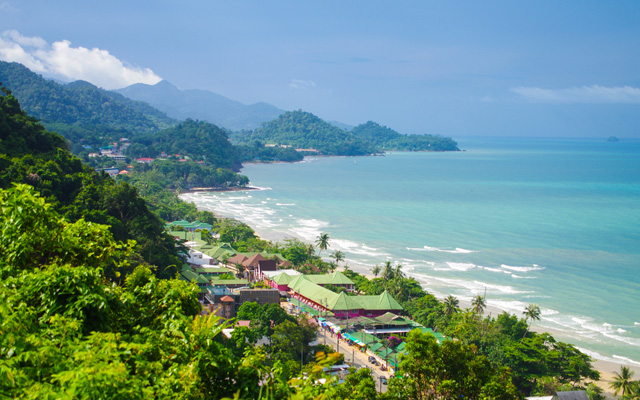
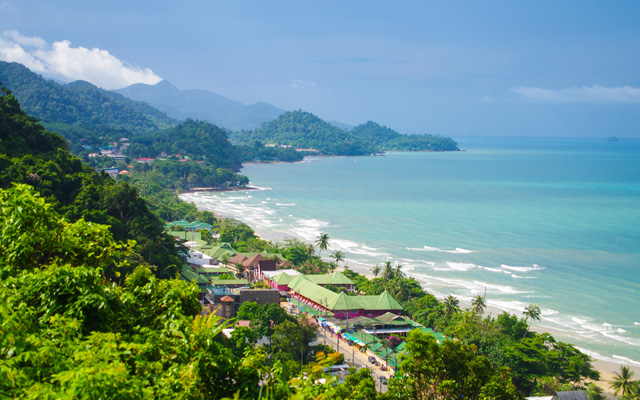
Despite being one of the country’s biggest islands in the Gulf of Thailand, Koh Chang has remained somewhat off the mass tourism development footprint due to limited accessibility, finds a recent C9 Hotelworks’ report.

The Koh Chang Tourism Market Review stated that in 2018, the island’s hotel market hosted 1.2 million guest arrivals at 272 tourism establishments with a combined total of 7,617 rooms. Over the past decade, domestic travellers accounted for between 59 per cent to 71 per cent of total room night demand.

Koh Chang (pictured), one of the largest Thai islands in the Gulf of Thailand, still remains largely under tourists’ radar

Market-wide hotel occupancy teeters between the mid to high 60’s, though the off-season often sees numbers drop by half. In a nutshell, it’s a very wide swing between high and low seasons, said the report.

C9 Hotelworks’ managing director Bill Barnett said: “The island is heavily reliant on domestic tourism due to limited international accessibility when compared to other popular Thai beach destinations such as Phuket and Samui.”

Among overseas source markets, mainland China has been the fastest-growing over the past few years, with year-on-year growth totalling 54 per cent in 2017. The other top five international markets are Germany, Russia, Sweden and the UK.

The average length of stay for tourists is 2.9 nights, with foreign and domestic demand averaging 4.6 and 2.6 nights respectively. Long-stay overseas travellers often reside up to two months.

However, the C9 report highlights that the biggest barrier to entry for new, larger hotels remains the lack of direct airlift and dependence on the privately operated Trat airport. Owned by Bangkok Airways, the region’s booming LCCs do not fly to the destination and most visitors come overland from Bangkok and then by ferry.

Based on C9’s recent visits to the island, Barnett expects that a clear uptick in new development for larger hotels and brands will start to appear in the pipeline in the near future.

With The Emerald Cove Koh Chang expected to rebrand to an international group by 2020, recognisable hotel brands are expected to drive occupancy during low season periods.

“Koh Chang is not unlike Koh Tao and Koh Pha-ngan in that they are largely tropical outposts that are likely to be caught up in a broader wave of development for the simple fact they offer sun, sand, sea and sunshine,” Barnett added.

Construction of a new road at the southern tip of the island is currently under the government’s development plan, which will make the east coast more accessible, said the report.

Hong Kong vintage tram gets on creative track

0

Since last September, an eye-catching tram can often be spotted plying the streets between Western Market and Happy Valley Terminus. But unlike the iconic double-deckers cruising the streets of Hong Kong, this bespoke teakwood tram is actually a mobile social club and premium event venue.

The Circus Tram, which sees a regular roster of performances by young talents on board, is the brainchild of Alvin Yip, partner and curator-in-chief of local creative startup Circus. After initiating the idea to Hong Kong Tramways, Yip engaged a team of designers, architects, artists and curators to build the nostalgic vehicle with the tram company from scratch.

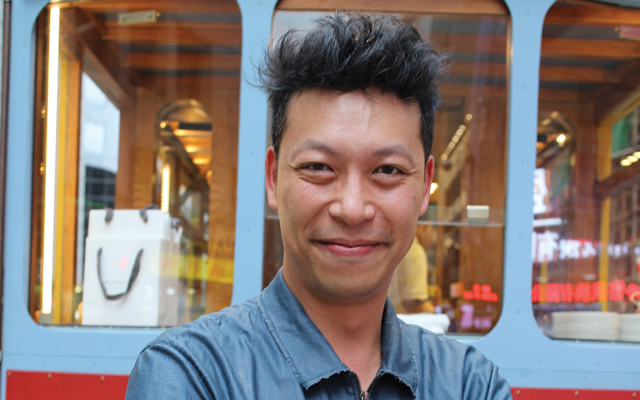
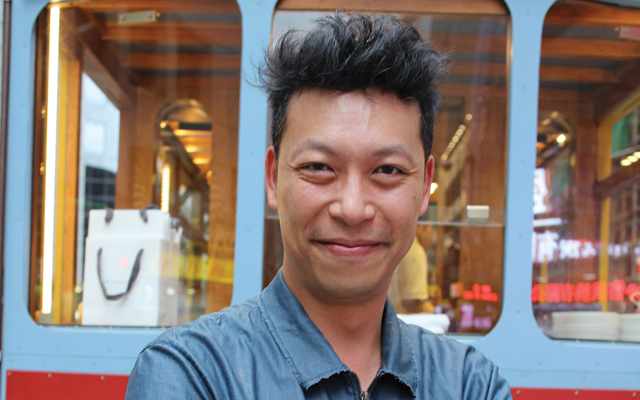
Alvin Yip was inspired by Hong Kong’s iconic 115-year tramways to launch the country’s first mobile social club Circus Tram (Photo Credit: Prudence Lui)

“We (thought of Hong Kong’s) iconic 115-year tramways as more than a transportation means, and first brought this notion to life in 2013 at a design festival called Detour. Fortunately, we successfully obtained a subsidy to produce four prototype trams and reimagined them as various mobile spaces – a library, restaurant and performing theatre,” Yip said.

He added: “Evolving from an academic research to a cultural and art experiment and now a new operation, the (most rewarding part) was being able to engage young designers and artists to work with experienced tram technicians, engineers and craftsmen. I am proud to say that our first Circus Tram is 100 per cent made in Hong Kong and by hand.”

From the outset, Yip wants to breathe new life into a beloved transport icon of Hong Kong by engaging the locals. He has also opened up the initiative to tourists by partnering with The Peninsula Hotels’ Peninsula Academy.

“Hotel guests interested in cultural experiences may charter the whole tram or join the two-hour ride through the Peninsula Hotels. Unlike ordinary sightseeing tram tours, we combine a unique range of onboard experiences like fortune telling, music and a magic performance. Even if a tour guide is deployed, we stress interactive conversations rather than mundane presentations,” Yip explained.

The posh tram interior boasts three lounges: Chatham House on the lower deck, and The Freudians and Darwin Gardens on the upper deck. The tram also boasts first-of-its-kind features, such as a modern electrical and mechanical system that can support lighting and sound systems for events, as well as a restroom.

The Circus Tram is also designed to accommodate artistic salons, concerts, cultural exchange, small business meetings, as well as private functions and receptions.

The launch of Circus Tram has added to Hong Kong’s growing array of iconic venues, opined Yip, offering inbound visitors and locals different possibilities to enjoy and appreciate the local culture.

“Our second and third trams are in the pipeline with more interesting ideas – they are not going to be the same,” he shared.

Sabre unveils consumer retail trends influencing hospitality

0

Today’s travellers crave flexibility, personalisation and a seamless shopping experience, according to Sabre Corporation’s recent consumer trends study.

The global travel tech provider partnered with TrendWatching to release the study explaining the consumer trends powering the “retail revolution” in the hospitality industry.

Sabre Corporation released a report on consumer trends fueling transformation of hoteliers into retailers

Clinton Anderson, president of Sabre Hospitality Solutions, said: “Technology is changing the expectations of today’s traveller. They demand flexibility, optionality and a seamless shopping experience that goes beyond booking a guest room. This presents exciting opportunities for hoteliers to extend far beyond their traditional offerings. Hoteliers must pay attention to the consumer behaviours driving this retail revolution and capitalise on the possibilities.”

The report details how innovative retail and hospitality players are harnessing six key consumer trends to drive innovation and improve their guest experience. It includes actionable insights to fuel creativity and gain a deeper understanding of how concepts can be applied to provide guests with convenience, relevance, fun, recognition and support – the things they crave in today’s retail-driven environment.

The three top trends are as such:

Trend 1: Sentient spaces
Travellers are increasingly aware of an ever-growing ecosystem of cameras and sensors. Although sensitive to security concerns, they crave personalisation and are willing to share their data to get it. Truly smart physical spaces – retail stores, hotel rooms and more – are now built with technology ranging from facial recognition to robots that create experiences tailored to the guests moving through them.

Trend 2: A-commerce
Retailers have mastered the use of algorithms and smart devices to increase convenience and serve up intuitive recommendations at crucial moments. Busy travellers will increasingly expect the same experience from their travel providers. Developing capabilities to automate shopping, selecting and purchasing activities will allow hoteliers to deliver increased simplicity – and a more meaningful experience – to their guests.

Trend 3: Village squared
Smart retailers are responding to society’s increasing sense of isolation by transforming their spaces in new ways to foster connections and promote social wellbeing. Hotels, with a myriad of unique and functional spaces at their disposal, have significant – and relatively untapped – potential to maximise their properties and provide unique experiences to their guests.

The full report can be read here: http://bit.ly/2MKnVna

Asia’s cruise destinations grow to 306 in 2019: CLIA

0

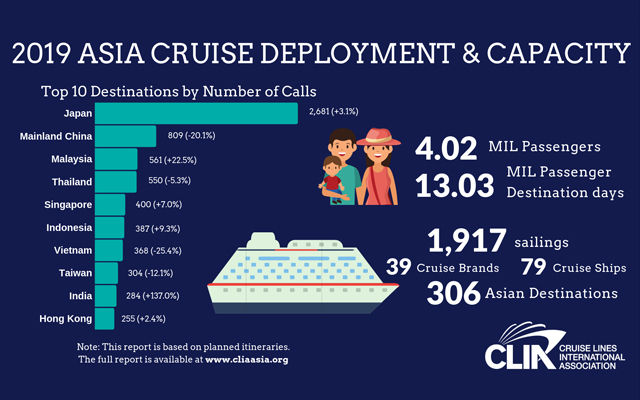
Asia is seeing an increase in the number of cruise destinations this year, according to the Cruise Lines International Association (CLIA)’s 2019 Asia Cruise Deployment and Capacity Report.

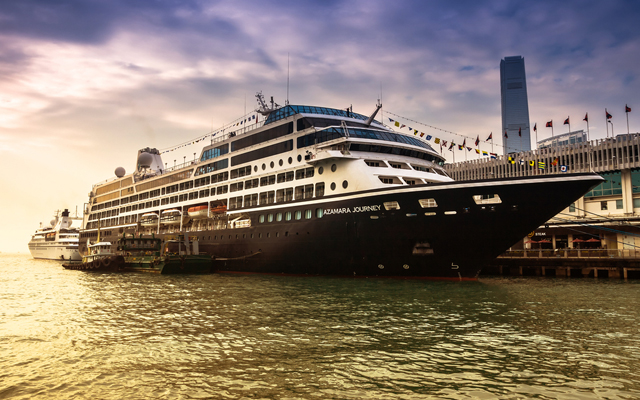
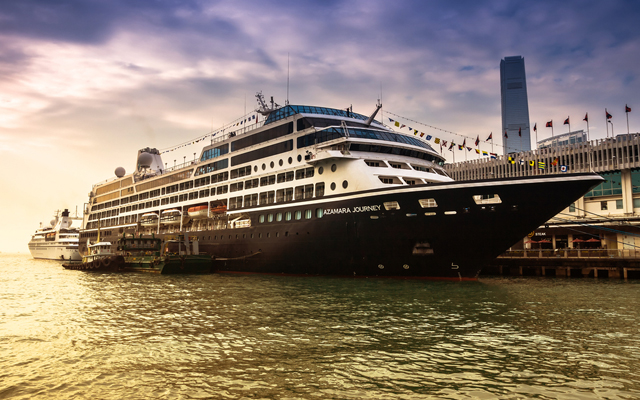
Asia has 306 cruise destinations this year

Joel Katz, managing director for CLIA Australasia & Asia, said: “The popularity of cruising in Asia is expected to grow further over coming years as cruise lines deploy new, larger vessels that have been purpose-built for Asian consumers. The coming generation of ships will replace older ships previously based in Asia, and when coupled with new cruise infrastructure in several Asian destinations, are expected to fuel strong interest among travellers. The result is likely to be a return to growth for cruising in Asia after a slight decline this year.”

Other highlights from the 2019 Asia Cruise Deployment and Capacity Report include:

2019 will see a total of 1,917 sailings, and generate capacity for four million passengers to cruise in Asia. After several years of rapid expansion, this year’s total passenger capacity has dropped 5.7 per cent year-on-year due to the decline in short cruise itinerary options from mainland China. Nevertheless, 2019 will still see 79 ships from 39 cruise brands sailing in Asia – a similar level to last year.

306 different destinations in Asia will receive cruise ships in 2019 – an increase from the 288 destinations in 2018. Ships in Asia increasingly call at more places, increasing the range of choice for passengers.

Port calls to Asia will remain steady this year with 7,154 calls. Many of the destinations – especially India, Malaysia, Indonesia, Singapore, Japan, Hong Kong and South Korea – will see growth.

Asia will also see a slight rise in passenger destination days. The 13 million passenger destination days forecast in 2019 will translate to more potential onshore visits from cruise passengers, creating a stronger tourism impact for the destinations across the region.

Oyo pushes expansion with new CEO for SE Asia, COO for India

0

Oyo Hotels and Homes has appointed Mandar Vaidya as the CEO for South-east Asia and the Middle East, two high potential markets where the India-based company will focus on as part of its expansion strategy.

With over 15 years of experience, Vaidya will be responsible for driving business growth for Oyo in these two regions, which include key markets like Indonesia, Malaysia, the Philippines, Vietnam, the UAE and Saudi Arabia. In South-east Asia, the company has already committed over US$200 million in investment to fuel its aggressive expansion plans in the region over the next couple of years.

From left: Mandar Vaidya and Gaurav Ajmera

Before joining Oyo, Vaidya worked at McKinsey and Co for 15 years, from 2002 to 2017, mostly in India with stints in Singapore and the UK. At McKinsey, he was a partner and led the health services practice in India and the hospitals practice for Asia. He also led the Delhi office of McKinsey for four years.

Mandar is a qualified medical doctor, having completed his MBBS and internship from Grant Medical College and JJ Hospital in Mumbai. After a brief stint as a medical officer, he opted out of an MD in Obstetrics and Gynaecology and pursued an MBA from Jamnalal Bajaj Institute, Mumbai.

Meanwhile, Oyo has also elevated Gaurav Ajmera to be its COO, India & South Asia, since May 1, 2019. Gaurav will report to Aditya Ghosh, CEO, India & South Asia.

Gaurav is one of the early OYOpreneurs and during his four-year stint as the head of North Region, he played a key role in the company’s growth and expansion across the country.

With over 10 years of experience, Gaurav will focus on growing Oyo’s business in South Asia and realising OYO’s expansion plans. He will be reporting to Aditya Ghosh, CEO, India & South Asia.

Before Oyo, Gaurav had a successful stint with Schlumberger, working across various countries in the Middle East, and gaining valuable experience in project management and operations.