Asia/Singapore Thursday, 9th April 2026
Page 354

Geopolitical shifts, climate change among top travel risks for 2020, says new study

0

Heightened security threats, civil unrest and geopolitical instability will be the top disruptors to the mobile workforce in 2020, according to an International SOS risks forecast for 2020.

The top 10 health and security risks for 2020 are risks borne from geopolitical shifts, mental health issues, physical health, cybercrime, climate change, infectious disease outbreaks from established and newly emerging pathogens, bleisure travel, millennials and Gen Z entering the workplace with different preferences, expectations and attitudes to risk; high-profile duty of care legal cases, as well as under-resourced and inexperienced start-ups and SMEs that will struggle to meet duty of care obligations.
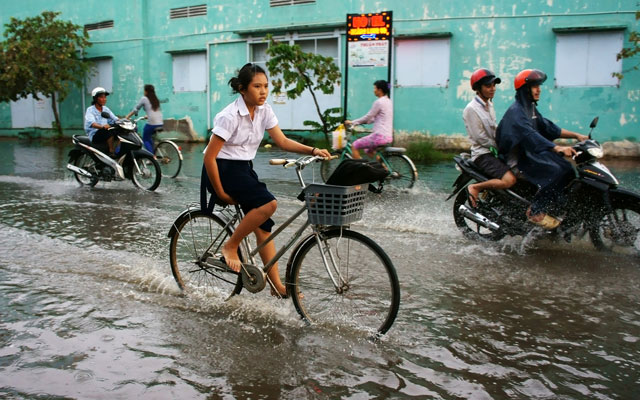
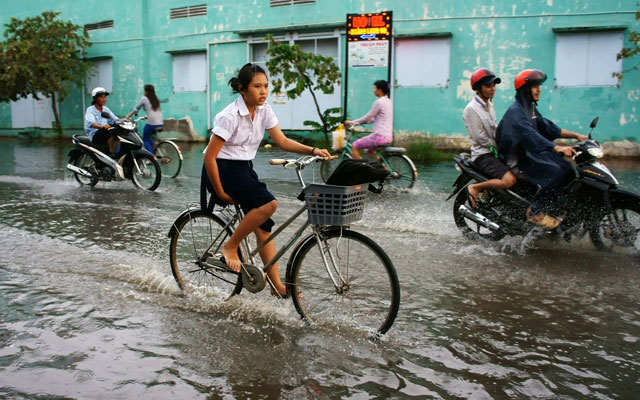
Vietnam (pictured) is one of the most vulnerable nations to climate change impactsBusiness

Alongside these predictions, results from the Business Resilience Trends Watch survey, which polled over 1,300 business travel decision makers, reveal the top reasons business travel managers expect to change itineraries in 2020, as 51% believe that health and security risks increased in the past year and 47% anticipate risks will rise in the coming year.

The bigger risk identified was security threats (68% – up 23 percentage points on the past year), civil unrest (52% – up 14 percentage points on the past year); geopolitical unrest (52% – up 20 percentage points on the past year); and natural disasters (51% – up 15 percentage points on the past year).

Along with these top disruptors, organisations are predicting major increases in the likelihood of having to modify traveller itineraries due to factors like epidemics (31% – predicted to be up 19 percentage points compared with actual impact in 2018); infectious diseases (35% – predicted to be up 17 percentage points compared with actual impact in 2018); and detention and kidnapping (29% – predicted to be up 17 percentage points compared with actual impact in 2018).

Security Services’ CEO David Johnson said: “Instability, unpredictability, rapid change and escalation are the key characteristics of many incidents in our modern world. The workforce potentially faces security risks in areas, such as accommodation choices, previously thought of as safe. Established global organisations to unicorns, regulated or otherwise, need to have their eye on this to protect their human capital and build resilience within businesses. The need is only going to increase, as over 40% of the workforce head to being mobile in some way.”

Meanwhile, the report also notes that emerging traveller habits, both domestically and internationally, and diversification of the workforce are creating grey zones of risk. Employers are not aligning travel policies with new potential risk factors, and people are choosing not to act within policy if it restricts the use of their preferred mode of transport or accommodation, according to the report.

Surprisingly, less than a third of organisations include cyber security in their travel policies, the study also found, which “could potentially open organisations up to litigation and reputational damage if they are not adhering to their duty of care, as well as negative consequences for employees and business”.

The report’s findings are as such: just 11% included shared economy services in their travel policy, only 26% of organisations include considerations for female travellers in their travel policy, 31% cover cyber security; one in 10 (11%) include considerations for LGBTQ+ travellers, mental health issues are included in mere 15% of travel policies, considerations for travellers with disabilities are covered by only 12%, and bleisure travel was covered in 22% of policies.


Bali tops expanding villa rental market in APAC

0

The overall villa rental market in the Asia-Pacific region grew by 12% in the past two years, reaching a value of US$440 million, with an increase in villa supply across various destinations, a recent study has found.

According to the Asia Pacific Villa Rental Market Research 2019 report by Villa Finder, Bali remains the biggest market with over 4,000 villas, and has grown by 18% since 2017, reaching US$162.5 million. The Bali market is also getting increasingly competitive with a 34% increase in the number of villas being built, despite an oversaturated market. Consequently, the average price for a villa stay in Bali decreased by 10% to US$220/night.

Asia-Pacific’s villa rental market grew by 12% in the past two years, with Bali remaining the biggest market; luxurious villa in Ubud, Bali pictured

China (23%) forms the top inbound market for Bali, overtaking Australia (19%), which the study boils down to a weak Australian dollar and the property market crisis in the country. Other main markets for vacation villas are Europe, Singapore and Hong Kong.

The study also noted that every single market in its study has more villas from two years ago as more investors look to tap into the ever-growing vacation rental market.

Meanwhile, villa rentals in Goa saw a growth of 23%, and is expected to continue growing till early 2020. With more villas on the market, the competition is higher, with occupancy rates at 60% to 70%, with Europeans and Americans making up the bulk of customers.

Australia’s villa rental market is also developing, with a rise in the number of villas in Byron Bay (30%) and Sydney (33%). While villa renters are mostly families, there has been an increase in Gen Z customers (aged 18-24) and corporate clients. However, the average occupancy in these destinations has dipped due to an oversupplied market.

Over in Sri Lanka, the number of villas rose by 25%, and the market grew by 20%, reaching US$4.6 million. However, occupancy rates went down. following the terrorist attacks in April.

Besides Goa, Australia, and Sri Lanka, other up and coming markets are Japan, New Zealand, Vietnam, and Malaysia.

Demand in Thailand’s villa rental markets have gone down, despite growing supply. The villa occupancy rate went down across various destinations, including Hua Hin (-54%), Pattaya (-21%), Phuket (-18%) and Samui (-11.5%).

The Phuket boat accident in July 2018, which affected Chinese arrivals, as well as a weak exchange rate against a strong baht and the impending world recession have contributed to the shrinking of the tourism market. The villa market in Hua Hin went down by 38%, Samui by 15%, Pattaya by 1.5% and Phuket by 2%.

Intra-Asia travel remains dominant force in region, shows PATA study

0

Asia continued to dominate the supply of international visitor arrival numbers (IVAs) into Asia-Pacific in 2018, generating close to 63% of the 696.5 million IVAs into the region, according to data from the Annual Travel Monitor 2019 Final Edition released by PATA.

In percentage growth terms between 2017 and 2018, Africa outbound into Asia-Pacific had the strongest annual increase at over 13% year-on-year, followed by Europe at almost 11% and then Asia at 7.3%. The nondescript ‘Others’ category increased by 7.5% in 2018, year-on-year.

Intra-Asia travel remains dominant force in region: PATA

By annual increase in the absolute volume of foreign arrivals over that same period, these positions changed somewhat, with Asia generating close to 30.3 million additional foreign arrivals, followed by Europe with more than 8.5 million and then the Americas with just over 5.9 million.
Africa generated a volume increase of just under half-a-million IVAs.

Out of Africa, it was North Africa that generated the largest volume of additional foreign arrivals into Asia-Pacific between 2017 and 2018.

Across the Americas, North America produced the strongest annual incremental increase in foreign arrivals into Asia-Pacific in 2018, generating almost 4.2 million of the 5.917 million increase in arrivals from the Americas between 2017 and 2018 (70.8%).

In Asia, North-east Asia as an origin market showed the strongest increase in absolute numbers out of this region between 2017 and 2018.

The collective markets of Europe added more than 8.5 million IVAs into Asia-Pacific between 2017 and 2018, with West and East Europe supplying the bulk of that additional volume between those two years.

Additional IVAs into Asia-Pacific from the Pacific between 2017 and 2018 were mostly out of Oceania.

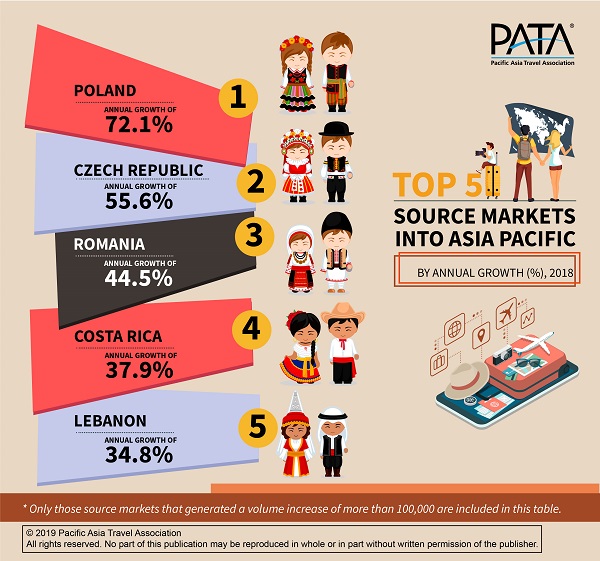
At the individual origin market level, those with the strongest annual percentage growth rates into Asia-Pacific in 2018 were ranked as:

All told, 46% of the 245 origin markets (including ‘Others’) covered in this report had annual growth rates in excess of 10%, while 66% grew by five per cent or more between 2017 and 2018.

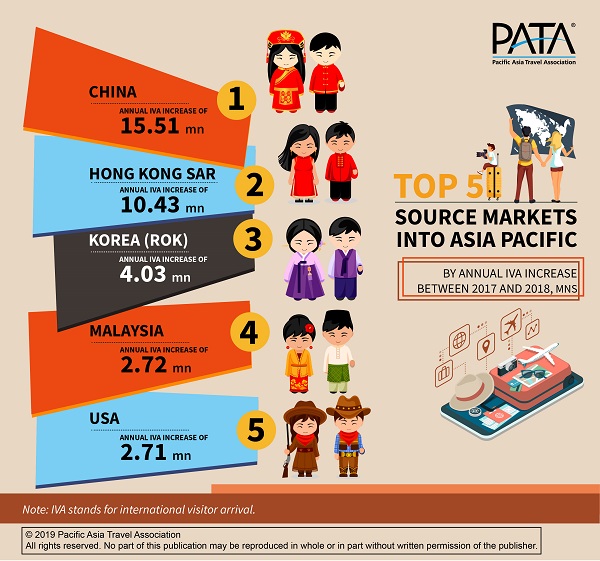
For the absolute volume increase between 2017 and 2018, the strongest source markets into Asia-Pacific were ranked as:

Interestingly, each of these top five origin markets are within the Asia-Pacific region. Intra-regional travel remains very strong.

Of the source markets covered in this report, 12 (about 5%) generated annual volume increases of more than one million each, while 20 (about 8%) produced more than half a million additional IVAs into Asia-Pacific between 2017 and 2018.

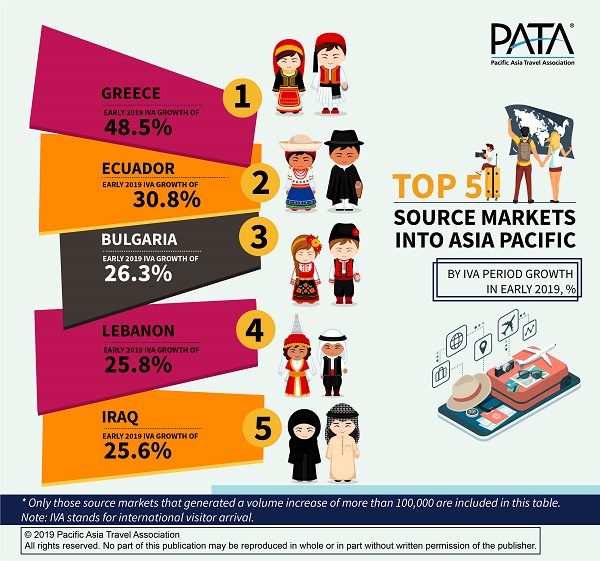
Early 2019 data for foreign arrivals into 37 Asia-Pacific destinations shows strong early performances from a number of destinations including:

While Europe’s Greece and Bulgaria both represent extra-regional increases into Asia-Pacific in early 2019 over early 2018, the remainder in this group are all from within Asia-Pacific.

While only two origin markets have so far added more than one million additional IVAs into Asia-Pacific between early 2018 and early 2019, just under 10% of these 232 markets had already generated more than 100,000 additional arrivals into the region over these periods. Included among these are:

PATA’s CEO Mario Hardy said: “Asia-Pacific is still the major generator of arrivals into Asia-Pacific, with Asia especially playing a lead role in that regard. Outside of Asia-Pacific, Europe is an important contributor, with both West and East Europe in particular, supplying significant numbers of additional arrivals in early 2019.”

“Nothing remains the same however and various tumultuous activities that are currently playing out globally and in the Asia-Pacific region will undoubtedly affect the origin and distribution of international arrivals by the end of the year.

“It remains imperative therefore that the international tourism sector remains agile and able to shift its marketing focus to areas of higher potential as these interventions peak and then ultimately fade. The provision of appropriate and timely intelligence as to what these areas of higher potential may be has never been more critical and could easily spell the difference between growth and contraction for players in this field and at this time.”

Digitalisation key to connecting with Chinese luxury travellers

0

Reuter: Intelligence, in partnership with ILTM China, has released a new study looking at how travel and hospitality brands can master WeChat, build up their digital presence in China and stand out in a crowded marketplace by winning hearts and minds through creative content.

The importance of emotion and storytelling

Luxury travel brands cannot only focus on the capabilities of platforms available in China’s social media landscape, but must provoke connections beyond mere digital, elevating engagement and making emotional connections. According to the report, big content wins of recent years found success thanks to boldly presenting more meaningful storytelling that was based on Chinese cultural moments and issues.

Travel and hospitality brands need to build creative content on top of mastering technology like China’s super-app WeChat to connect with Chinese travellers: study

Breaking down marketing labels across sectors

Marketing labels such as aspirational, immersive and inspiring are also broken down within the report, which describes their true meaning in relation to the functionalities offered by WeChat, and how Red and Douyin are being best employed by savvy luxury brands. A view outside of travel and hospitality takes a look at how leading brands in other sectors such as fashion and beauty are winning with luxury Chinese consumers.

The report also examines the closed-loop functionality offered by WeChat, explaining how the big content wins by international brands in recent years have not only been about mastering the technology, but winning hearts and minds. These successes have been achieved through telling stories that provoke emotional connections.

UGC and interactivity key for younger consumers

For luxury brands, the WeChat superapp must still be the foundation of digital communications in China, while user-generated content (UGC) platforms such as Red and Douyin offer exciting new opportunities for innovative connections with affluent Chinese consumers.

On Douyin, they don’t only want to watch, they want to “give it a go” themselves and get involved in whatever’s viral. Although a luxury brand may want to appear slick, luxurious and on-brand elsewhere, Red is the place to go under the cover, beneath the surface and behind the scenes. Red users have seen flashy and slick corporate communications a million times and expect to be able to enter the real world of the brand and product in their own Red world.

The report is available for free download here.

Tourism industry more resilient than ever to crises: WTTC

0

The travel and tourism sector is more resilient than ever, with average recovery times having decreased from 26 months in 2001 to 10 months in 2018, the latest research by The World Travel & Tourism Council (WTTC) and Global Rescue revealed.

The findings from the report titled “Crisis Readiness: Are You Prepared and Risk Resilient to Safeguard Your People and Destinations?” analysed the impact of 90 crises between 2001 and 2018 at national and city levels, and examined the time to recovery as well as lost arrivals and lost visitor spending.

Tourism industry shows greater resilience to calamities, new study shows

Of the 90 crises analysed, 32 per cent were terrorism/security related, 13 per cent were disease/outbreaks; 19 per cent were political instability and 36 per cent were natural disasters.

Of the four crisis categories analysed, political instability proved the most challenging, with average recovery times of 22.2 months, and minimum 10 months; while terrorist or security related incidents have the shortest average recovery time of 11.5 months and minimum 2 months.

Additionally, the study also found that the average recovery times for natural disasters and disease outbreaks were 16.2 months, and minimum one month; and 19.4 months, and minimum 10 months respectively.

Public private partnerships and effective, transparent communications are critical for preparedness and prevention, the study concluded.

WTTC’s president & CEO Gloria Guevara said: “This comprehensive research shows just how resilient the travel and tourism sector truly is. While there is still work to be done, the data shows that recovery times have fallen significantly over the past two decades, and that major strides have been made. It is crucial that we continue to learn from previous incidents and continue to come together through public private partnerships to make a real difference in reducing both the economic and human impact.”

She added: “Political instability has proven to be the most challenging crisis to overcome, with the longest recovery times. However, through public private collaboration, effective communication and continued efforts that focus on preparedness and prevention, we can make a real difference in reducing both the economic and human impact.”

In the report, WTTC and Global Rescue offer recommendations on how destinations can mitigate the impact of a crisis, showcasing successful examples from the likes of Kenya, Mexico, Egypt, Hawaii and Japan. The report also highlights the importance of being prepared and the need for coordinated management to ensure a successful recovery.

The full report can be read here.

Singaporean tour operator grooms young talent to drive industry innovation

0

The demand for local tours in Singapore may be flourishing, but sourcing for new talent to drive the industry is no mean feat. One tour operator has taken up the mantle of grooming a team of young management and guiding talent to lead innovation in the local tourism scene.

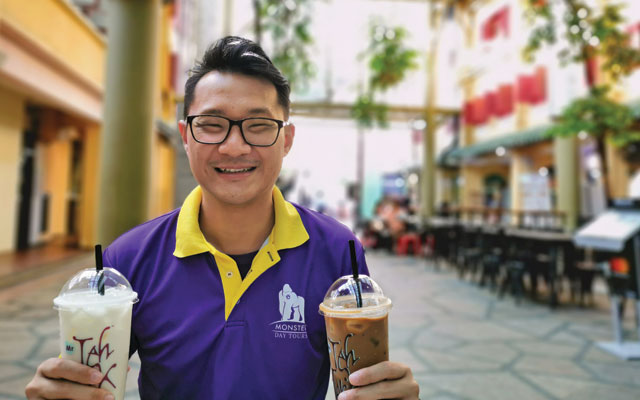
Monster Day Tours, run by founder & CEO TY Suen under Woopa Group, is now Singapore’s largest walking and private tour operator.

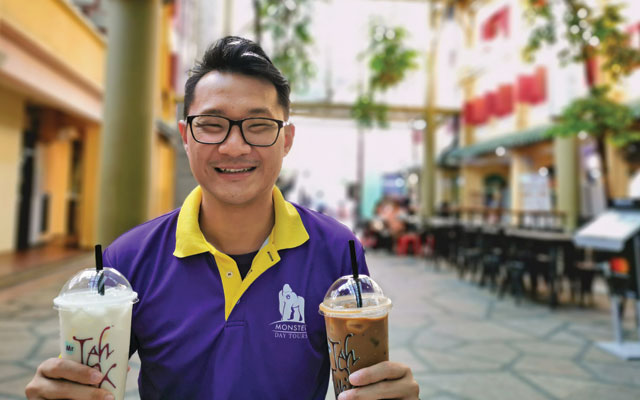
Monster Day Tours’ founder & CEO TY Suen wants to attract young talent into the tour operator and guiding industry

Monster Day Tours’ prominence grew in 2017 when it launched free daily walking tours in Chinatown and Little India, taking participants through the districts’ heritage sites, hipster hotspots and architectural wonders. The company has since expanded its menu of free tours to cover Kampong Glam, Marina Bay Sands, Gardens by the Bay, the Civic District, Bugis and Bras Basah.

Suen explained: “We aim to combine adventure and professional storytelling to create quality visitor experiences in Singapore, and to make travel accessible for everyone. Most tour and activities companies will address a specific audience or conduct a specific genre of tour, but we do our best to spread it out.”

But while Singapore’s touring landscape is thriving more than ever before, it is not immune to the challenge of recruiting bright and passionate talent.

Suen professed: “My idea is to be able to attract young talent into the tour operator and guiding industry. Most of Singapore’s younger generation still think that tours are big group bus tours, and a tourist guide is someone waving a flag and bringing the group from point to point. They are not aware that there are new ideas and innovation happening in this industry, and I hope to be able to change that.”

Now, Monster Day Tours’ management team and tour guides are among the youngest in the local industry, with an average staff age of 30 years. Suen said he involves the guides in the brainstorming of ideas for tours to keep them on their toes.

He said: “We continuously update and refresh our tour offerings. In the past two years, we have seen existing players start to innovate and develop more unique tour experiences. It has also begun to attract even players outside of the industry. I think the challenge for tour operators is how to keep our tours and tourist guides relevant for travellers.”

The company’s synergistic energy has empowered it to launch a number of paid themed tours, including A Taste of Michelin 1-Star Chicken Rice & Local Hawker Food Tour, Singapore After Dark Local Street Food & Nightlife Tour, as well as Crazy Rich Asians: Singapore Icons & Filming Locations Car Tour.

This year, Monster Day Tours has branched out to “other focus areas” and developed two new brands: UBE and 8xplore.

Touted as the “pioneer of start-up and business innovation tours in Singapore”, UBE organises localised tours in conjunction with creative start-ups and businesses from various industries in Singapore. Its debut product is Singapore’s first Silicon Valley of Singapore Insider Tour at one-north and JTC Launchpad.

Set to be launched next year is 8xplore, which will specialise in themed Singapore holidays curated for the China market, with offerings ranging from food and culture to heritage and shopping.

APAC reigns over global duty free and travel retail market

0

The Asia-Pacific region will continue to be a major driver of global duty free and travel retail sales, growing at an estimated 8.7% annually up to 2022, according to a new study commissioned by the Duty Free World Council (DFWC) and the Asia Pacific Travel Retail Association (APTRA).

That projection from the Economic Impact Report of Duty Free and Travel Retail in Asia Pacific study is based on the Asia-Pacific travel retail industry having generated an estimated US$36.2 billion in 2017, or 45% of total global duty free and travel retail sales.

Asia-Pacific is the market leader in global duty free and travel retail market, with South Korea emerging as the world’s largest duty free market; Lotte Duty Free shop in Gimhae International Airport in Busan, South Korea pictured

“Asia-Pacific is registering exceptional growth in duty free and travel retail sales. We are also seeing the regulatory landscape become more complex and dynamic across the various product categories. This report is an important investment on the part of DFWC and APTRA in getting the data that will help us engage policymakers and regulators in protecting the sustainable growth of our industry,” said Frank O’Connell, president of DFWC.

The report identifies the following key trends in duty free and travel retail across Asia-Pacific:

East Asian markets are driving growth
South Korea is the world’s largest duty free market, accounting for nearly US$12 billion in sales, with China and Japan also being globally significant markets. Mainland China is anticipated to strengthen its position as the second biggest duty free and travel retail market in the region.

Growing diversity in product demand
Fragrances/cosmetics, wines/spirits, and fashion/accessories accounted for approximately 67% of total sales in the global duty free and travel retail sector in 2017. In Asia-Pacific, these product categories made up 75% of all duty free and travel retail sales.

Duty free is becoming increasingly digital
Duty free shoppers in the Asia-Pacific region are increasingly looking to digital platforms to facilitate their purchases. Typically, this involves the use of mobile apps which are becoming increasingly common payment methods for consumers.

Channel diversification beyond aviation
Total estimated duty free and travel retail sales by land channels were US$14.2 billion in 2017. Downtown duty free in Asia-Pacific comprises a significant portion of sales for all land channels. Cruise tourism is an emerging sector in Asia, with capacity growing at an annual rate of 41% over the last five years as the fastest growing sub-region in the world.

“The report highlights the significance of the Asia-Pacific region to global duty free and travel retail, and on a macro level, to economies in the region through job creation and contribution to GDP. As the industry body that supports, protects and nurtures the growth of the travel retail industry, we are encouraged by the positive trends indicated by the report findings,” commented Grant Fleming, president of APTRA.

APAC’s physical activity market shows active growth

0

Asia-Pacific is now the number two physical activity market, valued at US$240 billion annually, or roughly 30 per cent of the global market, according to a research study by the Global Wellness Institute, Move to Be Well: The Global Economy of Physical Activity.

But the same study revealed that Asia will be the overwhelming growth leader from 2018 to 2023, with a market expanding 9.2 per cent annually, and is estimated to reach US$373.3 billion by 2023, overtaking North America as the world’s largest market.

APAC is now the number two physical activity market, valued at US$240 billion annually, according to a recent study

Asia-Pacific will account for a staggering 40 per cent of all global market growth from 2018 to 2023, with China and India combined driving nearly one-third of all growth.

The 180-page report found that the physical activity economy, which includes 1) fitness, 2) sports & active recreation, 3) mindful movement, 4) equipment, 5) apparel/footwear, and 6) technology, is now a US$828 billion world market, and is expected to grow to over US$1.1 trillion by 2023.

The top 10 recreational physical activity markets in Asia are 1) China (US$109.3 billion); 2) Japan (US$43.9 billion); 3) South Korea (US$23.5 billion); 4) Australia (US$16.7 billion); 5) India (US$13.4 billion); 6) Taiwan (US$7.7 billion); 7) Hong Kong (US$4.1 billion); 8) New Zealand (US$3 billion); 9) Thailand (US$2.9 billion); and 10) Indonesia (US$2.6 billion).

Four of the top 10 recreational physical activity markets in the world are in Asia: China, Japan, South Korea and Australia. The US and China are by far the world’s largest consumer markets, together accounting for 45 per cent of all global expenditures.

China’s physical activity sector is experiencing explosive recent growth with support from the government, a proliferation of gyms and fitness studios in Tier 1 cities and widespread adoption of fitness apps and other online platforms.

Meanwhile, Japan, Hong Kong, Taiwan, South Korea and Singapore have highly developed, competitive physical activity markets. Governments in these markets are also active in promoting physical activity through public education campaigns (e.g. South Korea’s Program 7330 and Singapore’s Active Health programme). South-east Asian countries, such as Malaysia, Thailand, Indonesia and the Philippines, have small physical activity markets, lower levels of participation, and the lowest fitness industry penetration rates across Asia.

The top 10 Asian markets for participation rate (%) in recreational physical activities are 1) Australia (84%); 2) Taiwan (84%); 3) New Zealand (84%); 4) Mongolia (75%); 5) South Korea (74%); 6) Japan (70%); 7) Singapore (65%); 8) Hong Kong (58%); 9) French Polynesia (58%); and 10) Vanuatu (54%).

When it comes to recreational physical activity participation rates, many Asian markets shine. Six rank among the top 15 worldwide: Taiwan, New Zealand, Mongolia, South Korea, Japan and Singapore.

The full report can be read here.

Personalisation, sustainability demands on the rise for APAC travellers: Sabre

0

A rising tide of group travel for retirees, eco-conscious movement and thirst for customisation are some of the key traveller trends that Sabre has identified in its Asia-Pacific survey for 2020.

Here are the five key trends as revealed by the survey, which polled over 500 leisure travel consultants from over 24 countries across Asia-Pacific:

Leisure travel consultants from over 24 countries reveal the five key trends across Asia-Pacific

Forever young
Travel professionals reveal that travellers aged between 35 to 50 make up close to 60 per cent of their customer base, proving that despite the rise of online platforms meant to facilitate personal bookings, there’s nothing like having a professional to help enhance the booking experience. What’s more, three in five respondents indicate that personalised requests are the main reason why customers reach out, allowing them to create unique packages that cater to each traveller’s needs.

Silver is golden
In Asia’s rapidly aging economies, more than 40 per cent of consumers served by travel agents are over the age of 50, and over one third of those surveyed identified that retirees are among their most popular customers, just after families and couples.

In fact, four in 10 agents confirm that travel for groups of retired people is on the rise, with packaged tours listed as the main reason why people over 50 reach out to travel agents. Some 46 per cent of those included folks in the 50 to 69 branch; and close to 60 per cent of the 70 and over age group request packaged tours that include flights, hotel and transportation bookings, with wellness or religious activities often being the main reason for their bookings.

Green giant
Sabre’s traveller trend survey found that over 60 per cent of travel consultants identified a growing concern for the environment among travellers. The survey also reveals that an impressive 70 per cent of travellers are asking for sustainable tourism options, and close to 30 per cent are requesting for alternate modes of transportation. However, the survey also reveals that only two per cent of leisure travellers across Asia-Pacific ask to purchase carbon credits.

The gender gap
With solo travel growing year on year, the Sabre traveller trends survey discloses that in Asia, men account for 10 per cent more of the solo travel bookings than women. When it comes to bookings, women tend to prefer travelling in groups. However, when it’s time for a couples’ getaway, the survey reveals that both parties do their part, with nearly 40 per cent of both men and women reaching out to their travel consultant to assist with the booking.

Me, myself and I
As consumers across the board expect customisation to be part of their retail experience, a significant 60 per cent of respondents indicate that personalisation is the main reason why they are called upon to book travel. Travel consultants are sought to fulfil the growing demands of those aged 34 and below to book their next sport and adventure travel, which account for approximately 50 per cent of group bookings, or simply to identify better prices for their customers.

August global air traffic rise on uptick in demand: IATA

0

Demand in global passenger traffic data for August 2019 (measured in total revenue passenger kilometres or RPKs) climbed 3.8% compared to the year-ago period, despite a weak performance compared to long-term norms, according to the International Air Transport Association (IATA).

This was above the 3.5% annual increase for July. August capacity (available seat kilometres or ASKs) increased by 3.5%. Load factor climbed 0.3% percentage point to 85.7%, which was a new monthly record, as airlines continue to maximise asset use.

Global air traffic demand for August 2019 rose 3.8% from the year-ago period: IATA

“While we saw a pick-up in passenger demand in August compared to July, growth remains below the long-term trend and well-down on the roughly 8.5% annual growth seen over the 2016 to 1Q2018 period. This reflects the impact of economic slowdowns in some key markets, uncertainty over Brexit, and the trade war between the US and China. Nonetheless, airlines are doing a great job of matching capacity to demand. With passenger load factors reaching a new high of 85.7%, this is good for overall efficiency and passengers’ individual carbon footprint,” said Alexandre de Juniac, IATA’s director general and CEO.

International passenger markets

August international passenger demand rose 3.3% compared to August 2018, from a 2.8% year-over-year growth in July. With the exception of Latin America, all regions recorded increases, led by airlines in Africa. Capacity climbed 2.9%, and load factor edged up 0.3 percentage point to 85.6%.

Asia-Pacific airlines’ August traffic increased 3.5% compared to the year-ago period, which was an acceleration compared to a 2.6% rise in July. However, this remains well below the long-term average growth rate of around 6.5%, reflecting slowing economic growth in India and Australia as well as the impact of trade disputes. Capacity rose 3.9% and load factor slid 0.4 percentage point to 82.8%.

European carriers saw August demand climb 3.7% year-to-year, fractionally up over a 3.6% increase for July. Capacity rose 3.4%, and load factor climbed 0.2 percentage point to 89.0%, which was the highest among regions. Slowing economic growth in key markets such as the UK and Germany, as well as uncertainties and disparate business confidence outcomes, are behind the softer conditions for the continent’s air carriers.

Middle Eastern airlines posted a 2.9% traffic increase in August, which was an increase from a 1.7% rise in July. While this was better than the average of the past 12 months, it remains far below the double-digit growth trend of recent years. Falling business confidence in parts of the region, coupled with some key airlines undergoing a process of structural change and geopolitical tensions are all likely contributing factors. Capacity increased 1.3%, with load factor rising 1.3 percentage points to 82.4%.

North American carriers’ international demand rose 2.5% compared to August a year ago, up from a 1.4% increase in July. Capacity rose 1.3%, and load factor grew by 1.0 percentage point to 88.3%. As with the Middle East and Asia-Pacific, this performance represents an improvement from July, but remains relatively soft compared to long-term norms, most likely reflecting trade tensions and slowing global demand.

Latin American airlines saw a 2.3% demand increase in August from the same month last year, down from a 4.0% annual growth in July. Argentina’s financial and currency crises, coupled with challenging economic conditions in Brazil and Mexico, contributed to the dismal performance. Capacity fell 0.3% and load factor surged 2.1 percentage points to 83.9%.

African airlines’ traffic climbed 4.1% in August, up from 3.2% in July. This solid performance comes after South Africa – the region’s second largest economy – returned to positive economic growth in 2Q2019. Capacity rose 6.1%, however, and load factor dipped 1.4 percentage points to 75.6%.

Domestic passenger markets

Demand for domestic travel climbed 4.7% in August compared to the same period last year, unchanged from the previous month. Capacity rose 4.6% and load factor increased 0.1 percentage point to 85.9%.

Australian airlines’ domestic traffic slipped 0.4% in August from the same period a year ago, which was a reversal from a 0.7% annual increase in July. Economic growth in Australia slipped to its lowest level in several years during the second quarter.

Russian airlines saw domestic traffic climb 6.0% in August, down from 6.8% growth in July and below the long-term average growth rate in the market of around 10%.