With the intensifying Covid-19 situation in India, with authorities in some cities tightening restrictions on movement and warning that the 21-day nationwide lockdown which kicked in on March 25 could be extended, the hotel occupancy rates in the country has taken a beating.
India’s daily hotel occupancy dropped to 11 per cent during the period of March 23-29, according to preliminary data from STR.
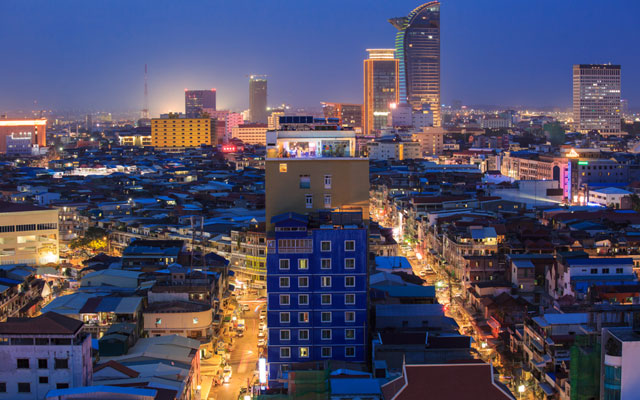
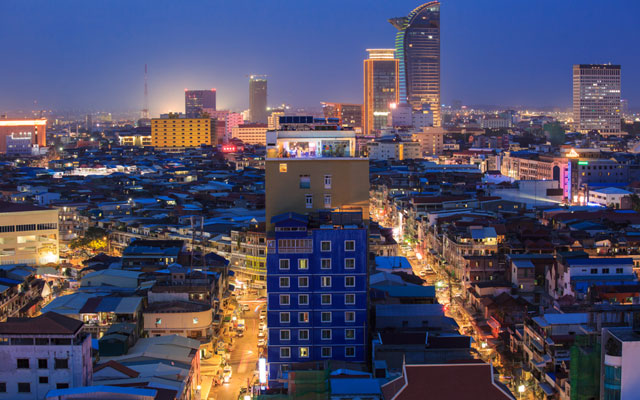
India’s daily hotel occupancy plummets to 11 per cent; Mumbai skyline pictured
Vidhi Godiawla, STR’s business development manager for South and Central Asia, said: “India remained resilient in February – in comparison with other Asia-Pacific markets that were more deeply affected – thanks largely to robust domestic demand coupled with the low number of Covid-19 cases in the country at that time.
“The story was different in March, especially during the later portion of the month, with year-over-year occupancy declines in excess of 80 per cent for the last nine days we have processed (ending April 2, 2020).
“These declines are consistent with the significant measures taken by prime minister Modi to combat the spread of the virus, and the extent of these measures will determine the hotel performance impact in the short- to medium-term.”
Along with a steep downward trend in occupancy, average daily rate (ADR) and revenue per available room (RevPAR) have also dropped significantly in India.
ADR, which has decreased year-over-year by roughly 20 per cent or more for eight consecutive days, went as low as 4,924 rupees (US$65) on 28 March 28. RevPAR reached its lowest absolute level at 538 rupees on March 22.
As fast-paced urban development and sprawling mega-infrastructure projects mount on Phnom Penh’s Mekong horizon, Cambodia’s attention has now shifted from its singular tourism magnet Siem Reap, where the Angkor Wat temple resides, to the nation’s capital city which brims with business and tourism potential.
That is the basis of a study by consulting group C9 Hotelworks, which showed that last year, the lead indicator of passenger arrivals by air saw Phnom Penh exceed two million passenger arrivals, surpassing Siem Reap’s for the first time in a decade.
Phnom Penh boasts a robust development pipeline
The report also showed a steady sustained growth trajectory, as passenger arrivals recorded double-digit growth rates from 2012 through 2018, with a CAGR (compound annual growth rate) of 18 per cent.
Clearly, the key catalyst of change for the city has been its proximity to the country’s leading private and public sector headquarters and strategic location for China’s ambitious BRI (Belt and Road Initiative). The BRI now spans across Cambodia and runs all the way south to the Gulf of Thailand and beyond into the South China Sea.
Asia is the dominant visitor source region, representing a 79 per cent market share, found the study. More telling is a deeper data dive that 66 per cent of the regional traffic is from mainland China.
China leads the top five geographic source markets at 52 per cent, followed by Malaysia (6 per cent), the US (five per cent), Japan (four per cent) and Thailand (four per cent).
Highlighting how overseas travellers are funnelling into the accommodation sector, C9’s report showed that there are 313 hotels with 19,337 keys and 523 guest houses in Phnom Penh.
A clear sign how fast-paced growth is impacting the hospitality sector is demonstrated in the fact that there are presently fifteen new hotels in the pipeline with 7,849 keys, with thirteen of the upcoming properties being major international brands including Marriott, Hyatt, Shangri-La and Accor.
As for the city’s hotel sector, there are challenges ahead with a spike in newer and bigger hotels, and it has yet to be seen how they will penetrate the existing hotel market.
C9’s managing director Bill Barnett said: “The next two years will see a massive transformation in the accommodation supply as ten new branded properties are forecasted to enter supply between now and 2022. While business travellers are the core guests, the task is how to attract other segments including tourists and the (corporate) sector.
“Phnom Penh finds itself in a similar situation as other Asian CBD gateway capital hubs like Jakarta and Yangon where hotels are defined by weekday business travellers. Manila, on the other hand, has been able to capitalise the gaming sector to grow the leisure segment and provides a more balanced model in the future.”
Unlike Siem Reap, hotels in Phnom Penh are mainly focused on the business segment. Expansion of the tourism sector remains challenging with limited direct flights, strained infrastructure and lack of diversity of tourism offerings, the report found.
Barnett added: “In general, the hospitality sector in Phnom Penh is at its early stage of development. The increasing exposure of global hotel operators, expansion of the country’s economy and improving infrastructure will help the city to shape its destination awareness and improve its appeal in the longer term.”
The Covid-19 outbreak has led to a global economy crisis. Instead of wallowing in despair, travel and tourism businesses should adopt a different – and open – mindset to help find better ways to grow and be ready for the rebound when it happens. Here are five things you could do:
Focus on strategies
A business slowdown is rare in the hospitality industry, as it is kept busy year-round fulfilling the promise that the customer is king. The current business climate presents an opportunity for travel and tourism business leaders to recollect, re-structure and re-frame their strategies, so as to bring about a stronger recovery when the time is ripe.
Knowledge is power
Take advantage of the downtime to upskill your team in various subjects, such as crisis and disaster management, and to conduct stress management courses. This not only improves their employability, it is keeps them engaged and motivated.
Expand your line
When business is brisk, the focus in largely on perfecting the delivery of core products and service. Use this opportunity to sharpen your secondary products and service. To do this, you need to understand the unique traits and special offerings of your organisation, and build on them. Don’t forget to invest in product training so that your staff have the confidence in delivering a new line.
A new look at competition and partnerships
Unity and healthy competition is more important than ever, and this isn’t the time for undercutting practices. Businesses should identify ways to work together to leverage business opportunities. Consider joint ventures on new initiatives that can strengthen your position when travel confidence returns.
Build sustainable power
In your fight for survival, don’t forget your responsible tourism promise to make better places for people to live in and better places for people to visit. Consider hosting webinars to share your sustainable tourism projects and best practices with industry peers, or join such programmes to learn a new approach or two.
As Covid-19 continues to wreak havoc on the world and our lives, travel has become such a dirty word.
The act of travel now is regarded as an act of defiance and selfishness, never mind the purpose. How dare you not stay home!
The travel and tourism industry is greedy, for continuing to promote staycations, vacations, and encouraging customers to only postpone their trips instead of just refunding their hard-earned money.
So the public say, from behind the safety of their mobile devices and desktops.
For those not in the travel and tourism industry, it must be hard for them to imagine the struggles people employed within are facing.
World Travel and Tourism Council has estimated that one million travel and tourism jobs are being lost daily around the world. That’s one million people suddenly faced with no source of income for only God knows how long. Many of them may not even find another job soon enough because many other industries and businesses are struggling too.
Despite a painful present and an uncertain future, many travel and tourism companies have chosen to protect their staff by resisting retrenchment for as long as their resources last, with or without government handouts.
Many have also chosen to demonstrate selflessness and grace by volunteering time and resources to help their country and community in the battle against the pandemic.
Airlines have been helping to transport medical devices and supplies, and even healthcare workers, to places in need.
Hotels, resorts and convention centres have – and some ready to do so now – converted their facilities into isolation centres or temporary homes for frontline healthcare workers who are afraid to go home to their family.
The travel and tourism community, as I know it, is hardly greedy and selfish. We seek humour in tough situations and we reach out to lift one another, even if we are competitors in the business.
When Singapore had a shortage of masks and hand sanitisers early on in the outbreak, my friend Daniel Tan, who runs a culinary school for tourists in Singapore, delivered a fabric mask and sanitiser – both of which he made himself, catching me right before my trip to ITB Berlin. Just in case I needed them, he told me.
When cruises everywhere were hard hit by bad publicity around infections onboard, the Royal Carribean Cruises team in Singapore visited agents and media partners with little gifts of snacks and cheerful notes to lift the mood.
They didn’t have to, but they did.
These are stories that need to get out more in the mainstream media, to remind the world of the human side of the travel and tourism industry. And when the crisis is over, this industry is more than ready to get back to its job of helping people create beautiful memories as well as broaden their mind and heart to different cultures and environments.
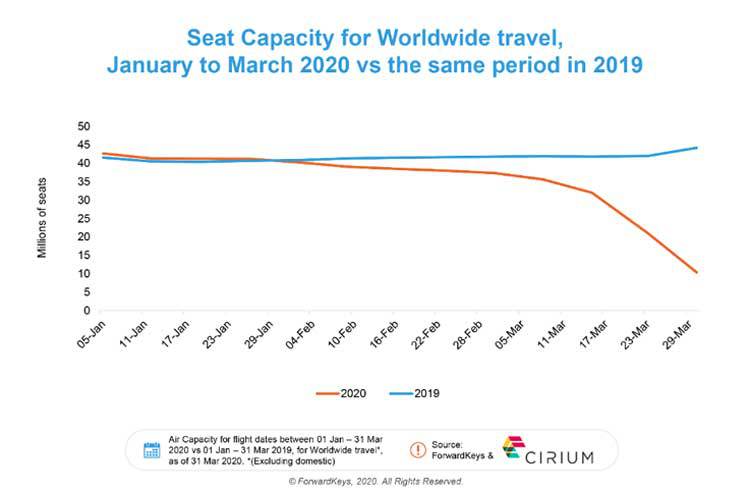
The Covid-19 crisis has left the global aviation industry reeling, in the wake of unprecedented capacity cuts across the world, leading to a 77 per cent collapse in global aviation year-on-year, found a report by ForwardKeys.
In the first week of April, international airline seat capacity fell to just 23 per cent of what it was during the same time last year. Just 10 million seats were still in service to facilitate essential travel, compared with 44.2 million a year ago.
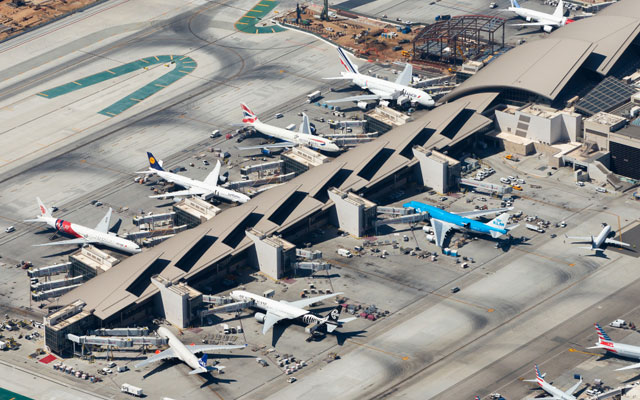
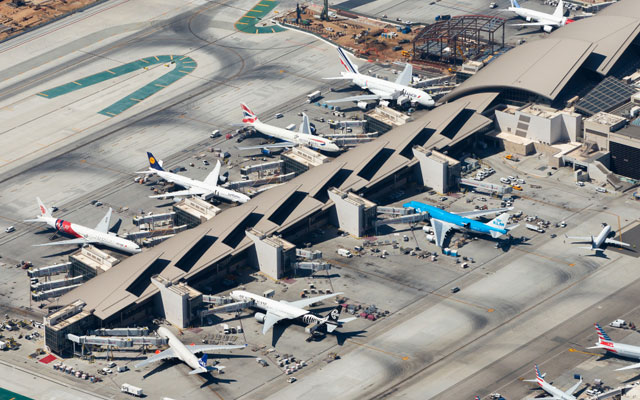
The coronavirus outbreak has led to a collapse in air travel; aerial overview of multiple aircraft at Tom Bradley International Terminal at LAX Airport pictured
In 1Q2020, airline seat capacity is 9.4 per cent down, with 482 million seats in service, compared with 532 million in the same period last year.
Despite an uptick in capacity at the start of January, compared to last year, it started to fall during the last week of the month when the Chinese government announced restrictions on outbound travel.
Following after until mid-March, air capacity fell substantially, and tumbled precipitously to the end of the month.
Olivier Ponti, vice president Insights, ForwardKeys, said: “Governments have closed entire countries; and in response, the airline industry has cut services to the bone. It is likely that when we get to the other side of the pandemic, things won’t return to the vibrant market conditions we had at the start of the year, anywhere near as easily as some people imagine.
“By then, it is possible that a number of airlines will have gone bust; consumers will have lost confidence in flying and uneconomic discounts will be necessary to attract demand back.”
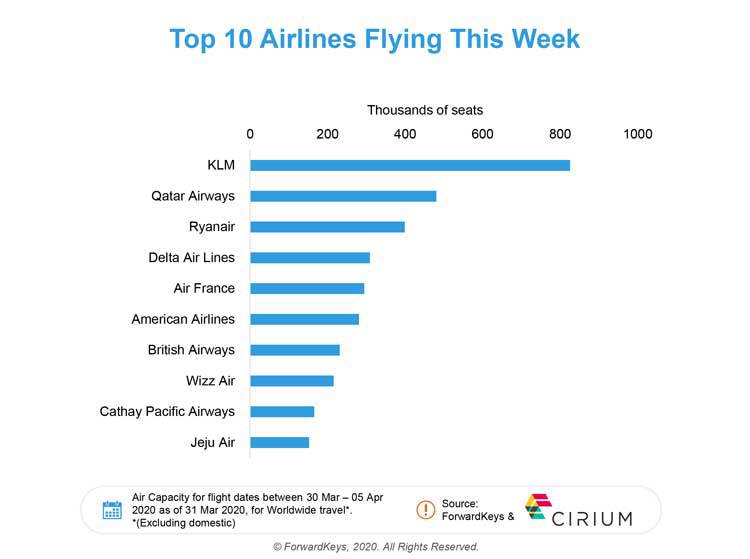
The top ten airlines still operating in the first week of April (March 30 to April 5) are KLM, with 800,000 seats still in service; Qatar Airways, with nearly 500,000 seats in service; and Ryanair, with 400,000.
They are followed in descending order by Delta, Air France, American, BA, Wizz Air, Cathay Pacific and Jeju. However, this picture will change soon, as Ryanair recently announced that almost its entire fleet will be grounded by the Covid-19 pandemic.
The Royal Park Hotel Iconic Osaka Midosuji, Japan
Royal Park Hotels and Resorts has opened its second hotel in Osaka, located in the brand-new OBIC Midosuji building in the CBD. There are 352 guestrooms within, starting from the 21m2 Comfort Double right up to the 102.5m2 Suite. Amenities on-site include two gyms, and all-day dining restaurant The Blink on the 15th floor. The executive lounge on the 25th floor also offers meeting facilities with complimentary two-hour usage.
Sindhorn Midtown Hotel Bangkok, Thailand
The flagship property of Thai-inspired hospitality brand Siam Sindhorn has opened in Bangkok’s Langsuan neighbourhood. Spread across two towers are 344 hotel rooms and suites, alongside 49 serviced residences. Facilities include two F&B offerings, the Horizon Pool on the 18th level, and the fitness centre on the 19th level.
Lemon Tree Hotel, Thimphu, Bhutan
India-headquartered Lemon Tree Hotels has opened its second international property in Bhutan. Built in the traditional Bhutanese architecture style, the hotel stands on Changlam street in Thimphu, and features 27 rooms. Other amenities include Citrus Cafe, a multicuisine restaurant with an al fresco dining area; Slounge bar; and fitness centre.
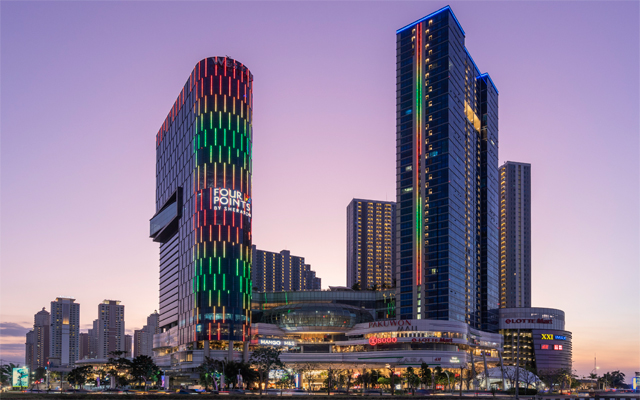
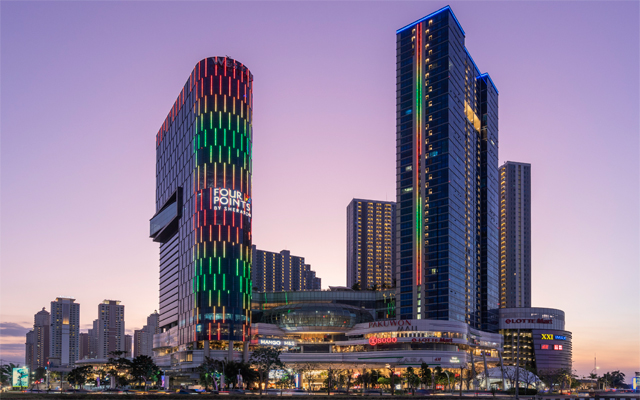
Four Points by Sheraton Surabaya, Pakuwon Indah, Indonesia
This four-star hotel in Surabaya offers 317 rooms across four room categories – Deluxe Rooms, Premium Deluxe Rooms, Junior Suite Rooms and Premium Suite Rooms. The property is connected with both Pakuwon Mall and The Westin Surabaya, where the latter offers more than 8,600m2 of meeting space across 21 function spaces. Facilities include two swimming pools and the Djaman Doeloe Resto & Bar.
Intrepid Travel has launched new women-only expeditions to Pakistan and Israel and Palestinian Territories – a move by the Melbourne-based travel company to strengthen its commitment to gender equality by including more female tour guides and female-owned enterprises on its tours.
The two new destinations add to the existing portfolio of Iran, Jordan, Nepal, Kenya, Morocco, Turkey and India; with customer numbers on the women-only expedition range growing 116 per cent in 2019.
Intrepid Travel launches women-only expedition that brings travellers to trek the Annapurna Base Camp in Nepal
“This is Intrepid’s fastest-growing range to date, and we have seen women connect with women in powerful and moving ways,” Intrepid Travel senior product manager Jenny Gray said.
“Now in its third year, local female leaders offer insight and a unique understanding of women in these regions with respect to their cultural and religious values. We have found experiences that share stories of female empowerment, and directly benefit local women by seeking out female-owned accommodation, restaurants, suppliers, and businesses in Pakistan and Israel and Palestinian territories,” she added.
This emphasis is in line with Intrepid Travel’s new gender equality goals. Last year, the travel company met its target of doubling female tour leaders, in its bid to increase opportunities for women in tourism. There were 154 female leaders in 2017; in January 2020, that number was 342.
In 2020, Intrepid will enhance those goals with new commitments to increase employment opportunities for women in the travel industry, including doubling the number of female porters globally who assist travellers on mountain hikes in Tanzania, Peru and Nepal.
“It’s crucial for us to enable women in all levels of the business – from our leaders on the ground all the way to gender parity on our board,” Intrepid Travel CEO James Thornton said.
Supply chain is an ongoing focus for Intrepid. The travel company will perform a rigorous audit to assess how many suppliers are women-owned or women-led in 2020. In 2021, Intrepid will work with its biggest suppliers to maximise opportunities for women and reduce gender inequality.
The Pakistan: Women’s Expedition, priced at A$4,270 (US$2,535), is a 15-day journey to Pakistan’s remote northern mountains, where a local female leader will guide guests to the Hunza and Yasim valleys. Guests will get to meet the local women working on empowerment projects throughout the region; stay with a local family in a remote mountain village, and witness the march of modern Pakistan in the country’s capital of Islamabad.
The Israel and Palestinian Territories: Women’s Expedition (A$3,195) is an eight-day journey to Israel and Palestinian Territories with local female leaders and guides from Israeli, Palestinian and Bedouin backgrounds.
Guests will get the chance to meet Palestinian peace activists, break bread with Bedouin women, and learn about Israeli women working to secure the right to pray at the Western Wall. They can also visit a social tourism project in an artist’s village in Arad, explore the West Bank city of Ramallah with a local peace activist, and enjoy a home-cooked meal and discussion with activists from the Women Wage Peace organisation.
Traveller intelligence provider, Adara, has picked up a new upward trend in data relating to China travel in an analysis published on Saturday.
It noted that China was the first global market that was impacted by Covid-19, and travel both to and from the country had started declining beginning in mid-January.
Analysing anonymised behavior of travellers on air and hotel bookings for 2020 year-to-date, Adara has found that there are promising signs for a rebound in flights within China and to China from international origins that align with the trajectory of the pandemic.
Travel to China
For this analysis, travel to China is referring to both domestic China origin travel (example: Beijing to Harbin) and international original travel (example: Sydney to Shanghai) with China as the destination.
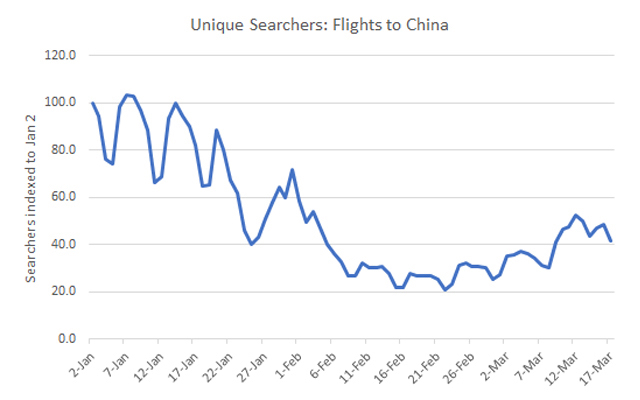
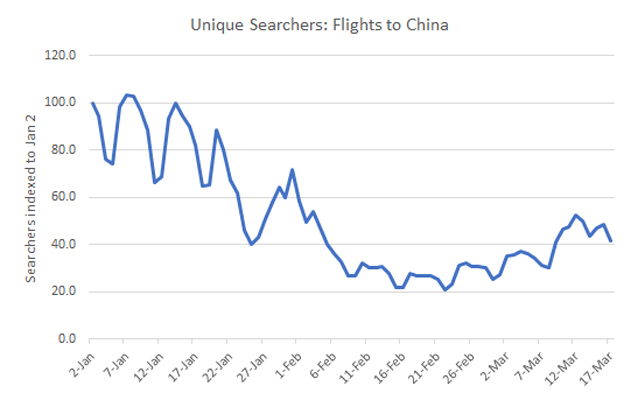
The number of unique travellers (both domestic and inbound international) searching for flights to China declined during three weeks in February to only one-third the number of searchers that was seen in early-January. In the past two weeks, Adara has seen an uptick in the number of searchers. Unique searchers were up 29% for the week of March 8, compared to the week of March 1.
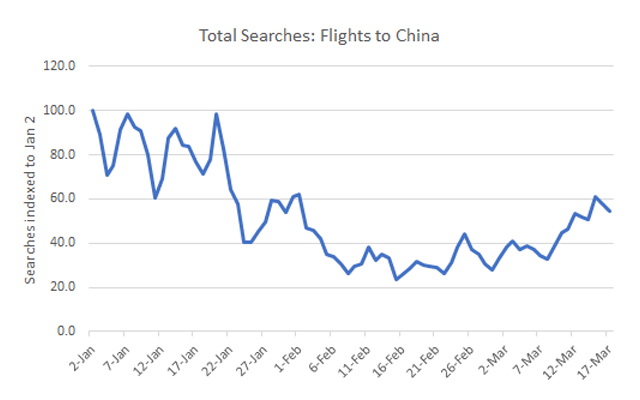
The number of total searches follows a similar pattern. The total number of searches for flights to China (both domestic and international inbound) is currently 55% of the volume of searches seen in the week of January 5, up from a low of 34% in mid-February. The average number of searches per searcher has increased in the past month, with an average of five to six searches per unique searcher.
Those who have searched for flights to China (domestic and inbound international) in the past several weeks are looking for flights with shorter booking windows. 58% of flights searched were with a 0-15 day advanced booking window versus only 38% of flights in early January. In addition, the percentage of flights searched for business travel has almost doubled since pre-Covid-19 levels (38% versus 20% in early January). As the Chinese government ramps up its efforts to boost the economy, these shorter booking windows and increased flight intent for business travel is not surprising.
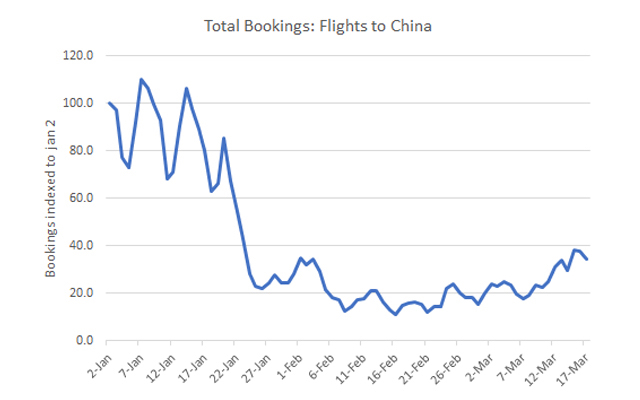
Total bookings to China are also rebounding, but at a slower pace. They are currently at about 30% of the level of flights that were booked to China in early January. Based on February 2020 data, time from initial flight search to booking data is an average of 13 days. Adara said that it will continue to monitor whether flight bookings to China will catch up to the trends we see in increased searches for flights to China.
Travel from China
Travel from China, for this analysis, refers to travel with origin in China and with an international destination, such as travel from Beijing to London.
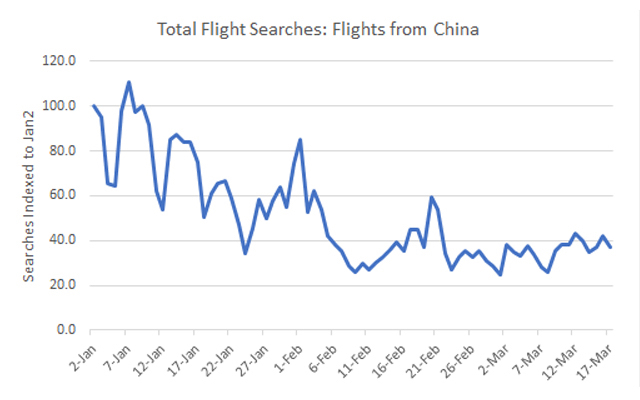
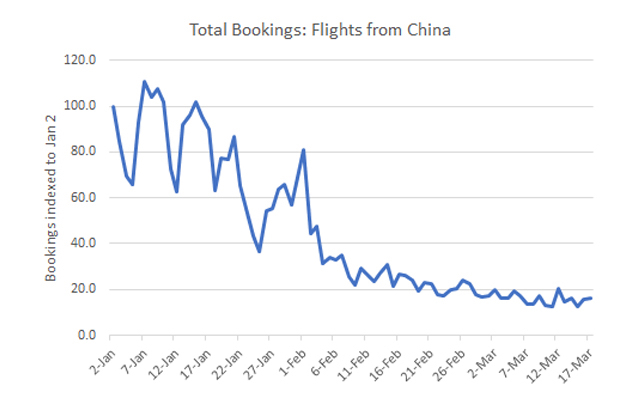
Flight bookings from travellers in China outbound to International destinations have yet to post any genuine rebound, either in searches or bookings. Adara said this is expected bases on the travel bans that are still in place.
“We are seeing subtle but meaningful changes across flight bookings and searches for China travel. While it is too early to predict any long-term patterns, these insights serve to help travel brands better understand how quickly the market shifts as the Coronavirus evolves,” said Carolyn Corda, CMO at Adara.
Some 70% of travellers would choose one travel provider over another if they received a positive payment experience, with price transparency, diverse payment options and enhanced security topping their list of demands, according to a study by Amadeus.
The Frictionless Travel Payments study surveyed 5,665 travellers across ten globally representative markets, and also drew on the results of a survey of payments leaders from 70 travel retailers and a range of interviews with Amadeus’ travel payments experts.
New Amadeus study identifies that travellers demand choice, transparency and security for frictionless payments
The study, which investigates what travellers value most from the payment experience so that travel companies can make better-informed decisions about how to cater to these travellers’ demands, found that travel and payment trends are colliding to drive new behaviour, with 74% respondents saying a poor payment experience reduces the enjoyment of their holiday.
For example, 74% of people now book travel less than two months before departure and millennials are more than twice as likely to do so than those over 55. When it comes to meeting the payment expectations of this growing group of late bookers, they demand price transparency, a wide choice of payment methods and improved security.
With millennials also more than twice as likely as those over 50 to ditch their shopping basket, payments represent a significant opportunity for the industry.
While new innovations such as “pay by instalment” are particularly popular with millennials, 66% of all respondents confirmed they would be more likely to buy with an instalment option and 56% said they would purchase higher-value services if they could spread the payments.
As the average traveller now relies on more than four different payment methods throughout their trip, it’s clear to see why 38% of travellers surveyed cite payment method choice (e.g. cards, bank transfer, e-Wallets) as their number one requirement. However, what matters even more is transparency, with 47% saying that unexpected fees, charges or foreign exchange surprises are a major point of friction.
Bart Tompkins, managing director, payments, Amadeus, said: “I’m confident that 2020 will be the year in which we see travel sellers aligning their payment strategies to meet not only customers’ demands but also their preferences. It’ll be the year where we see a significant step forward in delivering a frictionless payment experience in travel.”
He continued: “However, with 75% of travel firms still finding it hard to offer a simple and consistent payment experience, there’s work required to deliver on travellers’ desire for greater choice, transparency and security.”
The study includes a range of recommendations for the industry to deliver a frictionless payment experience. They include improving payment choice at checkout by regularly monitoring traveller payment trends at a local market level and having a process to continually test different payment methods locally; boosting transparency by integrating multi-currency conversion so travellers gain “price certainty” in a currency they’re familiar with and clearly displaying any charges up-front; and building trust by clearly communicating the steps they’ve taken to secure their customers’ data and by having a robust two-factor authentication process in place.
As well, travel operators should empower last-minute buyers by using open-APIs and cloud to deliver rich, fast and reliable payments as well as personalising the payment methods offered to a traveller during the trip; and remove the stress of travel with automated and pre-booked services by ensuring ancillary services like baggage or lounge access are offered pre-trip, and by providing “book-now, pay-later” options and modernised payments in areas like the airport.
Four-fifths of flight capacity between China and the rest of the world has been cut back due to the Covid-19 outbreak, according to a new report by ForwardKeys.
In response to emergency government regulations put in place to contain the virus outbreak in China, seat cancellations began in early February and by the third week of the month, only 20 per cent of seats remained in service.
Covid-19 has cut flight capacity to China by 80 per cent
Looking at the different regions of the world, Asia has experienced the greatest impact in terms of the total number of seats lost, at around 5.4 million in March.
In percentage terms, travel to North America is worst affected: American, United, Delta, and Air Canada cancelled all their flights to mainland China; and Chinese carriers cut their capacity by 70 per cent.
Between China and Europe, over 2,500 flights have been axed in March: the three major Chinese carriers cut capacity by 69 per cent; while BA, Lufthansa and Finnair ceased their services completely.
Qantas and Air New Zealand also stopped flying to China, which left only about 200 flights in March to Oceania, provided by Chinese airlines.
Capacity between China and the Middle East & Africa is also substantially down but less in both percentage and absolute numbers. Most flight suspensions are currently due to remain in force until March 28, the end of the winter season.
During the third week of March, 72 destinations in 38 countries had direct air links to China, which is around a third of the pre-crisis level, according to China’s Civil Aviation Authority.
Olivier Ponti, vice president insights, ForwardKeys, said: “At the start of the year, we were looking at another year of healthy growth in air travel from China. But now, we are witnessing the grounding of aircraft on an unprecedented scale. The loss in seats is more than the entire outbound market from the five Nordic countries combined.”