Newly updated forecasts from (PATA) has painted a likely 32% reduction in international visitor arrivals into and across Asia-Pacific this year, which brings visitor volume back to levels last seen in 2012.
Taking into account the impacts of the Covid-19 pandemic, the volume of arrivals is now expected to be under 500 million this year
The pandemic impacts are expected to be most severe in Asia, where visitor volume to South Asia is expected to fall by 31 per cent
At this stage, PATA expects growth to resume in 2021, returning to forecast levels by 2023. However, this depends on how quickly and completely the pandemic is contained and controlled.
A more optimistic scenario suggests arrivals in 2020 will fall just 16% year-on-year while a pessimistic narrative predicts a reduction of approximately 44%.
The impacts are expected to be most severe in Asia, especially North-east Asia, which is now predicted to lose almost 51% of its visitor volume between 2019 and 2020 (most likely scenario), followed by South Asia with a reduction of 31%, and then South-east Asia with a 22% drop in visitor arrivals.
West Asia is projected to lose almost 6% in visitor arrivals, followed by the Pacific with a projected contraction of 18%, and the Americas with a loss of a little under 12%.
Recovery rates relative to 2019 are expected to occur in most destination regions/sub-regions in 2020, however, North-east Asia is likely to take a little longer and exceed the 2019 volume of arrivals in 2022.
The same is essentially true for visitor receipts as well as they are expected to drop by 27% between 2019 and 2020 under the most likely scenario, reducing to US$594 billion, significantly below the original 2020 forecast of US$811 billion.
Asia is expected to lose more than US$170 billion (-36%), with North-east Asia predicted to lose more than US$123 billion (-48%) under this most likely scenario, followed by South Asia with a US$13.3 billion loss (-33%) and South-east Asia with a US$34.6 billion shortfall (-20%). The Americas is projected to lose more than US$35 billion (-13%) and the Pacific US$18 billion (-18%).
Recovery at the annual level is expected to return more quickly across most regions/sub-regions, with perhaps the Pacific taking a little longer to return to 2019 levels.
PATA CEO Mario Hardy said: “While there are obvious reductions in arrivals, there still remains a significant volume of visitors expected into Asia-Pacific through 2020, with just under half-a-billion such travellers still generating almost US$600 billion, with each visitor still requiring and expecting the attention and service that this region has become famous for delivering.”
He added: “Nevertheless, perceptions are difficult to change so recovery might take longer in the minds of many potential travellers. This however gives us time to reconsider the position we had created up to 2019; if numbers return only slowly, the obvious imperative will be to offer travellers such incentives that they remain in the destination longer and see more of what it has to offer. The metric should therefore shift from the numbers of arrivals, to time spent in any one destination and the dispersion across it. Receipts will then follow.”
The full PATA Asia Pacific Visitor Forecasts 2020-2024 report is available on the PATA Store.
A study on sustainable travel conducted among Indian travellers by Booking.com in March 2020 has revealed positive trends.
A vast majority (96%) of Indian travellers said sustainable travel was important to them, while nearly seven in 10 (76%) said they were more determined to make sustainable choices when looking to travel again in the future.
Indian travellers are more determined to make sustainable choices when looking to travel again in the future
Witnessing the impact tourism had on the environment while on vacation has also motivated 73% of travellers to make more eco-friendly choices in their everyday life.
However, while many of the findings are promising, there are still obstacles to overcome. 39% of Indian travellers do not know how or where to find sustainable travel options and more than half (54%) think there are insufficient travel options available. As such, there remains an opportunity to educate travellers on available sustainable travel options.
To make it easier for travellers to find and make sustainable travel choices, the Travalyst coalition – a global partnership founded by The Duke of Sussex together with Booking.com and other travel companies – recently announced the development of new frameworks that will help sift out more sustainable accommodation, aviation and experience options across the industry.
Sustainable accommodation choices
Some 97% of Indian travellers said they planned to stay in eco-friendly accommodation in 2020, while out of the 74% of travellers who have previously stayed in eco-friendly accommodation, nearly half (46%) did so to help to reduce their impact on the environment.
To help convince the 3% of travellers who did not express interest in staying at an eco-friendly accommodation, a universal eco-labelling system could be put in place. 77% of travellers surveyed expressed that they would feel reassured about staying in an accommodation if it has an eco-label.
Booking.com is making headway for clearer labeling and exploring new ways to highlight sustainable practices at accommodation of all kinds across the globe. These first steps to highlight sustainability practices at a property — which can also be verified by customers — are part of the company’s ongoing work with Travalyst to develop an industry-wide sustainability label.
The considerate traveller
Some 44% Indian travellers admitted they would be more encouraged to make sustainable travel decisions if travel companies proposed alternative destinations to reduce overcrowding.
Travellers were also considering alternative modes of transport to reach their destination, with 47% having opted to travel by train instead of car for longer distances to reduce their carbon footprint.
These findings suggest that when travelling is back on the agenda, travellers will likely want to continue making considerate choices by heading to less-visited destinations and selecting alternative modes of transport to get there.
The research, commissioned by Booking.com and conducted by an independent party, are sought to understand 21 other markets, including Brazil, Mexico, the US, Canada and Australia.
With Chinese outbound travel forecasted to rebound in Q3/Q4, it may well serve as the springboard for Thailand’s tourism recovery, according to a recent study by C9 Hotelworks and DAC China Digital Services.
The study, which was conducted in mid-April this year, surveyed over one thousand respondents in first-tier cities within China and focused on sentiment towards outbound overseas travel, along with a deep dive into the metrics of Thailand’s travel potential post Covid-19 and looking at the impact on specific destinations within the country.
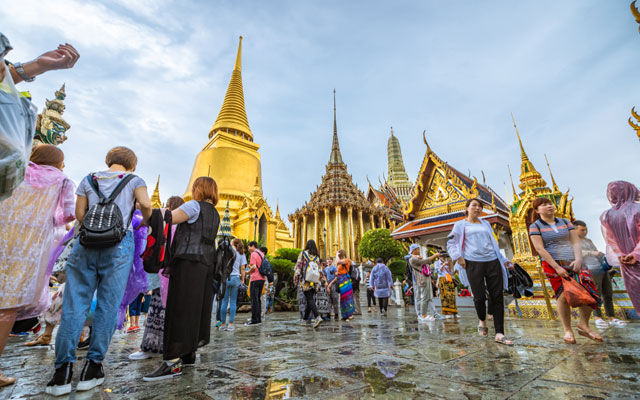
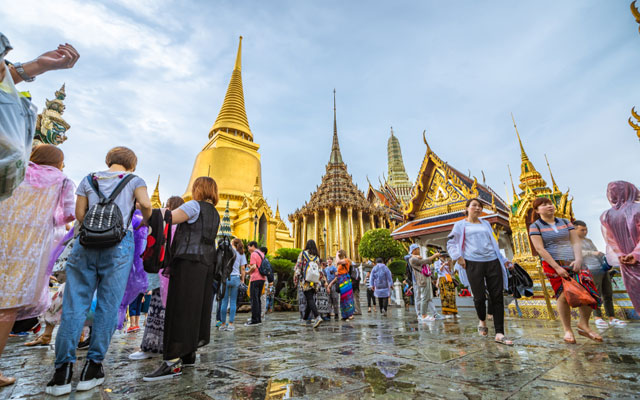
Chinese travellers’ positive outbound travel sentiment set to drive return of Thailand’s position as a global tourism destination; Chinese tourists in Wat Phra Kaew & Grand Palace in Bangkok pictured
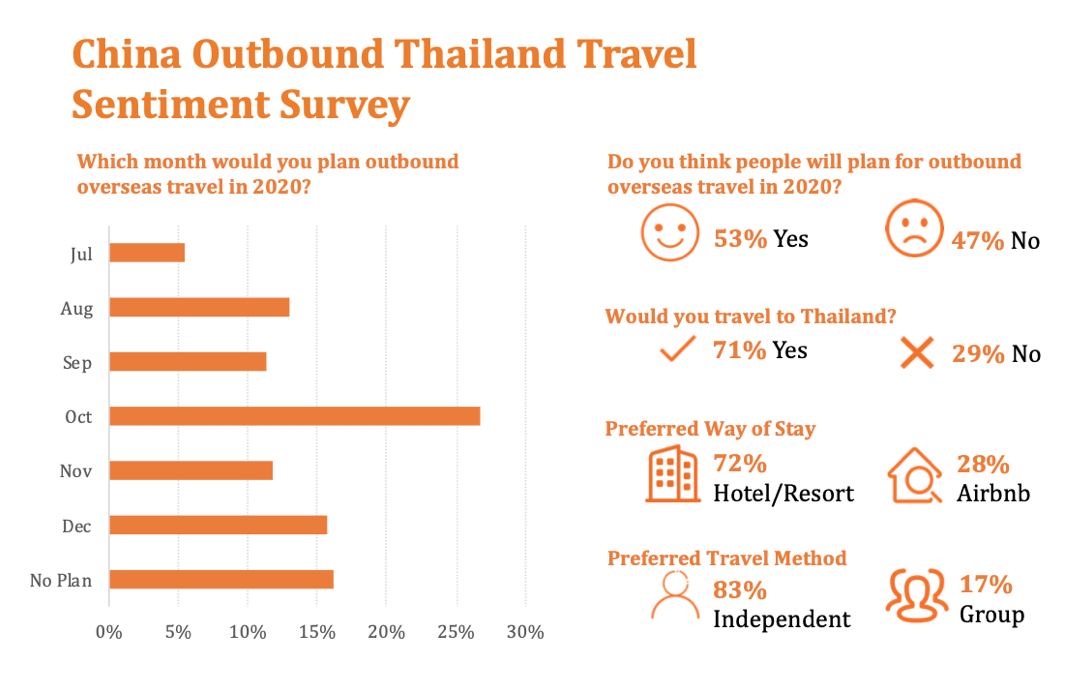
Positive sentiment towards outbound travel from China highlights the survey results that reveal 53 per cent of respondents would like to travel in 2020, with the most popular months for trips abroad for the remainder of the year being August, October and December.
Getting inside the numbers, and focusing directly on sentiment towards Thailand as a destination, 71 per cent of those surveyed said they would like to travel to the country. One interesting shift in the data is that 83 per cent would choose independent travel over group tours.
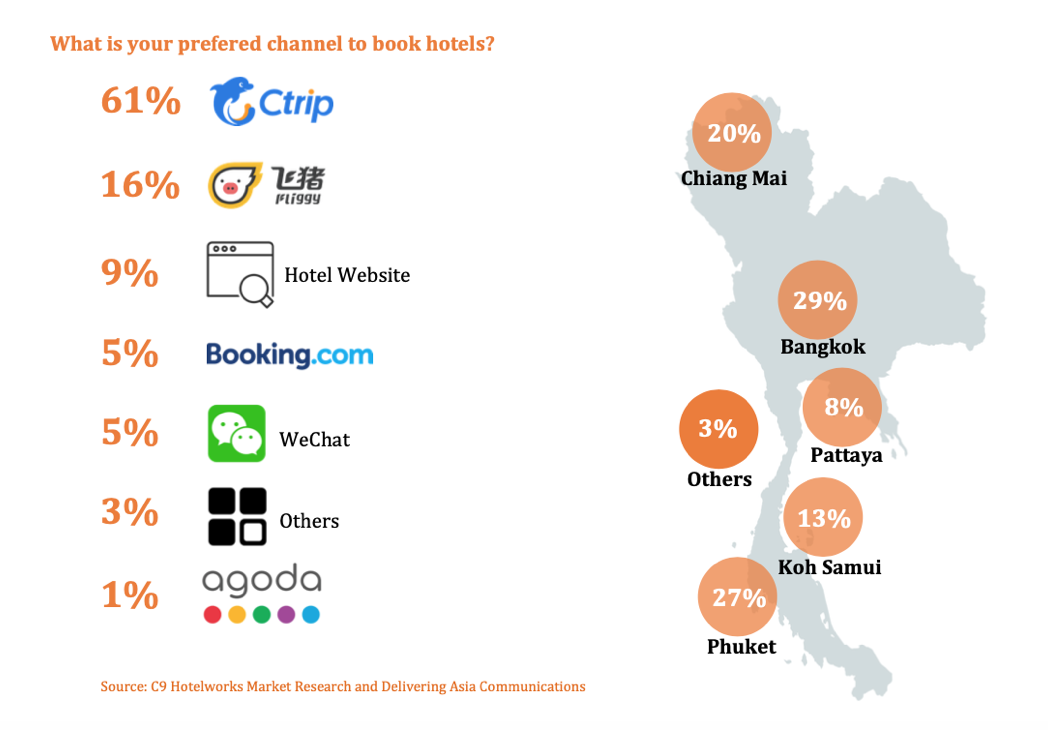
Bangkok leads the charge among the most popular Thai destinations Chinese travellers want to visit, followed in order by Phuket, Chiang Mai, Koh Samui and Pattaya. Over 75 per cent of demand was pinpointed in the top three destinations.
Accommodation-wise, 72 per cent said they would prefer staying at a hotel or resort, as opposed to an Airbnb lodging; while the trip budget for 50 per cent of those surveyed was US$2,100 per person.
Among the top five preferred booking channels for hotels are Ctrip (61 per cent), Fliggy (16 per cent), hotel websites (nine per cent), Booking.com (five per cent) and WeChat (five per cent).
Commenting on the road to tourism recovery, C9 Hotelworks managing director Bill Barnett said: “We expect Thailand’s reopening trajectory to initially be dominated by the domestic storyline but move quickly into inter-regional travel punctuated by the outbound China sector who are ready and willing to visit the country as demonstrated by the survey results.”
While undoubtedly, there will be a lingering global fear factor for travellers in the wake of the pandemic, Thailand’s favourable door to door flying time and vast network of approved routes to the mainland supports lead indicator. Another is the appreciation of the Chinese yuan against the Thai baht in 2020, after reaching a low point in 4Q2019. Thailand’s policy of visa-on-arrival for Chinese travellers is also a strong driver of demand.
Furthermore, short-haul travel due to flight health concerns is expected to be a key mover in Asia’s travel recovery.
Meanwhile, resumption of domestic air travel in China in Q2 is bolstering LCCs’ financial liquidity.
Thailand is one of the most impacted travel markets by Covid-19 in Asia. The country hosted 39.8 million international visitors last year, with China accounting for nearly 11 million arrivals.
The expanded Thai tourism, hotel and travel sector contributes between 12-15 per cent of GDP to South-east Asia’s second largest economy.
International Luxury Travel Market (ILTM) has published a white paper that brings clarity to the economic value and impact of luxury travel to communities, individuals and businesses, as well as a podcast that details the findings.
Both the white paper and podcast are now available on ILTM’s website.
The global luxury travel ecosystem of activities, valued at US$1.54 trillion, provides employment for an additional 62 million people globally
The white paper, produced by Barton Consulting under ILTM’s order, highlights several key discoveries. Valued at US$2.05 trillion, the global luxury travel universe would rank in the top 10 if it were a global economy; if it were a country, it would be bigger than Italy; and it is considerably larger than a number of other discretionary global goods and services industries, such as consumer electronics and fashion retail, according to the report.
The white paper also finds that 105.9 million people are directly employed within travel across the world and whose livelihood is dependent on High Net Worth (HNW) travellers, even though the latter comprise only 0.3 per cent of the global population.
The global luxury travel ecosystem of activities, valued at US$1.54 trillion, provides employment for an additional 62 million people globally.
The white paper also states that luxury travel is a vital component in the distribution of wealth across the globe: local economies are dependent on luxury travellers for arts, culture, restaurants, guides, sporting events, etc.
In the podcast entitled, Luxury Travel’s true impact on business and employment, Barton’s Winston Chesterfield explains how such a small community of HNW travellers can make such a big economic impact by spreading their wealth to benefit local economies, communities, individuals and businesses. He explores how these individuals will be the first to kick start the industry post-Covid-19, and why the wealth they control is vital to keep the world moving.
Explaining the move to commission the white paper and podcast, Alison Gilmore, ILTM portfolio director, said in a statement: “We wanted to contribute to our industry and provide some new insight, facts and figures that we hope will give comfort to those who have suffered as a result of the Covid-19 shutdown of this industry.
“When the time is right, a new future will emerge and ILTM is here as a catalyst, however long this journey takes”.
The UNWTO is calling on all governments to continuously review travel restrictions and ease or lift them once it is safe to do so, following its recent findings that almost all worldwide destinations have introduced travel restrictions in response to the pandemic.
The landmark report, highlighting the unprecedented disruption caused by Covid-19 to global tourism, shows that almost all global destinations have imposed restrictions on travel since January 2020, including complete bans on all travel as they work to contain the pandemic.
Coronavirus crushes tourism, with 96 per cent of all global destinations imposing travel restrictions
The UN body noted that its observations of a continuous trend towards more openness in travel facilitation in recent years has been dramatically interrupted by the pandemic.
As of April 6, 96 per cent of all worldwide destinations have implemented travel restrictions amid pandemic, found the study. Around 90 destinations have completely or partially closed their borders to tourists, while a further 44 are closed to certain tourists depending on country of origin.
UNWTO secretary-general Zurab Pololikashvili said: “Covid-19 has impacted travel and tourism like no other event before in history. Governments have put public health first and introduced full or partial restrictions on travel.
“With tourism suspended, the benefits the sector brings are under threat: millions of jobs could be lost, and progress made in the fields of equality and sustainable economic growth could be rolled back. UNWTO therefore calls on governments to continuously review travel restrictions and ease or lift them as soon as it is safe to do so.”
The UNWTO global review shows that the global regions are largely consistent in their response to Covid-19. In Africa, Asia and the Pacific and the Middle East, 100 per cent of destinations have adopted Covid-19-related restrictions since January 2020. In the Americas, 92 per cent of destinations have taken similar steps, while in Europe, the proportion is 93 per cent, as of April 6.
Specifically, the analysis identifies four key types of restrictive measures, namely, complete or partial closure of borders to tourists; destination-specific travel restrictions; total or partial suspension of flights; as well as different measures, including requirements for quarantine or self-isolation, medical certificates, invalidation or suspension of visa issuances, etc.
However, UNWTO also noted that in many instances, destinations have already adjusted their restrictive measures as the situation has evolved.
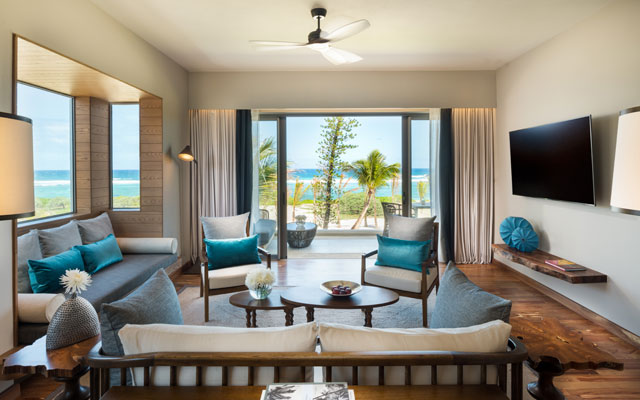
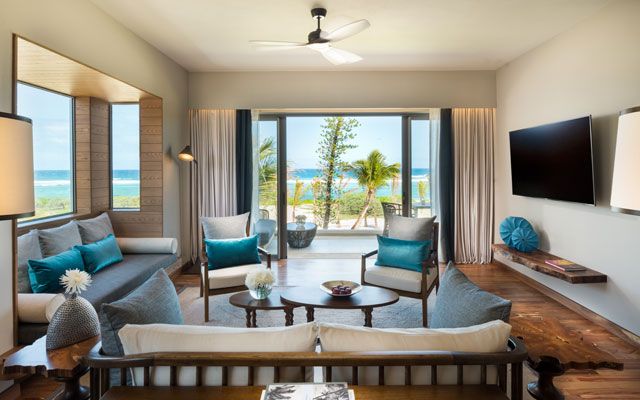
Tucked away on the southeastern coast of Mauritius on Le Chaland Beach, Anantara Iko Mauritius Resort & Villas is a tranquil hideaway offering secluded luxury. Set around manicured tropical gardens, the upscale beachfront hotel offers 164 guestrooms and suites, with eight additional pool villas set to launch in 2H2020. Resort facilities include a 30m infinity pool, four F&B outlets, spa, fitness centre and a library filled with classic fiction and historical and cultural books of Mauritius.
Nirjhara, Indonesia
Sustainable meets luxury at Nirjhara, which sits slightly further afield from the popular Balinese villages of Canggu and Seminyak. Nirjhara means “waterfall” in Sanskrit, which is befitting of the space nestled amidst natural wonder and mere minutes from tourist haven Tanah Lot Temple and scenic beach Pantai Kedungu. The 25-suite luxury hotel in Tabanan offers eight River Pavilions, four River Pool Pavilions, seven Canopy Suites, five Two-Bedroom Pool Villas, and private haven The Residence.
Nirjhara has launched a variety of eco-initiatives. Among others, Ambu, the hotel’s main restaurant, sources over 95 per cent of its ingredients locally, primarily from neighbouring farms in Tabanan. The resort’s menu of spa treatments draws inspiration from Bali’s rich tradition of village healers. Complimentary yoga and meditation classes are also available on-site.
Maven Stylish Hotel Hua Hin, Thailand
MJ One Group by Major Development has launched the Maven Stylish Hotel Hua Hin, located right in the heart of the resort town of Hua Hin, next to the famous Night Market on Petchakasem Road. The 59-key Maven Stylish Hotel Hua Hin offers three types of rooms: Superior, Deluxe and Corner Suite. On-site facilities include a cafe serving Thai delicacies, a pool bar, and a versatile function room. The hotel is located near tourist attractions such as Cicada Market, Hua Hin Market Village, Bluport, Vana Nava Water Jungle, and Hua Hin Beach.
Oakwood Apartments PIK Jakarta, Indonesia
Oakwood, a wholly owned subsidiary of Mapletree Investments, has opened its third property in Jakarta, Indonesia. Oakwood Apartments PIK Jakarta is also the first international serviced apartments brand to debut in the hip culinary district of Pantai Indah Kapuk in North Jakarta. The 151-key property offers direct access to the CBD, and is a 15-minute drive from the Soekarno-Hatta International Airport. Residential facilities include both indoor and outdoor swimming pools, fitness centre, restaurant, as well as a kids’ swimming pool and playground.
India’s industry players are banking on domestic tourism to revive their sagging fortunes amid travel slowdown, in view that local holidaymakers may prefer to travel domestically in the near term, due to global concerns over the coronavirus pandemic.
The shift towards localism follows Indian prime minister Narendra Modi’s extension of the country’s nationwide lockdown, the biggest in the world covering 1.3 billion people, until May 3.
Indian trade eyes domestic tourism amid pandemic; group of Indian tourists in front of Taj Mahal pictured
Tourism stakeholders in India told TTG Asia that post-pandemic, international travel will take a backseat once travel restrictions have been eased or lifted, and domestic tourism will lead the industry’s recovery.
Sarbendra Sarkar, founder and managing director, Cygnett Hotels and Resorts, said: “Internationally, for both business and leisure travel to normalise and to start growing, the larger world economy needs to start healing. Domestic tourism will be the only area of focus for the first few quarters once this pandemic is over.
“Also, considering that India is a key outbound tourism market, there is a good opportunity to attract this segment to domestic destinations.”
With that in mind, some stakeholders are urging the Indian government to do more and offer incentives to spur domestic tourism.
“This is the time that the Ministry of Tourism and state tourism departments should (come together to) brainstorm how to propel domestic tourism once the pandemic goes away,” said Ashwani Lohani, chairman, Andhra Pradesh Tourism Development Corporation.
Jyoti Mayal, president, Travel Agents Association of India, added: “The revival of our industry will begin if the government incentivises domestic travel because this segment will be the first to open business prospects for us. We have already requested the authorities to provide incentives for holding corporate events in India.”
Governments across Asia are tightening the screws on social distancing and travel restrictions, with many announcing the extension of travel bans and lockdowns, in a bid to stem the Covid-19 spread.
India’s nationwide lockdown is set to be extended till April 30; aerial view of Dadar in Mumbai pictured
India
India’s prime minister Narendra Modi is set to extend the nationwide lockdown for another two weeks, said state ministers on Saturday (April 11), in response to the growing fallout in the country, which boasts a population of 1.3 billion.
The 21-day lockdown is due to end on Tuesday, but several chief ministers from India’s 29 states and territories have been pushing Modi to extend the lockdown due to the rising death toll from the coronavirus.
Two states, Odisha and Punjab, have already extended the lockdown by two weeks, but there is growing pressure on the government to enforce the extension nationwide to freeze movement between states.
India has so far reported about 7,500 cases and 240 deaths.
Indonesia
Local authorities in Greater Jakarta have imposed large-scale social restriction (PSBB) to further limit people’s movement beginning Friday (April 10), in response to a spike in confirmed Covid-19 cases and fatalities in the region, which includes Jakarta, Depok, Bogor, Bekasi and Tangerang.
Anies Baswedan, governor of Jakarta, was the first to implement the 14-day PSBB, after extending the state of emergency to April 19 and earmarking a three trillion rupiah (US$189 million) stimulus package to soften the economic blow of Covid-19 in Indonesia’s capital.
Thereafter, Ridwan Kamil, governor of West Java, and Wahidin Halim, governor of Banten, followed in Anies’ footsteps by declaring similar restrictions in Bogor, Bekasi and Depok in West Java, as well as Tangerang and South Tangerang in Banten.
In Jakarta, the PSBB was enforced on April 10. In West Java, it is slated to kick in on April 15. Banten, on the other hand, has yet to announce when the PSBB will come into effect.
Under this stricter restriction, violators face up to one year jail term and a fine of 100 million rupiah.
In light of the physical distancing measures ordered by president Joko Widodo, schools, offices, public spaces and entertainment venues in Jakarta continue to remain closed. As well, religious gatherings, social and cultural activities, public celebrations like weddings, and any gatherings of more than five people are also banned during the PSBB period.
Companies in eight essential industry sectors such as health, food, energy, communications, finance and banking, delivery of logistics and daily needs, are allowed to remain fully operational.
Furthermore, public transportation services are permitted to operate only from 06.00 to 18.00, with passenger capacity capped at 50 per cent of the usual limit. App-based motorcycle taxis are also barred from transporting passengers within the PSBB period.
While roads in the capital city remain open, a limit has been placed on the number of passengers in private vehicles on Jakarta’s streets.
In Jakarta alone, the coronavirus has infected 2,044 people and killed 195 as of April 12, making the capital city the country’s epicentre of the Covid-19 outbreak. West Java is the country’s second worst-hit city, with 450 confirmed cases of Covid-19 and 43 fatalities. Banten has seen 281 infections and 21 deaths.
The entire country has seen 4,241 confirmed cases and 373 fatalities. – Reporting by Kurniawan Ulung
Malaysia
Malaysia’s government has announced a second extension of the movement control order (MCO) by another two weeks to April 28, from April 15, citing feedback from the Health Ministry and medical experts.
All businesses, schools, religious institutions, and government offices will remain shut, and only essential services including banks, supermarkets, and pharmacies are allowed to operate. All mass gatherings are also banned.
The MCO kicked in on March 18 and was initially for a period of two weeks to March 31, but was extended by another two weeks to April 14.
Yap Lip Seng, CEO of Malaysian Association of Hotels, commended the government’s extension of the MCO, but said it represented steeper losses for the tourism industry. “Even when the MCO ends, tourism is not expected to recover for at least another six months, depending on the situation worldwide,” he said.
He had earlier called for the government to provide targeted support for the tourism industry to tide through the MCO period and beyond.
He also acknowledged that post-Covid-19, travel will never be the same again and hotels in Malaysia are armouring up for the anticipated changes.
“The tourism industry, and particularly hotels, are actively drafting new standard operating procedures and practices to enable people to travel without worries in the near future. Operations such as F&B services and (corporate events) will be adopting new preventive measures to protect attendees and participants as (part of) the new norm,” he said.
Meanwhile, hotels are using the activity slump to give their properties a facelift. Anthony Wong, managing director, The Frangipani Langkawi Resort & Spa, said that he was using the MCO period to do maintenance and renovation works on the property.
The hotel’s 140 employees have also taken on new responsibilities, such as giving the resort a fresh coat of paint and planting more vegetables on-site for their own consumption.
Wong reckoned that it will take two to three years for the inbound travel industry in Malaysia to bounce back to pre-Covid-19 levels. And after the MCO is finally lifted until year-end, he expects occupancy at the property to hover between 10-20 per cent, with the domestic leisure segment forming the bulk of visitorship.
On Friday, the country reported 4,346 confirmed Covid-19 cases, with a death toll of 70. – Reporting by S Puvaneswary
Japan
Following Japan’s move to declare a month-long state of emergency for seven prefectures, other prefectures in the country are also crying out for a similar decree to be passed.
The governors of Aichi and Kyoto, the eighth and tenth worst hit prefectures, asked the government on Friday to grant them the state-of-emergency classification.
Both Gifu and Hokkaido have declared a state of emergency, but they cannot requisition buildings or supplies without the government classification.
Narita Airport shut one of its two runways on Sunday, in response to a slump in air traffic and the “soft lockdown” requirement of limited on-site workers. Lack of demand has also pushed Haneda Airport to close its new passenger facility at Terminal 2.
In Japan, the number of Covid-19 cases passed 6,000 on Saturday, prompting the government to ask residents nationwide to avoid nightclubs, downtown and other busy areas to help curb infections. – Reporting by Kathryn Wortley
Buddyz.co is a new B2C travel platform targeting millennials who seek authentic experiences and are willing to explore places off the tourist map with local guides who have intimate knowledge of the area and are passionate about the subject matter.
The person behind the platform is 37 year-old Eric Yap, who holds a degree in economics from the University of Malaya, and who is an experienced traveller himself.
The portal, Buddyz.co (www.buddyz.co), is the result of Yap’s personal frustrations in researching for information on the many hidden gems and local activities in Malaysia and around the world. Information that he could find featured mainly well-known destinations and activities. The platform was built with the purpose of addressing this gap.
Buddyz.co went live on January 24, 2020. Initially, it offered 20 experiences in Kuala Lumpur, Selangor, Penang and Sabah. Currently, the platform has 27 experiences across the same states; 18 of them are available in Chinese or Cantonese.
Activities on the site include cultural walks, food adventures, outdoor rock climbing and trekking, as well as street photography. What sets Buddyz.co apart is the strong focus on the travel buddy’s – the local expert’s – profile, as well as its emphasis on communicating to customers the buddy’s experience in a particular tour or activity.
According to Yap, buddies are carefully assessed through an interview before they are allowed to market themselves and their activities on the platform.
Buddyz.co selects those who show passion in their work, are skilled at communicating and have “something unique to offer” that “could promote the local living culture”.
Over the coming months, Yap hopes to extend the area the portal covers to other states in Malaysia. He is also seeking to revive local crafts that are in danger of becoming lost traditions, such as shadow puppet making, kris- and wau- (dagger- and kite-) making, as well as bamboo weaving.
Additionally, Yap plans to raise funds to upgrade the platform so buddies can upload videos of themselves and better manage the experiences they offer.
The company is looking to collaborate with tour guide training institutions in Kuala Lumpur to conduct workshops and short courses that will further enhance the skillsets of their buddies.
By end-2020, he aspires to expand Buddyz.co to include activities from Thailand and Indonesia.
The coronavirus has put the hospitality sector under huge strain, and India is no exception, with the majority of hotels in the country having shuttered, and the remaining few turned into quarantine centres or workspaces.
In an unprecedented event, some 57 per cent of 787 branded hotels in India have become non-operational as of March 30 this year, according to a report by global consulting firm HVS, which was based on discussions with key industry stakeholders.
Covid-19 has shut 57 per cent of hotels in India; aerial view of Central Delhi in India pictured
The few operating hotels are running around 10 per cent or lower occupancies, said HVS.
However, these hotels are now serving a different clientele – quarantine guests, people stranded by the country’s nationwide lockdown, and business continuity teams.
Some hotels have offered their facilities to people who have arrived in India recently and have to serve a 14-day quarantine. Others are housing foreign and domestic guests, some of whom were long-stayers, who were not able to return home due to the lockdown.
In other instances, hotel rooms have been converted to workspaces for businesses providing essential services. To continue their operations during this period, several organisations have set-up small business continuity teams, which are staying and working from hotel rooms.