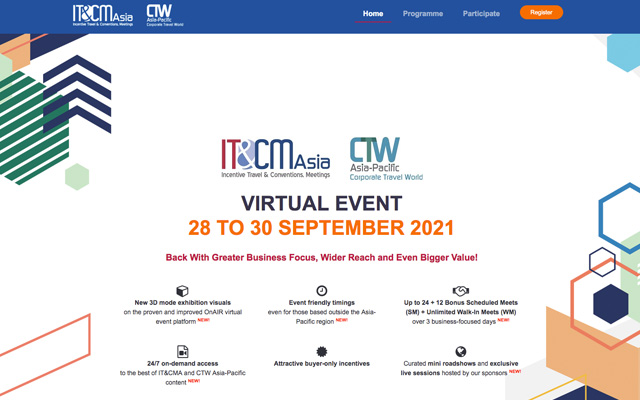
Double-bill trade event, IT&CM Asia and CTW APAC, is ready to throw open its virtual doors from September 28-30 amid ongoing travel restrictions.
This year’s virtual outing will be even larger than last year’s – with more than 150 exhibitors signed up – and will boast the tradeshow’s very first 3D experience.
Delegates to the three-day event will be able to enjoy 24-hour access to on-demand and live knowledge conversations, featuring sessions by ForwardKeys, Global Business Travel Association, International Association of Professional Congress Organisers, International Congress and Convention Association, and Society for Incentive Travel Excellence.
Organiser TTG Asia Media has also created flexible business meeting arrangements that allow for mutually requested scheduled slots and walk-ins; weaved in destination and corporate brand presentations and mini-roadshows; and knowledge sessions.
Join more than 300 qualified international Corporate, MICE and Association buyers and enjoy full-event access to the 3D virtual exhibition. There will also be a best-in-industry incentive scheme exclusively for buyers, featuring cash rewards and prizes, unlimited walk-in meetings and all other event programme highlights.
A new report from Amadeus has revealed that the adoption of New Distribution Capability (NDC) has accelerated over the past 18 months, as today’s travellers demand a seamless and personalised experience.
The report is based on insights from airlines, travel agencies and corporations, as well as Amadeus’ own experts. It showed the travel industry’s readiness for NDC and cited 2021 as the year that NDC is being adopted at scale.
Gallego: Travel industry increasingly views NDC as a key pillar of recovery
Airlines have begun to make tailored offers available, as well as to experiment with innovations like ‘continuous pricing’ and new types of bundled offers. Travel sellers of all shapes and sizes are now going live across the world, with over 2,500 travel agencies across 50 markets now able to book and service airline content via NDC using Amadeus solutions. These solutions include Amadeus Selling Platform Connect, Amadeus Travel API, and Amadeus cytric Travel & Expense.
The technology underpinning NDC has advanced significantly. Travel sellers are now able to consume NDC and EDIFACT content, alongside LCC content delivered via APIs, all in one place with the Amadeus Travel Platform. Importantly, the report cites recent improvements in servicing and preparation of travel agency mid- and back- office systems as key to scaling over the coming months and years.
The report also sheds light on some of the remaining barriers to widespread NDC adoption, and calls on the industry to prioritise collaboration and experimentation to advance NDC adoption.
The success of NDC remains dependent on the industry’s ability to keep talking. Through greater collaboration, it will be easier to recognise each other’s challenges and interests, helping to align goals and deliver the end-to-end value the entire ecosystem expects. NDC is an innovation playground and by ramping up NDC experimentation and testing, the industry can better understand how this new standard of digital retailing can improve the travel experience and accelerate recovery.
Ángel Gallego, executive vice president, travel distribution, Amadeus, said: “If we compare where we were 18 months ago to today, it’s clear that despite the strain caused by Covid-19, the industry has not sacrificed its commitment to NDC. On the airline side, we are now seeing new differentiated product bundles and price points. On the travel seller side, every Amadeus connected travel seller will be able to book NDC content, alongside content sourced in other ways, by the end of this year. On the technology side, we have continued to deliver on our promise to offer scalable, innovative solutions that incorporate vital features such as post-booking servicing.
“It is encouraging to see that the industry increasingly views NDC as a key pillar of recovery. With modern digital retailing, travel will be based around dynamic offers and this will deliver a competitive edge to airlines and travel sellers that embrace this change. Now is the time to engage with NDC to power great journeys for travellers and rebuild travel.”
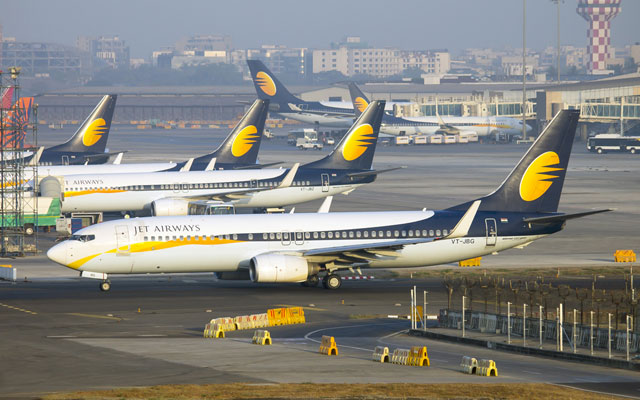
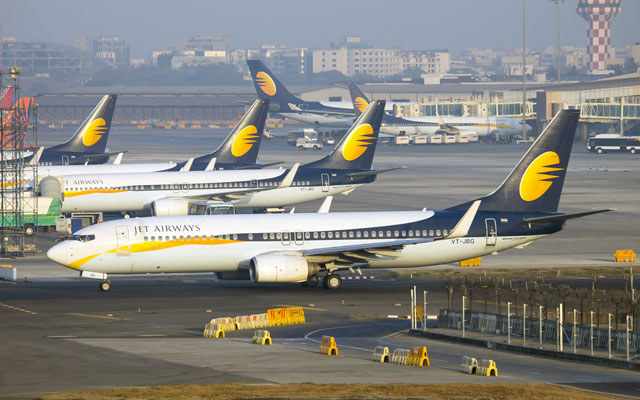
Major Indian travel trade associations have strongly expressed their disappointment at the announcement that defunct domestic airline, Jet Airways, plans to resume operations in the first quarter of next year.
The Jalan Kalrock Consortium, the successful resolution applicant of the carrier, said in a statement earlier this week that the process of reviving the grounded carrier is on track with regulatory approvals in place. Travel agent associations have raised apprehensions about the government allowing the airline to restart operations without clearing refunds that are pending with the airline since it ceased operations.
Formerly India’s largest carrier, Jet Airways went into bankruptcy in 2019 under mounting debts
“How can the Ministry of Civil Aviation allow an airline who has defaulted revive unless and until it clears all the dues owed to the travel industry, consumers and staff who have borne the brunt (of the defaults) and suffered?” said a dejected Jyoti Mayal, president, Travel Agents Association of India (TAAI). “We welcome more and more airlines to fly in our skies but not at the cost of killing the IATA agents and the consumers.”
India’s National Company Law Tribunal (NCLT) had issued a written order that approved the resolution plan for Jet Airways in June this year. Jet Airways had suspended its operations on April 17, 2019.
“Unfortunately, it has been never been a level-playing field in the case of airlines and travel agents. Even the NCLT order which paved the way for Jet Airways to restart its operations is unfair not just to travel agents but the travellers too,” opined Ajay Prakash, president, Travel Agents Federation of India (TAFI).
“The NCLT in its order has said that all the creditors will get a maximum 15,000 rupees (US$203.62) as refund amount irrespective of the actual price of air ticket. There are people whom the airline owes millions of rupees. You can’t expect such creditors to trust the airline once it resumes operations,” Prakash said, adding that the defunct airline owes 460 million rupees to one of its members.
The travel trade association stressed on the immediate need of a financial mechanism to be implemented that can safeguard travel agents and end consumers in case an airline goes bust.
“The guidelines for anyone to start an airline needs to be deliberated upon, not only among the promoters and government, but also associations like TAAI. (In the case of Jet Airways,) the promoters misappropriated the money and filed for bankruptcy and the government closed its eyes (to the predicament of the creditors),” said Mayal.
“I request the minister of civil aviation (Jyotiraditya Scindia) to look into the workings of the airlines and ensure that a sustainable model is being implemented. There is a need to establish a task force with TAAI on board to understand the workings and challenges of our members who play an important role in promoting the business of all airlines.”
The Jalan Kalrock Consortium, the new owners of the airline, had shared in their resolution application before NCLT that there are 5,081 creditors that have an option to get cash refund or seek credit for future tickets.
“When we become an IATA agent, we give a financial guarantee and we are not allowed to issue tickets beyond the level of that guarantee. If an agent fails to make a payment to an airline, there is a financial guarantee that he or she has given to IATA. There is no such guarantee that can rescue the travel agents and end customers in case of an airline failure,” said Prakash.
“At a meeting with the Ministry of Civil Aviation, this is one point that we have put up strongly. The directorate general of civil aviation has to look at some sort of insurance system to protect consumer money.”
Prakash added that the regulatory authorities allowing Jet Airways to fly without clearing refunds is a “cruel blow” to both travel agents and end consumers.
He said: “On one hand, it is good that you will have another airline and more competition, but at what cost? Even if this is a case where nothing more can be done, there are at least lessons to be learnt. An airline can go bust at any time, especially in the present challenging environment. So, we need a system that looks out for the interests of both travel agents and end consumers.”
Meliá Chiang Mai has welcomed an executive chef and director of F&B who bring more than four decades of combined experience to the urban hotel slated to open in December this year.
Thai national Suksant Chutinthratip and Filipino national Jay Tadifa Abiang have been named executive chef and director of F&B respectively.
From left: Suksant Chutinthratip; and Jay Tadifa Abiang
Equipped with 27 years of hospitality experience, Suksant comes to the hotel’s pre-opening team after working as the executive chef at Hotel Nikko Bangkok, Rayong Marriott Resort & Spa, and Courtyard by Marriott Bangkok. He was also an executive sous chef for SkyCity Auckland Entertainment, managing VIP and gaming restaurants, as well as Renaissance Ratchaprasong Bangkok Hotel.
Beginning his hospitality career in 1994 as a cook helper at The Ambassador Hotel and Convention Centre Bangkok’s Le Bistro, Suksant climbed the career ladder at various properties including Sheraton Grande Sukhumvit, a Luxury Collection Hotel Bangkok, The Peninsula Bangkok, Lotus One in Dubai, Raffles Singapore, The Athenee Hotel, a Luxury Collection Hotel Bangkok, and Le Meridien Bangkok.
Meanwhile, nine of Abiang’s 16 years in the hospitality industry have been in hotel management with Meliá Hotels International. Prior to his appointment at Meliá Chiang Mai, he was executive assistant manager at The Reed Hotel Managed by Meliá, and the F&B manager at Meliá Ba Vi Mountain Retreat in Vietnam. He also worked at Meliá Hanoi as an assistant F&B manager, as well as a banquet manager and bar manager.
Abiang started his career as a bartender at Hanoi’s Press Club. He has also been a restaurant supervisor and manager at My Way Café and Lounge in Hanoi and an operations manager in Au Lac Do Brazil Restaurant in Ho Chi Minh City.
Comprising a 22-floor tower fronted by an adjoining seven-floor podium building, Meliá Chiang Mai will have two restaurants, two bars, two lounges, a YHI Spa with seven treatment rooms, a fully-equipped fitness centre, swimming pool, ballroom and four other meeting spaces.
Signature restaurant Mai Restaurant & Bar on the 21st floor will specialise in contemporary Northern Thai dishes with Mediterranean influences, while all-day-dining restaurant Laan Na Kitchen will offer Mediterranean cuisine in a marketplace setting.
The Association of Asia Pacific Airlines (AAPA) has committed to net zero carbon emissions by 2050, surpassing the existing industry commitment to halve carbon emissions within the same time frame.
Sustainable aviation fuels (SAF) are expected to feature heavily in the industry’s overall reduction in carbon emissions by almost completely replacing fossil fuels on commercial flights by 2050.
Achieving the net zero emissions goal will require the support of governments and other stakeholders, says AAPA’s Subhas
Significant quantities of SAF will be needed by the industry as 80 per cent of emissions are from flights over 1,500 km, for which aircraft powered by alternative energy sources, such as electricity and hydrogen, are not available.
Underscoring the task that lies ahead, Subhas Menon, director general of AAPA, said during a media roundtable: “The Asia-Pacific region will constitute some 40 per cent of global SAF demand (somewhere between 450 to 500 million tonnes by 2050), but production and supply facilities in the region are lacking.
“Allocation of sufficient resources to convert feedstock, like municipal or agricultural waste, waste oils from food production and other biomass, for the production of SAF will make a critical difference.”
Support from governments and other stakeholders to commercialise SAF through research and development, subsidies, incentives, as well as the allocation of resources for its development and distribution, will also be crucial to ensure adequate and cost-effective supplies to meet the needs of the airline industry.
“The bulk of efforts is going to come from the promotion of the commercialisation of SAF. This is very important as it replaces fossil fuels on the majority of (longhaul) flights for this (goal) to be successful, and that supply has been ramped up. The supply of SAF also has to be done in a cost-effective manner. Right now, the price of SAF is several times of fossil fuels,” Subhas elaborated.
On whether now is an appropriate time to take sustainability into greater account given the state of Asia-Pacific’s aviation sector amid the pandemic, Subhas pointed out: “Twenty months is a very long time for us to be in hibernation. We want to use the remaining hibernation time to put plans into motion, so that when we restart – hopefully not too distant a future – we do so with strong momentum.”
While acknowledging that this goal is “ambitious and challenging”, Subhas is confident it can be achieved with “total cooperation of all stakeholders”, including governments, airports, aircraft manufacturers, and more.
Sustainability, in fact, has been “an ongoing effort” over the last three decades. Subhas pointed out that passenger journeys have been halved since then, and every decade or so, a new generation of aircraft with better fuel efficiency than its predecessors have been manufactured.
Turning to air travel recovery, Subhas noted that Asia-Pacific was the first region to be heavily impacted by Covid-19, but has now lagged behind other regions in showing improvement in travel demand. While other regions are easing restrictions on the back of successful vaccination rollouts, borders in Asia still remain largely closed due to low vaccination levels.
He elaborated: “Most places have been operating on the Las Vegas principle – whatever happens here, stays here. But we need to move towards the Olympics principle – where everyone plays by the same rules, use the same tools, and have equal opportunity to get to the finishing line.”
To enable smooth reopening of borders and the return of travel in the region, the issue vaccine inequality has to be tackled, Subhas stressed.
IATA has appointed Philip Goh as its regional vice president for Asia-Pacific, a position last held by Conrad Clifford who has been promoted to the role of deputy director general since July 1, 2021.
Goh is a 34-year veteran of the airline industry. He has held various senior management roles at Singapore Airlines in Singapore and overseas, at Virgin Atlantic Airways in London, and has extensive experience working throughout the Asia-Pacific region.
Most recently, he was regional vice president for the South West Pacific for Singapore Airlines (2017 to 2021), based in Sydney.
Goh reports to Clifford, and leads IATA’s activities across Asia-Pacific, a region covering 37 countries and territories and home to 45 IATA member airlines. He is based in Singapore, where IATA’s Regional Office is located.
Dubai’s flagship airline Emirates is inviting visitors to experience Expo 2020 Dubai in a new global campaign fronted by Australian actor Chris Hemsworth.
The campaign illustrates the ultra-futuristic themes and experiences in store at Expo 2020 Dubai when it opens its doors on October 1.
Emirates partners with Chris Hemsworth in bold new campaign inviting visitors to experience Expo 2020 Dubai
Reem Al Hashimy, UAE minister of state for international cooperation and Expo 2020 Dubai director general, said: “Expo 2020 Dubai will be one of the greatest must-see events in the world. In addition to impressive marquee pavilions that immerse visitors in the themes of mobility, sustainability and opportunity, and 191 amazing country pavilions, there will also be an unforgettable celebration of music, art and culture with a packed entertainment programme, unique culinary experiences, and much more. It’s truly shaping up to be an event not to be missed.”
Hemsworth said: “In 2019, I partnered with Emirates and Expo 2020 Dubai to help bring awareness to what is a really important event for the world. We all have the power to shape a better future, and the last year-and-a-half has shown us that the possibilities are endless when we put our minds together. At Expo 2020 Dubai, the world will come together in the spirit of collaboration to provide real-life solutions that will benefit future generations.”
Conceptualised and filmed pre-Covid in time for the original opening date of Expo 2020 Dubai, the ad aims to convey the energising spirit of innovation, creativity, and the drive to create a better future – all key themes of the global event. Taking a layered approach to storytelling, the ad is supported by a myriad of computer-generated imagery animations and visuals to illustrate what the event would look like, as it was filmed while the Expo 2020 site was still under construction.
In the ad directed by two-time Oscar-winning director Robert Stromberg, Hemsworth transports viewers from the beaches of Dubai to the Expo 2020 Dubai site, bringing to life the event’s flagship mobility, sustainability, and opportunity pavilions, alongside the participating country pavilions.
Emirates is the premier partner and official airline of Expo 2020 Dubai, running from October 1, 2021 to March 31, 2022.
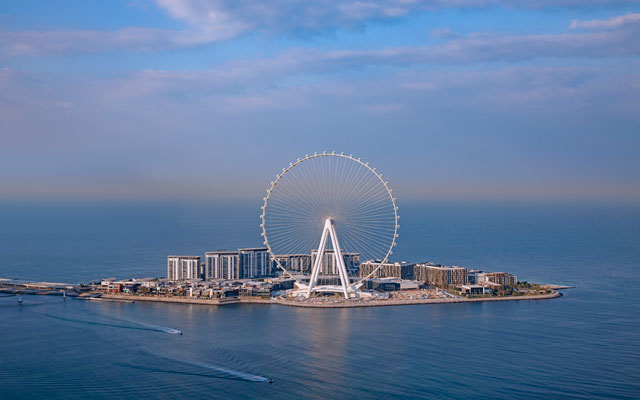
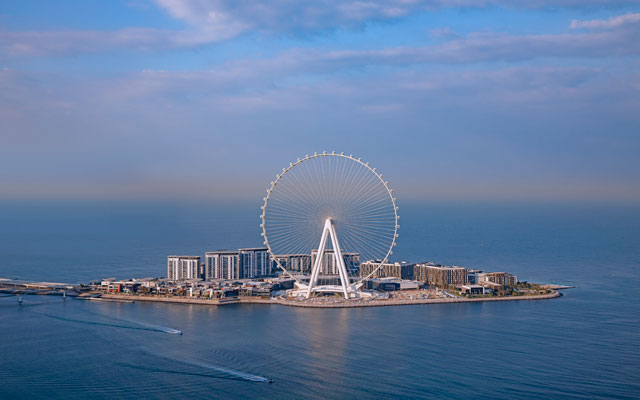
Ain Dubai, the world’s largest and tallest observation wheel sited at the heart of lifestyle destination Bluewaters in Dubai, is set to open on October 21.
Standing at over 250m high, Ain Dubai represents another addition to Dubai Holding’s entertainment portfolio and supports Dubai’s long-term vision to strengthen its global position as a key tourism hub.
Providing a bird’s eye view of the city’s skyline, Ain Dubai offers over 19 customisable experiences
From dining in the sky and exclusive celebration packages to bespoke corporate and event offerings, Ain Dubai brings over 19 customisable experiences available both day and night.
Offering views of Dubai’s iconic landmarks from indoor, air-conditioned cabins and a huge range of entertainment, the experiences are split into three main categories: observation cabins, social cabins and private cabins, with experiences starting with one rotation of approximately 38 minutes, up to two rotations of approximately 76 minutes.
The observation cabins provide the perfect platform for 360-degree views of Dubai, while the social cabins feature beverage-inclusive packages. Visitors can also step into a premium cabin for the VIP treatment or get the best social vibes at the Sky Bar cabins.
Meanwhile, the private cabins provide full exclusivity, with celebration packages available for birthdays, engagements, weddings, business functions, and more. The private cabins can also be customised to cater for all sorts of events, from intimate celebrations to cultural festivities.
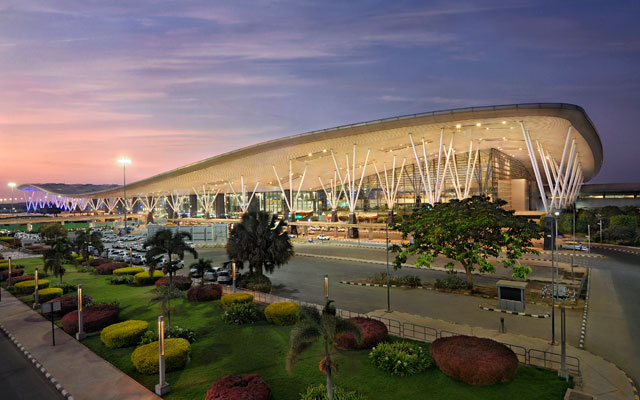
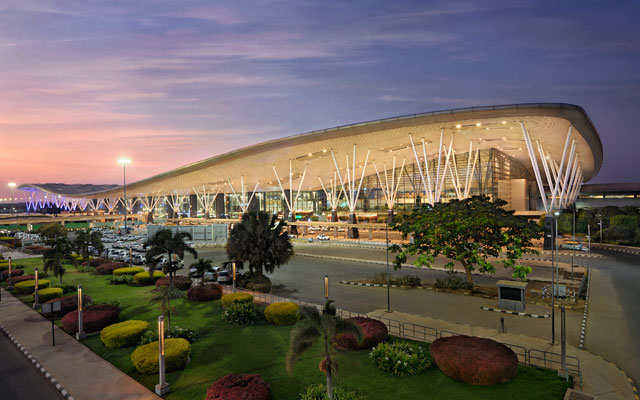
Plaza Premium Group (PPG) has been appointed by Bangalore International Airport (BIAL) to manage and enhance passenger services at the Kempegowda International Airport, Bengaluru (BLR Airport).
The 10-year full-service management appointment covers the entire portfolio of BLR Airport’s 22 services. The 360-degree airport service delivery scope includes: service delivery, control centre, training centre, customer engagement, marketing communications, sales and distribution as well as technology. More services will also be introduced to enable an end-to-end and globally connected passenger journey.
PPG to enhance 22 services from customer experience to technology innovation at Bangalore International Airport
The 360-degree airport service delivery scope includes: service delivery, control centre, training centre, customer engagement, marketing communications, sales and distribution as well as technology.
BIAL and PPG will collaborate in addressing the desires of travelling in the new normal – with seamless service delivery, world-class standards and quality, technology and innovation, as well as commercialisation optimisation.
In order to deliver seamless, optimal and data-driven operation excellence, PPG has teamed up with global IT services provider Tata Consultancy Services to develop an end-to-end passenger services technology platform. The new platform will be built based on the existing PPG operating platform with tailored architecture that suits the needs of BIAL’s passengers.
The platform will include an omni-channel booking engine which enables worldwide sales and distribution; a customer engagement centre with customer profiling and personalisation capabilities; a service delivery platform for dispatch and real-time incident management; and a back office system which powers HR, administration, asset and information management.
PPG is also partnered with one-stop customer engagement technology service provider oneDirect to ensure passenger interactions are managed through one-single platform via various touchpoints.
Song-Hoi-see, founder & CEO of PPG, said: “PPG is no stranger to the Indian travel market and we see huge potential in the travel market, therefore we have strategised to invest over US$15 million and will deploy a workforce of over 800 staff over the 10 years, supported by our Hong Kong-based headquarters with the hope to grow with BIAL in the years to come.”
It’s been a rocky road for tourism in South-east Asia the last 18 months. We’ve seen new waves of coronavirus hampering both domestic and international travel. Many of the larger Asian countries have fallen behind their counterparts in Europe and the US when it comes to vaccine rollouts, and the Delta variant is causing a serious rise in infections rates across much of South-east Asia.
Looking beyond the pandemic and making bold statements about the future is tricky. However, there is confidence in the market that tourism will make a comeback in 2022. And when it does, one sector is particularly rife for growth: integrated resorts.
A favoured destination
We know that there is a substantial amount of money sitting with private equity funds and owner operators ready to be invested in the South-east Asian hospitality sector, and a pent-up consumer demand for travel to resume. Set against this backdrop is a growing number of Chinese tourists in the region, which is driving investment in casinos and integrated resorts in markets like Singapore, Macau, Japan, Vietnam and the Philippines.
Now is a good time for the construction industry who will deliver on these projects to not just establish where the opportunities are but how they will be completed on time, on budget and to the highest quality standards, in markets with often challenging operating environments.
It’s not uncommon to hear that ‘anyone can build a hotel’. Whether that is true or not, it is an indisputable fact that integrated resorts are a completely different beast. An integrated resort is a destination, which incorporates not just more complex aspects of the built environment, such as gaming facilities, shopping experiences and convention centres, but more importantly it’s based on a vision. And that vision must be delivered.
Transforming delivery
How you make good on that vision for clients in South-east Asia largely depends on project management teams with long-standing local knowledge and the backing of global best practice.
Investors usually have support on the acquisition side, but when it comes to the actual development or repurposing of assets, they need guidance. Projects need to be delivered with integrity, process and procedures, but a Western approach alone can be incongruous with how business is conducted.
Building trust, understanding the pace at which business is conducted, and fostering strong relationships with contractors are cornerstones of success in this part of the world. More specifically when it comes to construction, the team’s technical expertise and ability to implement the highest standards of safety and quality during the project lifecycle is vital to a successful outcome.
This is where the backing of a large organisation with international best practice in innovation, health and safety and sustainability adds an important layer. Setting the right objectives from the beginning and managing the different stages of the project by integrating all the data in one place can smooth out difficulties further down the line.
Integrated resorts in Asia are more than just gaming facilities. They are complex and large-scale developments that turn into destinations, bringing different experiences together for people from around the world. The local teams leave the completed projects with new skills which they transfer onto their next venture.
In sum, as we eagerly await the escalation of vaccine rollouts in Asia and a return to tourism, hospitality investors must hone their strategies for how they will see integrated resorts to fruition in response to post-pandemic demands.
It’s impossible to say when the door to travel will reopen, but we know with certainty how we need to transform delivery to provide tourists in South-east Asia with the destinations that they so eagerly crave.








 Goh is a 34-year veteran of the airline industry. He has held various senior management roles at Singapore Airlines in Singapore and overseas, at Virgin Atlantic Airways in London, and has extensive experience working throughout the Asia-Pacific region.