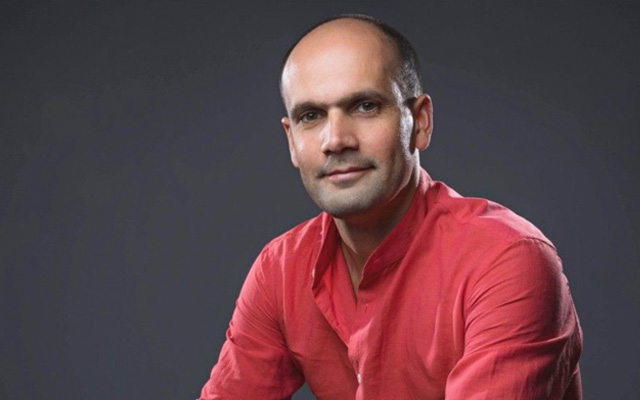
Maël Vastine is the new director of operations in Hong Kong for Ovolo Hotels.
He brings with him over 16 years of experience in hospitality, and will take on the responsibility for Hong Kong operations and provide strategic direction for shared services in Hong Kong.
Global DMC Kuoni Tumlare has signed a memorandum of understanding (MoU) with Switzerland Tourism (ST) to introduce the world’s first directly bookable tourism portfolio on the Swisstainable theme.
The Swisstainable movement was launched in 2021 when ST joined forces with the tourism industry to promote sustainable tourism in Switzerland, and encompasses all aspects of sustainability: the environment, business and society, with emphasis on proximity to nature, engaging authentically with local culture and lengthening the duration of stays in Switzerland.
Kuoni Tumlare and Switzerland Tourism introduce the world’s first directly bookable tourism portfolio on the Swisstainable theme
The partnership is aimed at the development and worldwide distribution of sustainable Swiss tourism products over the next three years. This will be the first time sustainable Swiss tourism can be booked worldwide.
ST CEO Martin Nydegger said: “I am proud to put pen to paper today on this global first, in the name of sustainable Swiss tourism. We will reap the benefits of Kuoni Tumlare’s global reach, which will provide a great showcase for our products. The cooperation with Kuoni Tumlare will greatly increase the visibility of the Swisstainable offering and above all, on a very tangible level, will make it bookable.”
Shinji Kamio, CEO of Kuoni Tumlare, said: “Our partnership with ST embodies our commitment to CSR and sustainability – reinforcing our promise to bring people closer and make lasting change across the communities we operate in.”
This collaboration will first roll out in the US, Canada and South-east Asia, where sustainable travel is trending, making these markets relevant and significant for Swiss tourism. It will also focus on four packages themed around rail and cycling holidays for small groups, incentive travel and educational trips.
The growing use of immersive technologies such as augmented and virtual reality will spur consumer-facing companies, such as those in retail, consumer goods and travel, to increase investment in new capabilities and experiences to blend physical and virtual worlds, or risk being left behind, according to the findings of a recent global survey from Accenture.
The survey of more than 11,000 consumers in 16 countries found that while 64% of consumers had already purchased a virtual good or taken part in a virtual experience or service in the past year, that figure is expected to rise, as 83% show interest in making purchases via the metaverse.
The growing use of immersive technologies such as augmented and virtual reality will spur consumer-facing companies (Photo: Accenture)
Furthermore, 42% of survey respondents said they had visited a retailer in the virtual world to get advice, make a payment or browse a product range when shopping for a physical item, while 56% of respondents plan to in the next year – these figures increase to 51% and 61% respectively among Millennials.
According to the Accenture Technology Vision 2022 “Meet Me in the Metaverse: The Continuum of Technology and Experience Reshaping Business”, 55% of consumers agree that more of their lives and livelihoods are moving into digital spaces. In response, 90% of retail executives say that they anticipate that leading organisations will push the boundaries of the virtual world to make it more real, increasing the need for persistence and seamless navigation between the digital and physical worlds.
72% of global executives state that the metaverse will have a positive impact on their organisations, with 45% believing it will be transformational.
Jill Standish, senior managing director and global head of Accenture’s Retail industry group, said: “The metaverse era has begun, and so for consumer-facing companies, it’s not about deciding if they’re going to go into the metaverse, it’s deciding how.
“Retailers and brands will need to reimagine and experiment with what new immersive and consultative experiences could mean to consumers. In addition to new opportunities to sell, the metaverse can also help build loyalty through experiences that go beyond just buying a product. For instance, retailers can create a personalised experience by offering a live-stream shopping event where customers can sit next to a brand ambassador, and then immediately be able to step into a virtual dressing room where they can try something on, add it to their cart, and check out.”
The survey also found that 50% of consumers are interested in buying a travel experience such as a sightseeing tour or hotel stay. This figure rises to 55% of Millennials, compared to 29% of baby boomers. For leisure, 54% of consumers said that they interested to buy tickets to a concert, a show or sporting event taking place in a virtual world.
Emily Weiss, senior managing director and global head of Accenture’s Travel industry group said: “It’s important to recognise that the metaverse is not intended to replace physical travel, rather provide a complementary enhancement to an overarching experience that, over time, may become an essential part of the travel ecosystem.
“Giving the option to sit in a virtual first-class seat, experience the lounge or walk around a hotel resort or room, opens up opportunities to truly engage and inspire people before they travel. And, through ‘trying-before-you-travel’, recreating landmarks in all their past glory or allowing travellers to investigate parts of nature, which they cannot explore within real-life interaction, the metaverse can also help create a more meaningful travel experience that delivers on or even exceeds customer expectations.”
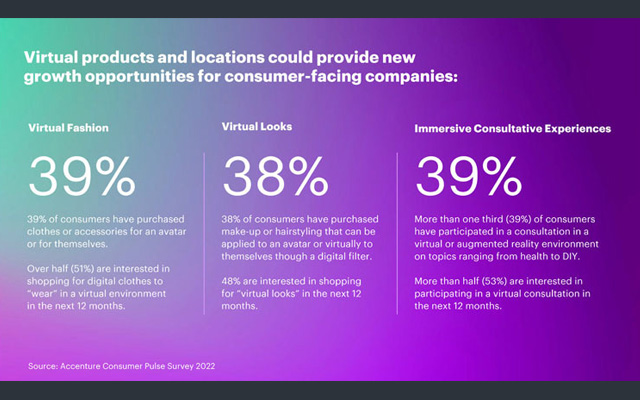
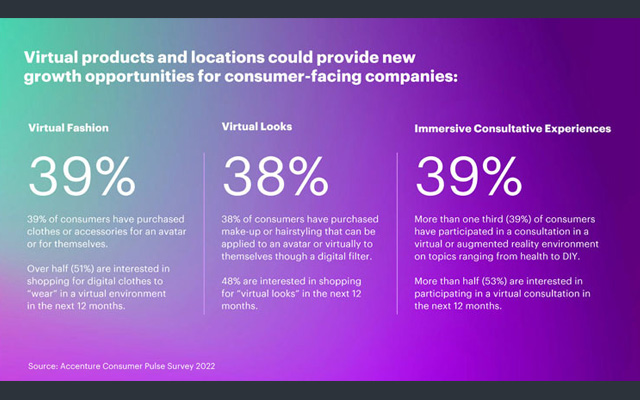
In addition to giving rise to new ways to shop, travel and socialise, virtual products and locations highlight a potential opportunity to grow revenue across industries.
Oliver Wright, senior managing director and global head of Accenture’s Consumer Goods and Services industry group said: “In a world where digital has become as important as the physical, consumer-facing companies are challenged to create, shape and market products, services and experiences that can move between the physical and virtual worlds. And they need to do this while coordinating a network of experts, skills, and technologies to help make it happen.
“While commercial applications of metaverse are still in their infancy, they will develop quickly because consumers already expect it. Successful consumer brands will be those that collaborate with consumers and the metaverse eco-system to create digital products and services that meet these rapidly emerging needs.”
Accenture recently announced the launch of the Accenture Metaverse Continuum business group, which combines metaverse-skilled professionals and market-leading capabilities in customer experience, digital commerce, extended reality, blockchain, digital twins, artificial intelligence and computer vision to help clients design, execute and accelerate their metaverse journeys.
Electric aircraft, planes fuelled by hydrogen and autonomous aviation are the future of transport, according to industry experts.
According to Kata Cserep, vice president and global managing director of aviation at ICF, electric aircraft are currently being tested for the short-haul segment and she predicts they will become the norm within the next two decades.
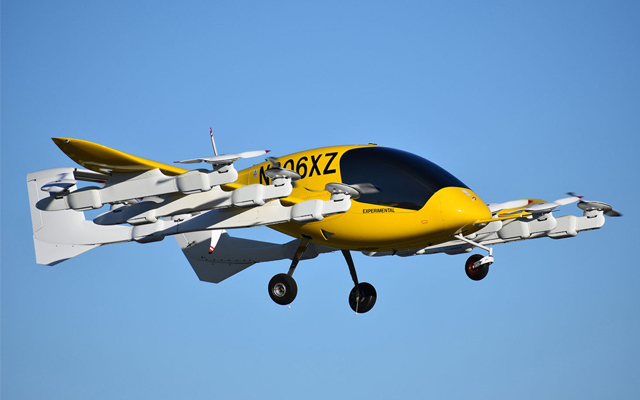
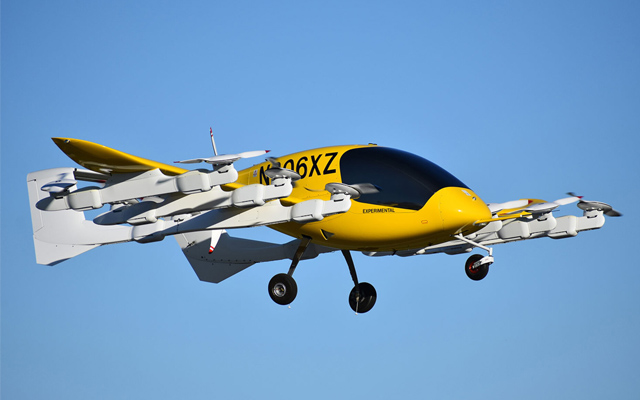
New forms of air transport, like Wisk, are set to revolutionise the travel sector
She said: “The pandemic has accelerated a lot of things, especially in terms of adapting technology. Electric aircraft are already being tested and this is a small but growing part of the transport supply that will be the future.”
Cserep said hydrogen-fuelled aviation is another concept being trialled that is predicted to be a cleaner and greener form of future transport. Aircraft using hydrogen will only emit water, with preliminary tests showing they can fly as fast as traditional planes, carrying more than 100 people for thousands of kilometres.
Kuljit Ghata-Aura, Boeing’s president for the Middle East, Turkey and Africa, said vertical take-offs and landings will also become the norm, alongside autonomous planes, especially for short-haul travel.
In January, Boeing invested US$450 million in Wisk. The advanced air mobility company has developed a prototype air taxi that has currently undergone 1,500 test flights. The self-driven electric plane can vertically take-off and land, a concept Ghata-Aura believes will become more popular within the aviation sector.
The current prototype is capable of flying up to 160km/h for 40km, with the potential to revolutionise city-to-city travel.
Ghata-Aura said: “Electricity and autonomy are two things to really watch out for as they will transform aerospace. This is how we imagine urban air mobility and taxis in the future, and is a really exciting product.”
Sustainable Aviation Fuel (SAF) is also slated to dominate the overhaul of the aviation space as part of the sector’s sustainability drive. Cserep said currently only 10 per cent of aircraft use SAF due to its high cost, which sits at about four times more expensive than traditional jet fuel.
However, she expects SAF prices to come down over time, “like we saw with solar panels”.
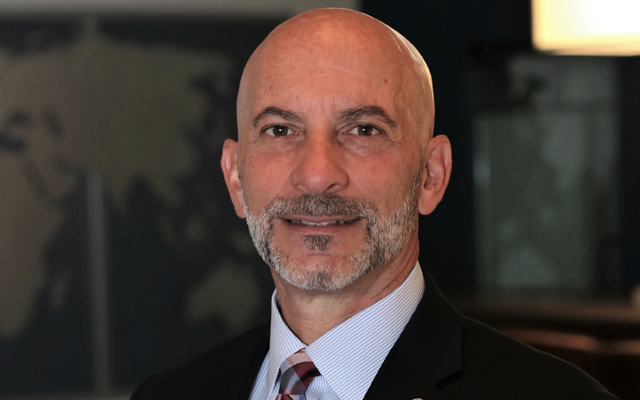
BWH Hotel Group has named Ron Pohl as the company’s president of international operations and president of WorldHotels.
Pohl joined the organisation in 2007 and previously served as senior vice president and chief operations officer.
Pohl will be responsible for further strengthening the organisation’s presence around the world and enhancing the company’s operations on a global level.
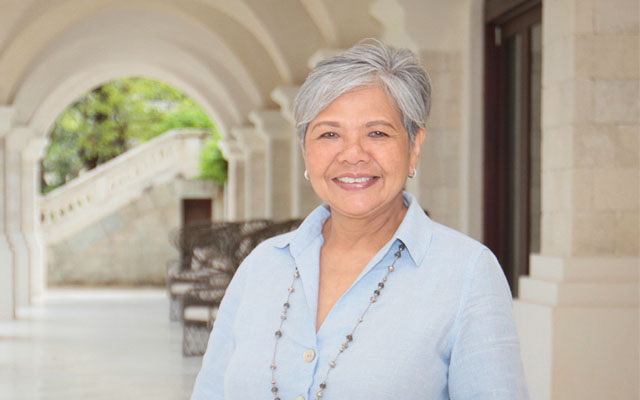
Ram Hiralal is the new general manager at Jumeirah Bali in Uluwatu. She brings with her a keen understanding of the luxury hospitality sector having worked as a hospitality leader across Bali, Thailand, Malaysia, Maldives and the Caribbean, with eight luxury hotel openings under her belt.
Ram joins Jumeirah Bali from COMO Shambhala Estate Bali resort, where she was the general manager from 2018.
In her new role, Ram is passionate about working alongside her team to create exceptional experiences for the guests and furthering Jumeirah’s legacy in Asia.
To help the travel industry get back on its feet at a time when many airports are burdened with lost income and limited resources, SITA is offering two approaches to passenger processing technology development that will ease the financial burden on airport operators.
First, for airports whose documentation procedures and systems do not inter-operate with that of other countries, SITA is offering an off-the-shelf solution that is free of cost for one year.
Patel: the only answer (to the congestion problem) is technology
Second, for airports with a system in place, SITA offers a phased technology refresh. For instance, an airport with available check-in desks could begin with two improved touch points to reduce passenger processing time, and move on to improvements at the immigration section, duty free retail and lounge facilities in the next phase.
SITA president Asia Pacific, Sumesh Patel, told TTG Asia that governments will have to eventually adopt new technology to address airport congestion and answer to a growing need for passengers to be in control of their trip while being exposed to minimal contact. New processes needed now include inter-operating passenger documentation and health detailing with that of other countries, touchless apps, and biometrics.
Patel noted that airports infrastructures were already strained by high passenger growth rate pre-pandemic, and the pressure is mounting as travel returns post-lockdown.
Pre-pandemic, the global average duration for passenger processing, from the time the traveller reaches the airport until boarding, was 1.5 hours. Now, with additional documentation scrutiny, the process has stretched to 5.5 hours.
“The only answer (to the congestion problem) is technology,” he stated.
As travel resumes, travellers can expect to face a broader set of risks, beyond those associated with the pandemic, according to BCD Travel’s latest Travel Risk Outlook report.
Based on both internal statistics from BCD’s Global Crisis Management (GCM) team, which monitors global risks and incidents around the clock, and external sources such as IATA, IPCC, WHO, Oxford Economics and the World Economic Forum, the Travel Risk Outlook report outlines seven risk categories that may impact business travel.
Not only are business travellers facing a bigger set of travel risks now, threats are also changing in intensity, which requires careful scrutiny by travel managers
One, the health of the economy may be the biggest underlying challenge faced by travel programmes, as it influences the pressure companies face to control their costs and therefore their travel budgets.
Two, climate change and extreme weather events will disrupt travel. In fact, BCD statistics show an increase in travel disruptions from natural events. In 2020, the number of incidents per million airline passengers increased by 82 per cent year-over-year, with a further 23 per cent rise recorded in 2021. According to the Intergovernmental Panel on Climate Change, the next two decades will herald unavoidable multiple climate hazards.
Three, geopolitical developments will impact travel, as shown by the Ukraine-Russia war. To keep travellers safe, it is key to have a comprehensive travel risk management programme in place and to stay abreast of such events.
Four, personal risk persists. The random nature of kidnappings or terrorism makes locating and communicating with business travellers a vital part of a travel manager’s role.
Five, the sudden shift to remote work during the pandemic has increased the exposure of company IT systems to external threats. With 31 per cent of all employees worldwide expected to be hybrid or fully remote workers in 2022, these cyber risks are unlikely to disappear.
Six, vaccine hesitancy and the diversion of medical resources to deal with the pandemic have increased the risks associated with traditional diseases such as measles, mumps and rubella. Meanwhile, scientists continue to be concerned about the emergence of a new Covid-19 variant, one that is highly transmissible and capable of evading existing vaccines.
Seven, there are new travel risks in a new world. The transition to remote working is changing the way we work and travel. To ensure that all employees, not just travellers, are protected when working remotely, companies should consider a shift from travel risk management to people risk management.
Jorge Mesa, director of global crisis management at BCD Travel, said: “Companies should refamiliarise themselves with these risks and ensure travellers are safe. The expertise of their travel, purchasing and security managers has never been more valuable than right now. The last two years have prepared them for this moment.”
BCD’s GCM team has also highlighted that the nature of travel risks has significantly changed over the past four years. Natural events are proving to be more disruptive, with extreme weather, earthquakes and wildfires accounting for 24 per cent of all travel incidents in 2021 (up from 18 per cent in 2018).
Civil unrest and incidents of violence represent 20 per cent of all risk-related events in 2021 (up from 15 per cent in 2018). This shows that risk is not confined to the journey to/from a destination; travellers are as much at risk at the destination and need support from travel managers for the entire trip.
Air travel-related incidents fell from 29 per cent in 2018 to 20 per cent in 2021. This does not necessarily mean fewer flight disruptions. Given the rise in rail incidents – up from 15 per cent in 2018 to 20 per cent in 2021, it could be that travellers are using alternative means of transport or taking fewer trips that require air travel.
“Clearly, not all organisations travel to destinations where kidnapping or geopolitical discord pose risks,” said Mike Janssen, global chief operating officer and chief commercial officer at BCD.
“But worldwide, there is a growing number of different dangers that threaten employees and organisations. Our GCM team’s findings show the need to act now and assess, adopt and apply risk management strategies that fit company travel patterns and goals.”
Tāmaki Makaurau Auckland will host the main event in the countdown to next year’s FIFA Women’s World Cup 2023 on October 22 – an activity that will boost inbound tourism and major events recovery for the destination.
The Official Draw, set to take place at Aotea Centre, is expected to attract an international television audience of more than a billion viewers, said Phil Goff, mayor of Auckland.
The Official Draw is set to take place at Aotea Centre, Auckland
He added: “Those attending in person will boost visitor nights in Auckland by about 130,000, and the event will contribute about NZ$60 million (US$38.2 million) to regional GDP in Auckland.
“The draw will be eagerly followed by countries around the world keen to find out who their teams will compete against, and when and where they will play. Auckland will be in the international spotlight during the Official Draw, just as it will be for the opening match in July 2023 and the semi-final, both to be held at Eden Park.”
The Official Draw will see 32 participating teams being allocated into eight groups to determine who they will face in next year’s event, as well as which country they will be based in for group stage matches.
FIFA estimates that around 800 attendees, including senior FIFA officials and international media will attend the event, which will also be broadcast live to a captive global audience – providing a platform to showcase what makes Tāmaki Makaurau and Aotearoa unique with viewers around the world.
Approximately 120 team representatives will then visit shortlisted training sites and accommodation across New Zealand and Australia.
Hosting the Official Draw brings Auckland one step closer to hosting the FIFA Women’s World Cup 2023 – the largest women’s sporting tournament ever staged in Auckland or New Zealand. The event will help to underpin the region’s ongoing Covid-19 recovery, said Auckland Unlimited chief executive Nick Hill.
“A truly international event, the FIFA Women’s World Cup 2023 will be a cornerstone in Auckland’s major event calendar and our gradual re-opening to the world,” Hill added.
The government of Western Australia has handed down its 2022-23 State Budget, announcing an increase of A$31 million (US$21.8 million) in funding for tourism events.
This includes A$20 million for a new Major Events Fund, of which A$5 million has been allocated for hosting business events.
Western Australia’s latest financial support for the business events industry comes with a new Major Events Fund, where A$5 million has been allocated specifically for hosting business events
The latest financial injection comes in addition to the A$15 million Reconnect WA package announced in December 2021.
The boost in funding comes at a pivotal time for Western Australia’s business events industry, which is poised to experience a significant period of growth and recovery following the reopening of state borders and renewed appetite for travel from business event delegates.
Business Events Perth chair Bradley Woods said the additional funding recognised the important role that business events played in strengthening and diversifying the state’s economy, and the support that was needed to revive the sector after a significant disruption.
“The impact of Covid-19 on the business events industry has resulted in a massive hit, in terms of real losses and future business confidence, so this funding boost is well timed as we continue our efforts to secure lucrative business events to re-energise and rebuild the many venues and small businesses that are still struggling two years into this pandemic,” Woods said.
Tourism minister Roger Cook said the increased funding would maximise opportunities for the state, securing lucrative business events not just for their tourism impact, but also as a platform for economic diversification, presenting an opportunity to promote Western Australian expertise to the world.
“This is the next stage in turbo-charging Western Australia’s economic transition after the successful management of Covid-19 for more than two years,” Cook remarked.
“A revived programme of business events will help to create an economic legacy beyond the value of initial tourism expenditure – helping us build towards a bigger, better Western Australia.”


 He brings with him over 16 years of experience in hospitality, and will take on the responsibility for Hong Kong operations and provide strategic direction for shared services in Hong Kong.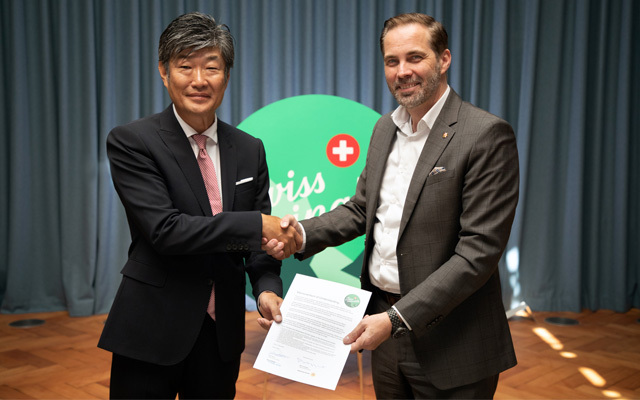

 Pohl will be responsible for further strengthening the organisation’s presence around the world and enhancing the company’s operations on a global level.
 In her new role, Ram is passionate about working alongside her team to create exceptional experiences for the guests and furthering Jumeirah’s legacy in Asia.