Sri Lanka is targeting three million tourist arrivals in 2026, up from a record 2.36 million in 2025, but hoteliers have expressed caution, citing the absence of a long-delayed destination marketing campaign as a potential constraint on growth.
Hiran Cooray, chairman of Jetwing Symphony group of hotels, stated it would be better to aim for a 10 per cent increase this year to about 2.6 to 2.7 million, as the main obstacle to achieving a higher figure is the delay in launching the long-awaited destination marketing campaign.
Tourism officials and industry representatives address the media in Colombo as Sri Lanka targets 3 million arrivals in 2026
Last week tourism minister Vijitha Herath said the industry’s 2025 performance resulted in record arrivals, exceeding the previous high of 2.33 million recorded in 2018, while tourism revenue in 2025 was recorded at US$3.2 billion, lower than the US$4.48 billion achieved in 2018.
The lower revenue in 2025, despite higher arrivals, was attributed to a decline in daily tourist spend. Average daily spend was US$170-180 in 2018, compared with US$148 in 2025. The growth of guesthouses and low-cost Airbnb-type accommodation in recent years, often priced below US$50 per day compared with US$125-150 at higher-end hotels, has contributed to this decline. The informal sector is estimated to account for close to 40 per cent of the industry.
“We have not had a marketing campaign for years which if done sooner than later, will propel tourism revenue, increase prices not only for the big hotels but also smaller guesthouses. A positive impact will be felt across the board,” Cooray reiterated, adding that his company spends heavily on its own marketing in the absence of a national campaign.
There are two main issues in finalising a destination marketing campaign. The preparation process is subject to a lengthy state procurement procedure, and even once approved, a change of government can result in plans being dropped, as political considerations often influence such campaigns.
Herath noted the higher arrivals target was intended to boost tourism revenue and support the country’s recovery from Cyclone Ditwah in late November, which killed more than 600 people and caused damage to buildings, property and infrastructure.
Authorities are also examining tourism leakage, based on a survey conducted with the support of a consultant from UNWTO, according to Udana Wickramasinghe, director of research and international relations at the Sri Lanka Tourism Development Authority. Tourism leakage refers to revenue that does not remain in the local economy because of reliance on imported goods and services rather than local products.
“We are planning to have a workshop for all stakeholders to discuss these findings and see where we can enhance the local component in the industry; for instance, hotels using local wines and alcohol, local meat and cheese, local furniture and fittings instead of importing these items, which can help to save foreign exchange,” he pointed out.
He cited the Maldives as an example of tourism leakage, where most goods, including labour, are imported.
The department of tourism, government of Arunachal Pradesh has unveiled its latest brand campaign, Take a New Turn in Arunachal at a news conference in New Delhi on Tuesday (January 6). The initiative was launched in the presence of senior state government tourism representatives and industry stakeholders.
The new campaign aims to position the state as a holistic destination catering to diverse segments like culture, adventure, eco-tourism, farm tourism and MICE.
Arunachal Pradesh’s tourism department launched its new brand campaign at a New Delhi media briefing on January 6
“A refreshed brand identity is important to create interest in the market. With this campaign, we will embark on parallel domestic and international promotional activities. We will soon come-up with a calendar of roadshows for the domestic markets while for international markets, we will be participating in different tradeshows like WTM and ITB,” said Pasang Dorjee Sona, minister for tourism, government of Arunachal Pradesh.
Destinations like Tawang, Ziro, Anini, Namsai, Dong and Mechuka will be promoted in both domestic and international markets as part of the new brand campaign.
The north-eastern Indian state is also planning to reach out to new international markets like South Korea with its new brand identity.
“In the past also, we have visited new markets like Costa Rica as part of our international promotions. We are working on plans to create awareness about Arunachal Pradesh in South Korea too,” added Sona.
As part of its tourism policy introduced last year and its new brand campaign outlook, involving the locals through channels like homestays is a priority area for the state government. The tourism minister shared that homestays have seen an overwhelming growth in Arunachal Pradesh on the back of subsidies and financial assistance offered by the state government.
“Homestays on one hand provide revenue to locals and on the other hand for a tourist is a great medium to learn about culture, cuisine and folklore of the locals. We will soon have a convention for homestays where all the owners will come together to learn how to meet the needs of new age customers,” shared Sona.
As per the statistics available with India’s Ministry of Tourism, Arunachal Pradesh recorded 0.87 million and 5,000 international visitors in 2024. The state is targeting to achieve a CAGR of 15 to 20 per cent in overall tourist numbers in the next decade.
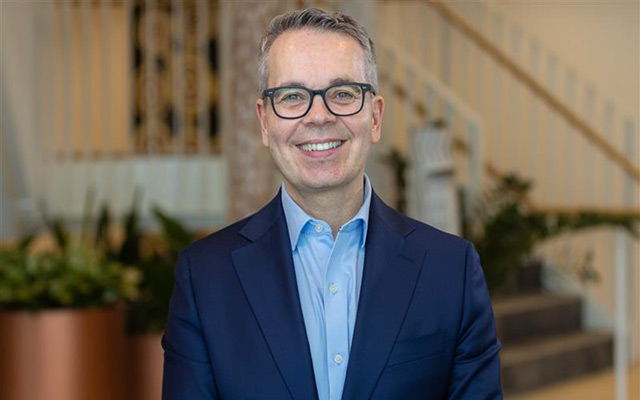
Tourism Australia has appointed Robin Mack as managing director. Mack brings almost 30 years of experience in the global travel and tourism sector, including more than a decade with Tourism Australia.
Most recently, he oversaw market strategy and operations across 16 international markets, alongside responsibility for commercial activity, distribution development and partnerships. He also led Business Events Australia, working closely with industry stakeholders to support demand.
His experience spans destination marketing, international trade relations and long-term demand planning, with a focus on priority growth markets in Asia.
Mack, commenting on his new role, said competition for high-value visitors was intensifying worldwide, making Tourism Australia’s role in driving demand through marketing, partnerships and industry engagement central to protecting and growing Australia’s share of the international travel market.
Momentus Hotel Alexandra has appointed Chantel Lim as director of commercial, with responsibility for sales, distribution and partnerships.
In the role, she will lead the hotel’s commercial strategy across corporate and leisure segments, focusing on account development, market expansion and revenue performance aligned with wider business objectives.
Lim has more than 20 years of experience in hospitality sales and business development across South-east Asia. Most recently, she held a senior commercial role at Dao by Dorsett AMTD Singapore, working across corporate and extended-stay segments. Her previous experience includes leadership roles with Hyatt, Pan Pacific Singapore, Resorts World Sentosa and InterContinental Hotels Group.
The Tokyo Metropolitan Government has launched a new website, Go Tokyo Gourmet, aimed at promoting the city’s food culture to domestic and international visitors.
The website features articles and videos introducing Tokyo’s culinary landscape, covering both established cuisine and everyday food culture. The government said the platform is intended to deepen interest in Tokyo’s food scene and encourage visitors to experience it first-hand.
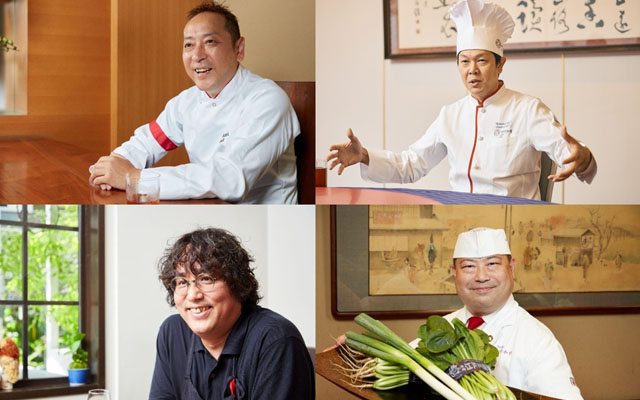
Chefs and food specialists, including Tokyo Tourism Ambassadors, contribute insights to the Go Tokyo Gourmet website to highlight the depth of the city’s food culture
Tokyo’s culinary offering is presented through a wide range of themes, from dishes that developed during the Edo period, including sushi, tempura, eel and soba, to contemporary cuisine shaped by global influences. The site also highlights locally sourced ingredients and the role of chefs and food professionals in shaping the capital’s dining scene.
Perspectives from chefs appointed as Tokyo Tourism Ambassadors, along with chefs active in Tokyo, food specialists and other industry figures, are also featured. Their contributions are used to explore the background, techniques and ideas behind Tokyo’s food culture.
In addition to restaurant-focused content, the website examines the historical development of Tokyo’s cuisine, tracing its evolution from the Edo period to the present day. Topics include food-related traditions, dining customs, everyday meals enjoyed by residents and emerging themes such as sustainability and dietary diversity.
Sections aimed at travellers focus on food experiences commonly associated with visits to Tokyo, including ramen, rice balls, convenience store meals and vending machine culture. The site also provides information on vegan, halal and gluten-free dining options, as well as guidance on Japanese dining manners, services and restaurant reservation platforms.
The website includes details of food-related events in Tokyo and practical information to help visitors navigate the city’s dining scene. Content is available in Japanese and English.
Go Tokyo Gourmet was launched on December 18, 2025, and is operated by the Tokyo Metropolitan Government. Updates related to Tokyo’s food attractions will also be shared through official social media channels on YouTube, Instagram and Facebook.
Mövenpick Resort & Spa Bintan Lagoon, Indonesia
Mövenpick Resort & Spa Bintan Lagoon is scheduled to open in 1Q2026 on Bintan’s northern coast, a short ferry journey from Singapore. The beachfront resort is set along the island’s longest private beach, with access to two nearby championship golf courses designed by Jack Nicklaus and Ian Baker-Finch.
The resort will boast 420 rooms and suites, including premium terrace rooms with ocean views. Facilities are planned to include six dining venues, a spa, beach club, multiple swimming pools, children’s splash areas, sports courts, playrooms and a recreation village. Events space will total 2,000m², including a grand ballroom of 900m² and additional function rooms.
AC Hotel by Marriott Puchong
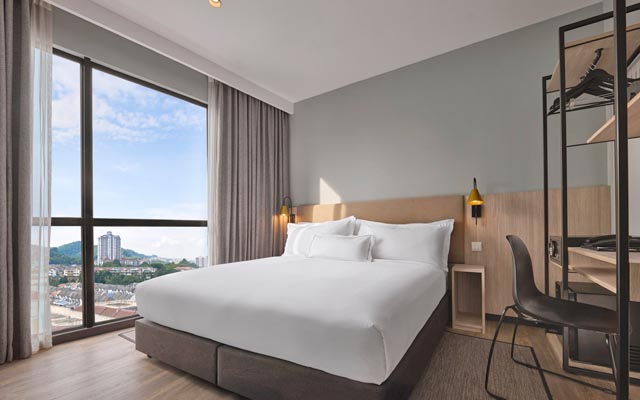
AC Hotel by Marriott Puchong, Malaysia
AC Hotel by Marriott Puchong has opened in Bandar Puchong Jaya, close to the IOI Puchong Jaya LRT station and with access to the LDP. The hotel is near IOI Boulevard, Skypod Square, IOI Mall and the Puchong Financial Corporate Centre, with Sunway Lagoon, Putrajaya International Convention Centre and Kuala Lumpur City Centre a short drive away.
The hotel has 180 rooms, including deluxe rooms, junior suites and suites, with open layouts, workspaces, high-speed internet access and USB charging points. Facilities include the AC Lounge, AC Kitchen with live cooking stations, 695m² of event space, an outdoor swimming pool, a fitness centre and a prayer room.
Four Points by Sheraton Amritsar, Mall Road
Four Points by Sheraton Amritsar, Mall Road, India
Four Points by Sheraton Amritsar, Mall Road has launched as a dual-branded complex with Marriott Executive Apartments Amritsar in the city centre. The property is 11 km from Sri Guru Ram Dass Jee International Airport and 2.3 km from Amritsar Junction railway station, with the Golden Temple, Jallianwala Bagh, the Partition Museum and Durgiana Temple all a short drive away.
Four Points by Sheraton Amritsar, Mall Road features 124 rooms overlooking Mall Road, with workspaces, USB charging points and Wi-Fi, while Marriott Executive Apartments Amritsar offers 59 apartments, including studio, one-bedroom and two-bedroom layouts with separate living, dining and sleeping areas and kitchenettes.
Shared facilities include all-day dining at Kitchen 1574, a Pan-Asian restaurant, a bar, lobby lounge, outdoor swimming pool and fitness centre. Event facilities span around 1,201m², including a pillarless ballroom of approximately 557m².
The Imperial Hotel, Kyoto
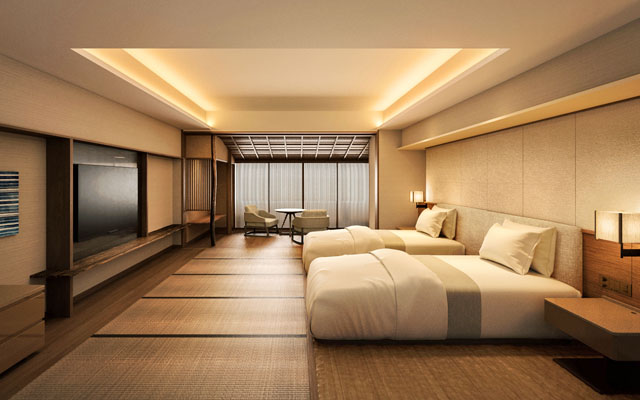
The Imperial Hotel, Kyoto, Japan
The Imperial Hotel, Kyoto is scheduled to open on March 5, 2026, in the Gion district of Kyoto. The hotel occupies part of the Yasaka Kaikan, a registered Tangible Cultural Property, within the grounds of the Gion Kobu Kaburenjo. Located amid historic streets and close to temples, traditional theatres and cultural landmarks, the property places guests at the centre of one of Kyoto’s best-known districts.
The hotel has 55 rooms across three areas: the Main Building Heritage, the Main Building and the North Wing. Accommodation ranges from premier rooms to suites, with designs incorporating preserved architectural elements, city and mountain views, and, in the North Wing, tatami flooring. Facilities include restaurants and a bar, a spa, swimming pool and fitness centre.
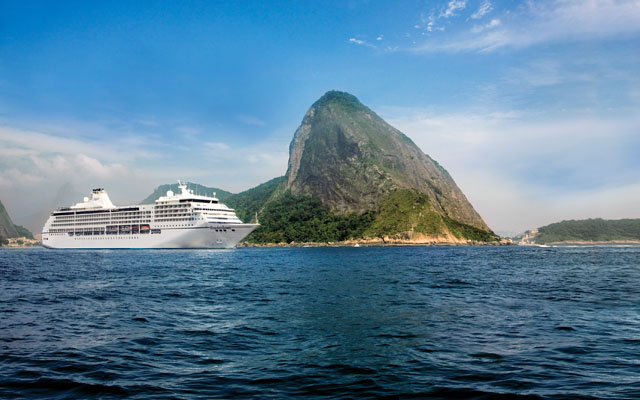
Regent Seven Seas Cruises has relaunched its Upgrade Your Horizon offer, giving travellers booking selected voyages the option of a complimentary two-category suite upgrade, up to a Penthouse Suite, alongside a reduced deposit of 7.5 per cent.
The promotion applies to new bookings made by February 28, 2026, on selected sailings from 2026 onwards, covering itineraries scheduled for 2026, 2027 and 2028.
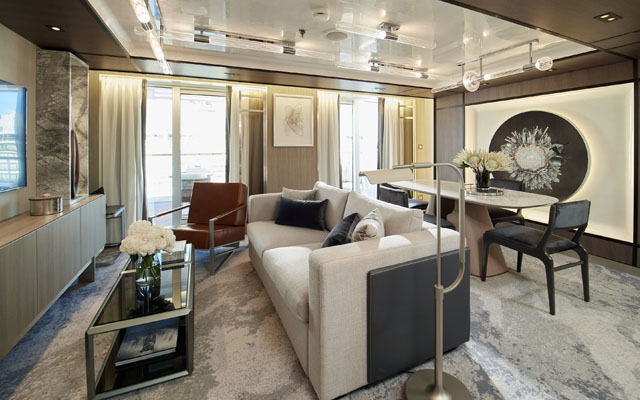
Guests can enjoy a complimentary two-category suite upgrade on selected voyages; the Grandeur Suite aboard Seven Seas Grandeur, pictured
The offer is available across a wide range of destinations, including Alaska, Africa, Australia and New Zealand, Canada and New England, the Caribbean, the Mediterranean, Northern Europe, South America and the South Pacific. Eligible guests benefit from enhanced onboard inclusions linked to their upgraded suite category, such as a complimentary one-night pre-cruise hotel stay for Concierge Suites and butler service for Penthouse Suites.
Among the voyages available under the promotion is a 12-night round-trip sailing from Miami aboard Seven Seas Grandeur, departing March 26, 2026, which includes an extended stay in Bermuda and calls in Norfolk, Charleston and Nassau. A 17-night Northern Pacific journey aboard Seven Seas Explorer departs Tokyo on May 3, 2026, crossing the International Date Line before continuing through Japan and Alaska to Vancouver.
Other highlighted itineraries include a 20-night sailing from Doha to Cape Town aboard Seven Seas Navigator on May 22, 2026, an 11-night European itinerary from Amsterdam to Barcelona aboard Seven Seas Mariner on September 7, 2026, and a 10-night autumn voyage from New York to Montréal aboard Seven Seas Splendor on October 20, 2026. A shorter seven-night Adriatic and Mediterranean sailing aboard Seven Seas Voyager departs Trieste on November 10, 2026, ending in Athens.
Brij Hotels is expanding its portfolio with a new beachfront resort development in Sindhudurg, a coastal district in Maharashtra, adding to its collection of boutique properties across India that focus on local heritage, culture and landscape.
The project, to be known as Brij Sindhudurg, will be a private-villa resort located north of Goa and within driving distance of MOPA International Airport and Sindhudurg Airport. The property is planned as a low-density development along the coastline, with direct beach access from its villas.
Brij Hotels’ new Sindhudurg resort project marks the group’s entry into the coastal district north of Goa
According to the company, guest experiences will centre on the surrounding marine and coastal environment. Proposed activities include dolphin spotting, snorkelling and other water-based experiences, alongside dining based on local coastal cuisine. Cultural elements linked to Konkan traditions and local communities are also expected to form part of the resort offering.
The development aligns with Brij Hotels’ strategy of entering destinations that remain less developed for tourism, with an emphasis on smaller-scale properties rather than large resort complexes.
Udit Kumar, co-founder of Brij Hotels, said: “Sindhudurg is a coastline that has remained beautifully untouched, and our intent is to preserve that essence while creating a deeply romantic and immersive retreat. With Brij Sindhudurg, we’re not just adding a destination, but opening a new chapter in how luxury coastal travel is experienced in India.”
In The Magician’s Nephew, the first novel in C S Lewis’s Chronicles of Narnia, the author imagined a world between worlds – a tranquil forest dotted with mirror-clear pools, each a portal to another realm. The best of Asia-Pacific’s airports now conjure something similar, transforming the turbulence of transit hubs into restorative environments of calm and sensory renewal.
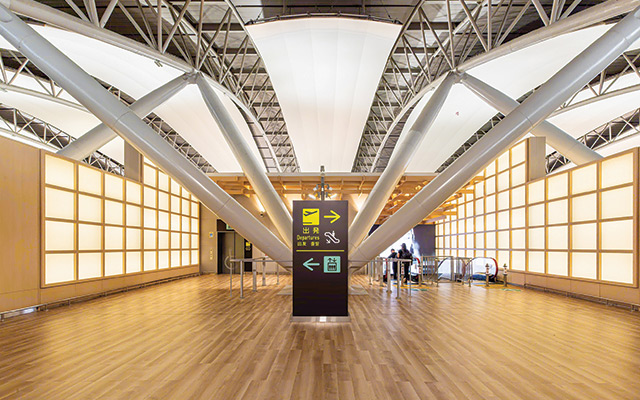
Timber design and natural light redefine Kansai International Airport ahead of World Expo 2025
Destinations, not detours Designed with nature’s materials and interwoven with cultural themes, these new terminals are portals in their own right: artful, biophilic sanctuaries that allow travellers to move through calm instead of chaos, while quietly steeping them in the sense of place.
“Airports are now the leaders out of all sectors in design and development. They want to make memorable environments – to introduce garden concepts in cities,” observed Patrick Keane, founder of Enter Projects Asia (EPA).
At Bengaluru’s Kempegowda International Airport Terminal 2, Keane’s studio has reimagined the post-security landscape as a living organism. Opened in 2024, the 12,000m2 departure hall, crafted from nine kilometres of hand-woven rattan, feels more arboreal than architectural. Sculptural pods are surrounded by hanging gardens, vines, and 700-year-old olive trees.
“If you think of rattan structures, bamboo framing, handmade elements and wood – you think wellness retreat, somewhere remote. But now you’re seeing that in an airport that welcomes 20 million visitors a year. If you touch a pod, it feels like a tree, not a wall. Wellness has become mainstream,” Keane reflected.
Across the East China Sea, global design firm Populous has brought similar material sensitivity to Japan’s Kansai International Airport, renewed ahead of World Expo 2025 Osaka Kansai.
“The T1 renovation project was envisioned as the symbolic gateway to the World Expo – the ‘first pavilion’ that sets the tone for visitors’ experience of Japan,” explained Ben Dawson, Populous’ principal and head of aviation, APAC. “The renovation prioritised openness, clarity, and cultural immersion.”
A once-enclosed immigration hall now bathes in natural light. Timber finishes and exposed trusses recall Japanese craftsmanship, while intuitive sightlines – literally framing the passenger journey – create ease and orientation.
Techo International Airport (KTI) in Cambodia’s Kandal province introduces a new vernacular to Cambodia’s aviation. Developed by Cambodia Airport Investment Co. (CAIC) and spanning 2,600 hectares, its sweeping scalloped wooden roofline and vaulted timber lattices reinterpret Khmer architecture in a distinctly contemporary key. The interior will feature a traditional wooden Cambodian house for passengers to visit – a cultural touchpoint amid the choreography of departure.
In Vietnam, the vast Long Thanh International Airport is taking shape. Designed for a final capacity of 100 million passengers annually, its first phase will debut in 2026 with what is expected to be the world’s largest bamboo structure – a glulam (glued laminated timber) canopy of interlacing bamboo arches. More than sustainable, the design draws on the material’s deep cultural resonance in Vietnam.
Across these projects, new airport terminals in Asia-Pacific are no longer conduits of motion but living works of architecture – immersive ecosystems of plant-based materials that refresh, restore, and reawaken the senses before flight.
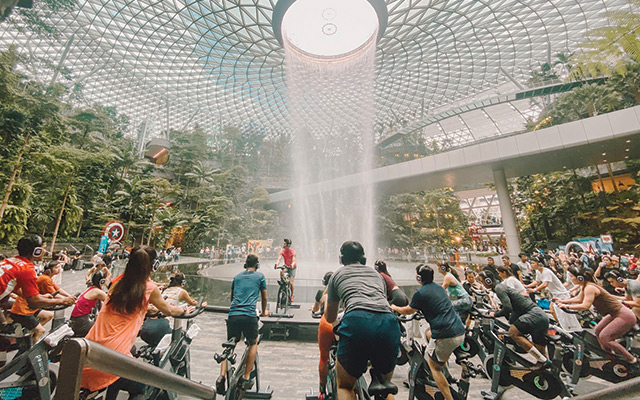
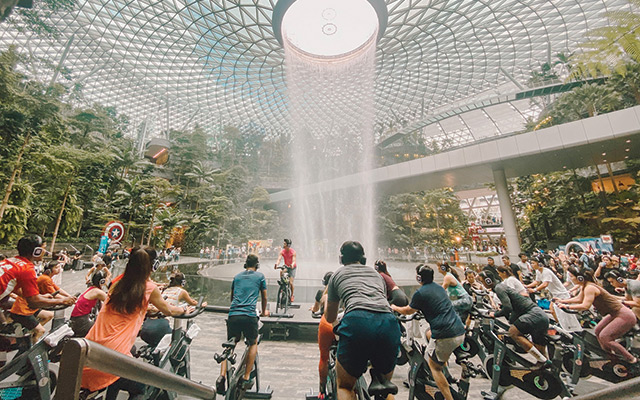
Passengers can take Rhythm cycling classes amid greenery at Changi Airport’s Forest Valley
Portals of calm If Bengaluru and Kansai express biophilia through material empathy, Singapore’s Changi Airport has turned sensory design into science. With 600,000 plants, a signature Orchid Tea scent, and the aptly named Quiet Terminal Initiative, Changi orchestrates fragrance, light, and sound into what it calls “wellness through seamlessness”.
Carpeted floors hush the terminal’s tempo, while immersive installations such as Dreamscape and Wonderfall sync movement with nature’s rhythms, transforming waiting into wonder.
Wellness extends beyond design: the Minmed Wellness Collective at Jewel’s Canopy Park offers yoga, barre, and Pilates, while rhythm cycling classes in the Forest Valley overlook the Rain Vortex. Travellers can even rent a bike and cycle outdoors from Terminal 2 to Jurassic Mile, where life-sized dinosaurs line a 3.5-kilometre park connector – proof that wellness can be playful as well as peaceful.
Behind the scenes, Amadeus technology powers Changi’s biometric bag drops, translating operational efficiency into a subtler kind of well-being: freedom from friction.
In Australia, Woods Bagot’s design for Western Sydney International (Nancy-Bird Walton Airport), opening 2026, takes this idea of emotional ergonomics to heart.
“Our approach has been to create a space for everyone – a place that is easy to navigate and in which people feel calm,” said Jodi Archer, Sydney aviation lead at Woods Bagot.
Filtered sunlight softens through slatted ceilings, changing hue through the day. Wide circulation paths, clear sightlines, and sensory rooms desensitise tension points. Seating areas adapt to individual rhythms – from contemplative corners to communal zones.
“Wellness services are scattered throughout. People find what they need, when they need it,” Archer added.
Here, architecture choreographs emotion as much as movement, immersing passengers in tranquil, light-filled environments that ease transitions between destinations.
Harmony with the planet Wellness now extends beyond the traveller – it encompasses the planet itself. At Western Sydney, the terminal’s roof generates solar energy, harvests rainwater, and filters daylight through energy-efficient skylights designed to limit heat gain. “Sustainable and recycled materials will be used throughout the terminal, including the structure, finishes and furniture,” noted Archer.
At Kansai, Populous’ approach to adaptive reuse – increasing capacity without expanding the footprint – is a quieter but equally powerful act of sustainability.
“That decision alone has massive benefits in terms of energy, materials, and cost,” Dawson explains.
For its work in Bengaluru, EPA merged digital precision with handcraft, collaborating with Thai artisans to handweave each section at its Bangkok studio before assembling them using bespoke logistics software that streamlines production and shipping.
This fusion of digital precision, handmade craft, and natural materials defines the firm’s approach to sustainable innovation – an act of ecological as well as cultural regeneration.
And at Changi, sustainability quite literally takes root. The airport’s dense horticultural network serves as both air filter and acoustic buffer, moderating temperature and humidity while softening the sensory impact of travel itself.






 His experience spans destination marketing, international trade relations and long-term demand planning, with a focus on priority growth markets in Asia.
 Lim has more than 20 years of experience in hospitality sales and business development across South-east Asia. Most recently, she held a senior commercial role at Dao by Dorsett AMTD Singapore, working across corporate and extended-stay segments. Her previous experience includes leadership roles with Hyatt, Pan Pacific Singapore, Resorts World Sentosa and InterContinental Hotels Group.