


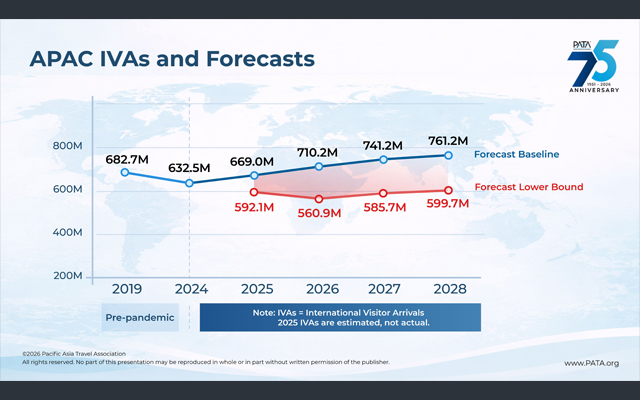
International visitor arrivals to Asia-Pacific are expected to exceed pre-pandemic levels from 2026, according to the PATA Asia Pacific Visitor Forecasts 2026-2028.
The report projects that inbound arrivals could reach 761.2 million by 2028 under a baseline scenario. However, a lower-bound scenario, reflecting geopolitical and economic uncertainty, estimates arrivals could reach 599.7 million, or about 88% of 2019 levels.
The study, developed in partnership with the School of Hotel and Tourism Management at The Hong Kong Polytechnic University, covers 39 destinations across the region and outlines a period of uneven growth influenced by external factors.
These include geopolitical tensions, climate-related disruptions, changes in aviation capacity and visa policies, as well as ongoing digital transformation across the sector.
China, the US and Türkiye are expected to remain the leading destinations through 2028. Key source markets include China, Hong Kong, the US and South Korea.
Several destinations, including Mongolia, Japan, Chile, the Maldives and Sri Lanka, are projected to exceed 150% of their 2019 arrival levels. Overall, 27 of the 39 destinations are expected to surpass pre-pandemic volumes by 2028.
The report also highlights the need for destinations to diversify source markets and strengthen collaboration between public and private sectors to manage risks and support recovery.
“International tourism is entering a more complex phase where growth continues, but under increasing pressure,” said Noor Ahmad Hamid, CEO of PATA. “At PATA, we recognise both sides of the equation – the positive momentum driven by strong regional demand, and the downside risks arising from geopolitical tensions, economic volatility, and climate-related disruptions.
“In this environment, growth is no longer linear or guaranteed. Destinations and organisations must be prepared for multiple scenarios, with the ability to adapt quickly, recalibrate strategies, and respond with agility. Decision-making must be grounded in real-time data and a clear understanding of risk.”
“The results reflect not only the pace of recovery across destinations, but also the deeper structural changes transforming the tourism economy,” added Haiyan Song, School of Hotel and Tourism Management, The Hong Kong Polytechnic University.
“Ultimately, resilience and preparedness will define how well the industry navigates this next phase of uncertainty,” Hamid concluded.


