
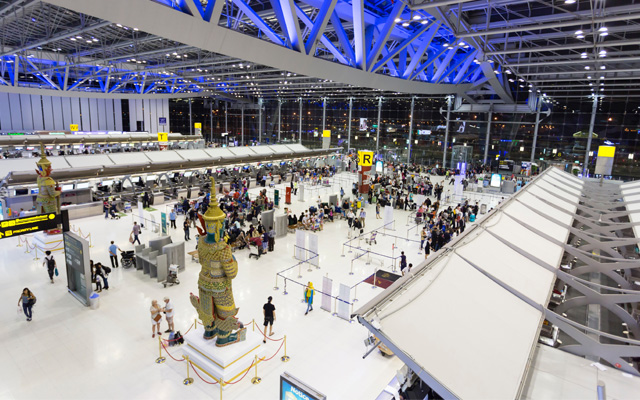
- Airports are providing welfare support for stranded passengers
- Tour operators and travel agents wade through evolving updates in a fluid situation to help guests carry on with travel plans
- Impact on travel to and through the UAE is expected to be temporary
Asian tourism players are seeing varying degrees of disruption to both inbound and outbound movements amid missile strikes in parts of the Middle East.
Suvarnabhumi Airport in Bangkok, Thailand has faced significant disruptions between February 28 and March 1. A total of 32 flights – 16 inbound and 16 outbound – were cancelled across nine airlines, including Emirates, Etihad, Kuwait Airlines and Qatar Airways. To assist affected travellers, Suvarnabhumi Airport has mobilised extra staff, provided drinking water, and set up dedicated waiting areas at Gates 1 and 10.
Additionally, as of March 1, the Tourism Authority of Thailand (TAT) has set up a Tourism Crisis Monitoring Center to coordinate support for affected travellers, preparing for both short and medium term scenarios. The bureau reports that the Suvarnabhumi, Don Mueang, Chiang Mai, Phuket, and Krabi international airports have received notifications of flight cancellations from 59 international airlines with routes to or through the Middle East region.
Singapore’s Changi Airport Group has reported 32 cancelled flights that were scheduled to depart between February 28 and March 7. The cities affected by these cancellations are Abu Dhabi, Bahrain, Doha, Dubai and Jeddah.
Malaysia Airports has reported 26 cancelled flights, comprising 13 departures and 13 arrivals across Kuala Lumpur International Airport terminals. It has teams on standby to provide guidance and coordinate with airlines on necessary arrangements and to provide assistance to affected passengers at passenger terminals.
Ground support
Stephan Roemer, CEO of DTH Travel, one of the largest tour operators in Asia, told TTG Asia that his emergency teams in the region have been assisting all affected guests with rebooking, extending and cancelling tasks.
He noted that the situation is unpredictable, so his teams are dependent on information from the governments and airlines.
Bayu Buana Travel Services in Indonesia has established a task force to partner its Emergency Support Services team to manage impacted group and corporate travellers. Affected guests are those transitting in Dubai, Doha and Abu Dhabi as well as those who are due to head towards or are already in the Middle East.
Malaysian inbound specialist, Saini Vermeulen, executive director of Within Earth Holidays, is relying on updates from its overseas agent partners regarding revised arrival schedules, particularly as airlines rework their flight path to avoid areas of conflict.
Arokia Das Anthony, executive director of The Essence of Asia Tours and Travel, described the situation as fluid.
He expects some postponements from both FIT and group travellers from Eastern and Western Europe this month.
“Travellers are understandably cautious. If flight routes become longer or more uncertain, some may choose to delay their trips,” Arokia said.
On the bright side, Arokia expects Malaysia to benefit from a change in travel plans among Indian travellers who are choosing to avoid Middle Eastern air hubs and reconsider European trips due to “current uncertainties and higher airfares to Europe”. Malaysia’s visa exemption for Indian passport holders facilitates spontaneous travel plans.
Hoteliers are also stepping in to assist guests.
Duncan O’Rourke, chief executive officer, premium, midscale & economy division for Middle East, Africa, and Asia Pacific at Accor, said the group is “committed to providing flexibility and support to our partners and clients during these uncertain times”.
Bjorn Courage, general manager of InterContinental Phuket Resort by IHG and president of the Phuket Hotels Association, shared that hotels across Thailand’s Phuket are currently offering flexible rebooking options or waiving amendment fees for guests affected by flight changes.
He added: “A small portion of our guests travelling to or from Phuket have experienced schedule adjustments, rerouting, or short-notice delays.”

Bali Hotels Association (BHA) has urged member hotels to offer flexibility, shared board member Fransiska Handoko.
“BHA is currently gathering data over the next week to determine the exact number of room-night cancellations versus reschedules. At this stage, our efforts are focused on advising hoteliers to remain flexible and to offer special rates for stranded guests, as this is a force majeure situation. We also advise guests to monitor official airline, airport, and immigration websites to avoid overstaying their visas,” Fransiska added.
John Flood. CEO, Archipelago said no penalties are imposed on room cancellations resulting from flight suspensions and airspace restrictions.
“Our priority is to remain fair and flexible under the circumstances while maintaining clear communication with our partners and guests. For any guests currently stranded or facing travel uncertainty, our hotels are providing flexible extension options, preferential rates for extended stays where necessary, and direct assistance through our front office teams. Our teams are also supporting guests with coordination of revised travel arrangements, including transportation guidance and communication with airlines or agents where needed,” he told TTG India.
One Farrer Hotel in Singapore has arranged extensions for guests who are unable to return due to the ongoing suspension of flights, and is providing the necessary support to ensure their continuity of accommodation during this period. The hotel spokesperson added that a case-by-case approach is taken for guests who are unable to arrive as planned.
“We will continue to prioritise the safety, comfort, and support of all our guests. We hope that conditions stabilise soon and that normal travel operations can resume safely,” One Farrer Hotel’s spokesperson said.
What’s next for travel to and through the Middle East?
At press time, the UAE’s General Civil Aviation Authority has approved what it terms “exceptional flight operations” across airports in the region. These are flights to get stranded passengers out of the UAE.
Most travel professionals do not expect the war to have a long-term dent on travel interest to and through the Middle East.
JTB Tours Indonesia’s CEO Hellen Xu told TTG India that there had been no “significant requests from clients to avoid transiting via the Middle East or to switch away from Middle Eastern carriers”.
Xu has observed a larger impact on departures within the first and second weeks of March, potentially involving around 20 groups that are bound for Europe via Middle Eastern carriers.
“For now, we have not confirmed how many passengers are stranded, as many return sectors are only due in early March. The main operational challenge for us remains seat availability, as finding alternative flights for our clients has been challenging,” stated Xu.
Agustinus Pake Seko, president director of Bayu Buana Travel Services, is confident that overall demand for Middle Eastern destinations and faith in Middle Eastern airport hubs will return once aviation schedules are back to normal.
The number of affected guests is still “manageable”, according to Agustinus, who expressed relief that customers are mostly choosing to postpone their trips instead of harsher cancellations. The situation is also causing some leisure guests to go for shorthaul destinations, which run a lower risk of transit disruptions, while corporate clients are opting to defer trips.
In an event of an extended conflict, Fransiska said Bali could see an impact on European arrivals, as many European travellers utilise Middle Eastern carriers to access the Indonesian island.
“However, the exact extent of this decline remains uncertain, as there are many alternative flight options,” he added.
Christine Kowandi, tour manager, Horas Tours, Medan, North Sumatra, holds a more cautious outlook. Her clients from Munich had planned to fly into Medan via Abu Dhabi on February 28 for a three-week holiday across Indonesia. It did not happen.
“Our other March arrivals are in a wait-and-see phase. I anticipate further cancellations as safety concerns grow,” lamented Kowandi.
“Switching to alternative airlines often results in higher costs and more complex travel routes. In these cases, agents may simply suggest alternative destinations altogether,” she added.
She also expressed concerns of a long-term impact should the US-Israel-Iran conflict persists.
She said: “I am attending ITB Berlin and am prepared to promote Etihad’s direct service to Medan. The closure of Middle Eastern airspace is very unfortunate. However, I believe both buyers and sellers are on the same boat, having to navigate the shared challenges brought on by the war.”
Sari, reservation and contracting manager at Floressa Bali Tours, shares similar worries. “If the war continues to disrupt (aviation), the impact on our industry will be significant. Even those eager to travel may switch to destinations perceived to be safer,” she said. – Additional reporting by Anne Somanas, Mimi Hudoyo, S Puvaneswary, and Tiara Maharani